The day my father came home, I was kneeling on the marble floor of our front hall, scrubbing mud from my stepbrother’s shoes with a toothbrush.
That was how Alexander Vale, CEO of Vale International and owner of half the city skyline, found his only daughter.
Not in school uniform.
Not at the piano where my mother once taught me to play.
Not in the bedroom with the blue ceiling she painted herself so I could “sleep under my own sky.”
But on my knees.
In a gray maid uniform.
With cracked hands, swollen eyes, and a purple bruise circling my wrist like a bracelet made of shame.
The front door opened without warning.
Cold afternoon light spilled across the floor.
I looked up.
And saw my father standing there with a black suitcase in one hand and disbelief frozen across his face.
For one breath, neither of us moved.
He looked older than when he left. Thinner, tired, his hair touched with silver at the temples. But his eyes were the same deep brown eyes that used to soften whenever I ran down the stairs calling, “Daddy!”
Only now, those eyes did not soften.
They broke.
“Lila?” he whispered.
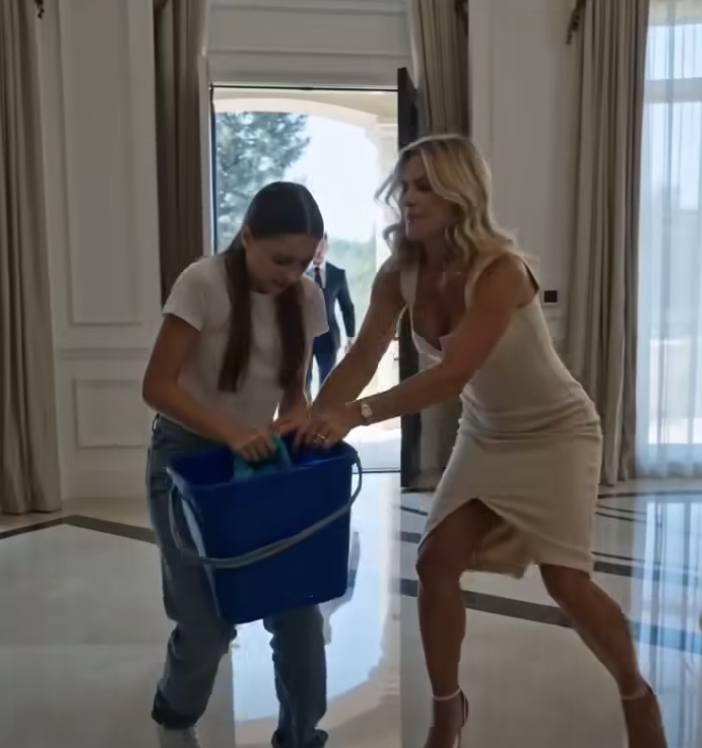
I tried to stand too quickly. The bucket tipped over. Dirty water spread across the marble, soaking my knees.
“I’m sorry,” I said automatically. “I’ll clean it.”
The words came out before I could stop them.
My father’s face changed.
Not anger.
Something worse.
Horror.
His eyes moved over me again. The uniform. The rubber gloves. The red marks on my fingers. The bruise on my wrist.
Then the house went silent.
From the staircase came the sharp click of heels.
My stepmother, Vivian, appeared in a cream silk dress, diamonds at her ears, her smile already forming.
“Alexander,” she said, too brightly. “You’re home early.”
Her smile lasted until she saw his face.
My father did not answer her.
He walked straight toward me, stepping through the spilled water without looking down. Then, very gently, he took the bucket from my hands.
His voice was quiet.
Too quiet.
“How long has this been happening?”
That question should have been easy.
Three months.
Ninety-two days.
Since he left for Singapore to rescue a project that, according to Vivian, needed him more than his own daughter did.
But the answer stuck in my throat.
Because how could I explain that it had started so slowly I almost believed I deserved it?
The first week after Dad left, Vivian moved me out of my bedroom.
“It’s too big for one girl,” she said, standing in the doorway while two staff members carried my books into the small room beside the laundry area. “Ethan needs space. He’s preparing for university interviews.”
Ethan, her son, had smirked behind her shoulder.
My room became his gaming suite.
The room my mother decorated.
The room where my father measured my height on the doorframe every birthday.
The room with the hidden wall panel I thought only my mother and I knew about.
The second week, Vivian cut off my allowance.
“Humility builds character.”
The third week, she took my phone.
“Distraction ruins discipline.”
Then my laptop.
Then the driver.
Then dinner at the table.
By the end of the month, I ate in the kitchen after everyone else finished.
“Leftovers are still food,” she said. “Many children have less.”
Before school, I cleaned bathrooms.
After school, I washed dishes, folded laundry, polished silver, scrubbed windows, and vacuumed rooms I was no longer allowed to enter unless I carried cleaning supplies.
Ethan called me Cinderella at first.
Then he got bored of that.
“Move faster, maid,” he would say, tossing his jacket onto the floor seconds after I hung it up.
The staff looked away.
Some cried when Vivian wasn’t watching.
Mrs. Alvarez, our cook, once slipped me a warm roll wrapped in a napkin.
Vivian found out and fired her the next morning.
After that, no one helped me.
Fear became another chandelier in the house, hanging over every room.
And then came the charity gala.
Vivian turned our mansion into a palace of golden lights and champagne, inviting politicians, business leaders, journalists, and donors who praised her elegance while I carried trays in a black-and-white maid uniform.
Nobody recognized me.
Why would they?
Vivian introduced Ethan as “the future of the Vale legacy.”
I stood two feet away holding sparkling water while people applauded him.
My father’s portrait hung above the staircase.
My mother’s portrait had been removed.
That night, I cried so quietly into my pillow that even I barely heard myself.
Now Dad was home.
And Vivian was smiling like none of it had happened.
“She wanted to help,” Vivian said. “You know how teenagers are. Lila needed structure.”
My father slowly turned to her.
“Structure?”
Vivian lifted her chin. “She was becoming spoiled.”
“Why is she wearing that?”
“It was for a school project,” Ethan said, appearing behind her with his phone in his hand. “Community service or something.”
My father looked at him.
Ethan stopped smiling.
Dad reached for my wrist.
I flinched.
That tiny movement destroyed him.
“Who did this?” he asked.
Vivian laughed nervously. “Alexander, please. You’re overreacting. She bruises easily.”
My father’s eyes never left mine.
“Lila.”
I wanted to be brave.
I wanted to say everything.
But Vivian was standing there, and three months of fear do not vanish just because a door opens.
So I only whispered, “I dropped a laundry basket.”
Vivian exhaled with relief.
My father did not.
He looked toward the ceiling, where tiny black security cameras were hidden in carved corners.
Then he said, “Everyone leave the hall.”
Vivian’s smile vanished.
“Alexander—”
“Now.”
Nobody had ever heard my father use that voice in our home.
Not even the staff.
They scattered.
Vivian tried to touch his arm. He stepped back.
“Do not,” he said.
That night, the mansion did not sleep.
My father locked himself in his study and reviewed the security footage.
I sat outside his door with a blanket around my shoulders, listening to hours of silence broken by the occasional click of the mouse.
At midnight, I heard glass shatter.
At two, I heard him curse for the first time in my life.
At dawn, the study door opened.
My father emerged pale, hollow-eyed, carrying a tablet and a stack of printed stills.
He had watched Vivian order me to clean floors on my hands and knees.
He had watched Ethan trip me while I carried hot tea.
He had watched Vivian grab my wrist hard enough to leave bruises.
He had watched me eat alone in the kitchen while guests toasted “family values” in the dining room.
But one recording had changed everything.
At 2:37 a.m., Vivian entered my old bedroom.
Ethan’s bedroom now.
She moved a framed painting aside, pressed the wall behind it, and opened the hidden compartment my mother built years ago.
From inside, she removed a sealed envelope.
My father watched that clip four times.
Then he went upstairs.
Vivian was still asleep when he opened her safe.
By eight o’clock, we were all gathered in the study.
Vivian stood rigid near the window.
Ethan sat with his arms crossed, pretending boredom.
I sat beside my father, wrapped in one of his coats because I could not stop shaking.
On the desk lay the envelope.
Cream paper.
My mother’s handwriting.
To my Lila, when the house finally tells the truth.
My father touched the envelope as if it might burn him.
“I thought this was destroyed,” he said.
Vivian’s face tightened.
“You knew about it?” I asked.
He swallowed. “Your mother told me she left something for you. After she died, I searched everywhere.”
Vivian said quickly, “Perhaps she misplaced it.”
My father’s eyes hardened. “You found it.”
“I found many things in this house.”
“You hid it.”
“I protected this family.”
He opened the letter.
His hands trembled as he read.
At first, his expression was grief.
Then confusion.
Then shock.
By the time he reached the second page, all the color had drained from his face.
“Dad?” I whispered.
He looked at me like he was seeing me and losing me at the same time.
Then he read aloud.
“My dearest Lila, if you are reading this, then I am gone, and someone has tried to make you feel like a guest in the house I built for you.”
Vivian went still.
My father continued, voice breaking.
“Your father believes he owns the mansion because I let him believe it. I did that out of love, not deception. When Vale International nearly collapsed before you were born, I used my inheritance to purchase this land and build this home under a private trust. I named the trust after the one person I wanted protected above all others.”
He stopped.
The room felt suddenly too small.
Ethan frowned. “What does that mean?”
My father turned the page.
“The true owner of the mansion is not Alexander. It is not his company. It is not any future son or heir. The sole beneficiary is our daughter, Lila Rose Vale.”
My breath disappeared.
Vivian whispered, “No.”
My father closed his eyes.
The room spun around me.
The house.
Every room.
Every wall.
Every brick.
It had never belonged to my father.
It belonged to me.
My mother had built me a sanctuary.
And Vivian had turned me into a servant inside it.
My father kept reading.
“If anyone attempts to remove you from this home, diminish your rights, or transfer ownership without your consent, contact the trustees listed below. The documents in this envelope prove everything. Trust no one who tells you that blood must be earned through suffering. You were loved before you could offer anything in return.”
Tears slipped down my face.
For three months, Vivian had made me sleep beside the laundry room.
In my own house.
She had made me serve strangers beneath chandeliers bought with my mother’s money.
She had introduced Ethan as the future heir while the real owner held a tray of champagne behind her.
My father set the letter down.
“Vivian,” he said softly, “what did you do?”
She lifted her chin, but her lips trembled.
“I did what your dead wife never could.”
Nobody spoke.
“She trapped you,” Vivian snapped. “She made you dependent on her money, her memory, her precious little daughter. Even dead, she controlled everything.”
My father stared at her. “You abused my child.”
“I disciplined a spoiled girl.”
“In her own home.”
Vivian’s eyes flashed. “A technicality.”
That word changed my father.
Until then, he had looked wounded.
Now he looked dangerous.
“A technicality?” he repeated.
Vivian stepped forward, desperation sharpening her voice. “Alexander, listen to me. Think clearly. If this becomes public, your reputation suffers. The board will ask questions. Investors will panic. We can fix this quietly.”
I looked at her in disbelief.
Even now, she was negotiating.
My father looked at Ethan.
“Did you know?”
Ethan shifted. “Mom said Lila needed to learn her place.”
“My place?” I whispered.
For the first time, Ethan looked unsure.
My father stood.
“Your place is outside this house.”
Vivian froze.
“You can’t throw us out,” she said.
My father looked at the documents.
“No,” he said. “I can’t.”
Then he turned to me.
“But Lila can.”
The room fell silent.
All eyes moved to me.
I was seventeen.
Barefoot under my father’s oversized coat.
My hands still smelled faintly of bleach.
For months, I had been ordered where to sleep, when to eat, how to stand, when to speak, and how low to lower my eyes.
Now everyone was waiting for my decision.
Vivian’s face softened instantly.
It was terrifying how quickly she could become gentle.
“Lila,” she said, voice sweet as poisoned honey, “you know I only wanted what was best for you. Your mother would not want you to destroy a family.”
My mother.
The woman Vivian had erased from the walls.
The woman whose letter she had stolen.
The woman who had protected me better from the grave than Vivian ever had in life.
I looked at Ethan.
He stared at the floor.
For a moment, I remembered when he first moved in, before he became cruel. He had been twelve, awkward and quiet, carrying a backpack with one broken strap. I had offered him half my sandwich because he looked lonely.
He had taken everything since.
But maybe cruelty was also something taught in this house.
“Ethan,” I said, “did you ever feel bad?”
His jaw tightened.
Vivian snapped, “Do not answer that.”
But he did.
“At first,” he muttered.
My heart twisted.
“And later?”
He looked up, eyes red with embarrassment and resentment. “Later, it was easier not to.”
That honesty hurt more than a lie.
I nodded.
Then I looked at Vivian.
“You have two hours to pack.”
Her face collapsed.
“Lila—”
“You will leave my mother’s house.”
My father inhaled sharply.
Vivian’s eyes turned cold.
“You stupid girl,” she whispered. “You think a house makes you powerful?”
“No,” I said. “But it means you can’t lock me out of my own life anymore.”
The next two hours were chaos.
Vivian screamed at lawyers over the phone.
My father contacted the trustees named in my mother’s letter.
Ethan packed silently.
Staff members moved through the halls like ghosts waking from a curse.
Mrs. Alvarez was called back before noon.
When she stepped into the kitchen and saw me, she dropped her bag and hugged me so tightly I cried into her shoulder.
“I’m sorry, niña,” she whispered. “I should have done more.”
“You came back,” I said.
“That is not enough.”
“No,” I said, thinking of my father, of Richard in another life, of every adult who mistakes regret for repair. “But it’s a start.”
By evening, Vivian stood at the front door with five suitcases and a face stripped of elegance.
My father handed her a folder.
“Divorce petition,” he said.
She laughed once, sharp and broken. “After everything I did for you?”
He looked at me.
Then back at her.
“Everything you did was for yourself.”
Vivian leaned close to him and said something I barely heard.
“She will become just like her mother.”
My father smiled sadly.
“I hope so.”
The door closed behind her.
For the first time in months, the mansion breathed.
But the story was not over.
That night, after the lawyers left and the staff went to bed, my father and I returned to my old bedroom.
Ethan’s posters were still on the walls.
His game console sat on my desk.
My mother’s blue ceiling had been painted black.
I stood in the doorway, feeling grief rise like water.
My father saw my face and whispered, “I’ll have it restored.”
I shook my head.
“No.”
He looked surprised.
I walked inside and touched the wall where the hidden compartment had been.
“For three months, I wanted my old room back,” I said. “But now it feels like a place where I waited to be rescued.”
My father lowered his head.
“I failed you.”
“Yes,” I said.
He flinched, but I needed to say it.
“You left me with someone who hated me. I tried calling your office. Vivian blocked me. I emailed twice. Someone replied that you were unavailable.”
His face sharpened. “Someone?”
I nodded. “Your assistant.”
His eyes darkened.
The next morning, we learned the final betrayal.
Vivian had not worked alone.
My father’s executive assistant, Martin Hale, had intercepted my messages, rerouted calls, and sent my father edited reports claiming I was “adjusting well” and “too busy with school to talk.”
In exchange, Vivian had promised him a promotion and access to company accounts after she secured influence over my trust.
But my mother’s documents had another secret.
A clause.
If anyone attempted fraud against the trust, all related evidence would be delivered not only to the trustees, but to Vale International’s board.
My mother had known.
Maybe not Vivian’s name.
Maybe not the exact shape of the danger.
But she had known power attracts hands.
Within a week, Martin was fired and investigated.
Vivian’s attempt to access trust documents became a legal scandal.
Ethan was sent to live with his biological father, a quiet mechanic in Oregon who called me unexpectedly one evening.
“I didn’t know,” he said, voice heavy. “I’m sorry for what my son did in your home.”
For the first time, I realized Ethan had another parent Vivian had pushed away.
The happy ending did not arrive all at once.
It came slowly.
In court papers.
In therapy appointments.
In my father learning how to knock before entering my room.
In staff meetings where I sat beside him, not behind him.
In my mother’s portrait returning to the staircase, cleaned and framed beneath warm light.
Three months later, my father held a new charity gala.
This time, I almost refused.
The memory of the last one still lived in my body.
The tray in my hands.
The uniform.
The laughter.
But Dad said, “Only if you want to. And only on your terms.”
So I agreed.
On the night of the gala, the mansion glowed again.
Politicians came.
Business leaders came.
Journalists came.
The same chandelier burned above the same staircase.
But everything was different.
My mother’s portrait hung where everyone could see it.
Mrs. Alvarez supervised the kitchen proudly.
The staff wore name tags with their real titles, not invisibility.
And I wore a deep blue dress the color of the ceiling my mother painted for me.
When guests gathered in the ballroom, my father stepped onto the small stage.
“Many of you knew my late wife, Rose,” he said. “You knew her as graceful, private, generous. But tonight, you will know something else about her. She was the reason this house exists.”
A murmur moved through the room.
My father looked at me.
“This mansion belongs to my daughter, Lila. It always has. And tonight, with her permission, we are dedicating part of it to a foundation in her mother’s name.”
My chest tightened.
“The Rose Vale House Fund,” he continued, “will provide emergency housing, legal support, and education grants for young people trapped in abusive homes.”
The room erupted in applause.
But I barely heard it.
Because near the back of the ballroom, by the open doors, stood Ethan.
He was not dressed like a guest.
No expensive jacket.
No smug smile.
Just a nervous eighteen-year-old holding an envelope.
Security moved toward him, but I raised my hand.
He walked up to me slowly.
“I’m not here with Mom,” he said.
I believed him.
He handed me the envelope.
Inside was a folded piece of paper and a small silver key.
“What is this?” I asked.
“The key to your music box,” he said. “The one from your room. Mom told me to throw it out. I didn’t.”
My eyes filled.
My mother had given me that music box when I was five.
I thought it was gone.
Ethan swallowed.
“There’s a note inside it. I never read it. I just thought… maybe you should have it.”
I stared at him.
“I was cruel,” he said. “I don’t have an excuse.”
“No,” I said softly. “You don’t.”
He nodded.
“I’m sorry, Lila.”
It did not fix everything.
But it was the first apology from that side of the family that did not ask for anything in return.
After the gala, I took the music box to my room.
My new room.
Not the old blue-ceiling room.
A sunlit room facing the garden, with fresh white walls and my mother’s books on the shelves.
The silver key turned with a tiny click.
Inside, beneath the velvet lining, was a note in my mother’s handwriting.
My hands shook as I unfolded it.
My brave Lila,
One day this house may feel too large, too heavy, or too full of ghosts. Remember this: a home is not marble, chandeliers, or locked doors. A home is the place where love is allowed to tell the truth.
If the house ever becomes a cage, open it.
Let others in.
Let light in.
And when you are ready, build something kinder than what you inherited.
I pressed the note to my chest and cried.
Not because I was broken.
Because I was finally safe enough to feel everything.
One year later, the west wing of the mansion opened as Rose House.
The first girl who stayed there arrived with one backpack and the same terrified eyes I once saw in my mirror.
I met her at the door myself.
No uniform.
No tray.
No lowered gaze.
Just me, standing in the entrance of the house my mother had saved for me so I could someday save someone else.
The girl looked up at the chandelier, then at the marble floor.
“I’m scared I don’t belong here,” she whispered.
I thought of Vivian.
Of the bucket.
Of my father taking it from my hands.
Of my mother’s letter waiting in the wall like a heartbeat.
Then I smiled and opened the door wider.
“You do,” I said. “This house was waiting for you.”
