The slap came so fast that Clara didn’t even have time to close her eyes.
One moment she was standing in the hallway, soaked from the rain, holding a trembling brown dog against her chest. The next, her mother-in-law’s palm cracked across her cheek so sharply that the sound seemed to freeze the entire house.
For a second, no one moved.
Not Clara.
Not her husband, Daniel.
Not even the dog.
Then the animal slipped from Clara’s arms and stepped between her and Margaret Vale as if it had known Clara all its life.
It did not bark.
It did not bare its teeth.
It simply stood there, thin ribs rising under matted fur, dark eyes fixed on Margaret with a stillness that made the older woman take half a step back.
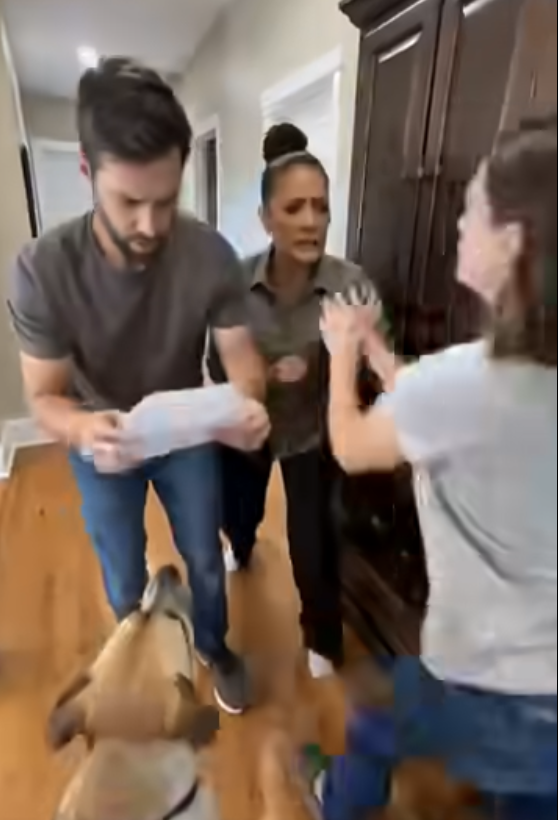
“Get that filthy thing out of my house,” Margaret hissed.
Clara touched her burning cheek. “It was starving.”
“I don’t care if it was dying.”
Daniel stood by the staircase, one hand still on the railing. He looked pale, tired, uncertain—the way he always looked when his mother raised her voice.
“Mom,” he said weakly, “maybe just for tonight—”
“No.” Margaret turned on him. “Your father never allowed strays in this house, and neither will I.”
At the word father, something changed.
The dog’s head lifted.
Its ears twitched.
Then it turned away from all of them and walked down the long hallway.
Clara frowned.
The dog’s paws left wet marks on the polished wood. It passed the family portraits, the antique clock, the locked study door, and stopped at the end of the hall in front of an old walnut cabinet.
Clara had noticed the cabinet before. Everyone noticed it eventually.
It was tall, heavy, and strangely out of place, with brass handles dulled by age and a keyhole shaped like a tiny eye. Margaret never let anyone touch it. She dusted around it, guarded it, and once snapped at Clara for placing a vase on top.
The dog stood before it.
Then it barked.
Once.
Twice.
Again and again.
The sound was not wild or random. It was urgent. Almost pleading.
Margaret’s face drained of color.
“Drag it out,” she ordered.
Daniel hurried forward, grabbed the dog by the collarless neck, and tried to pull it away. The dog resisted, not violently, but with the stubborn weight of an animal that had chosen its place to die.
“Daniel,” Clara whispered, “look at him.”
But Daniel didn’t look at the dog.
He looked at his mother.
That was the tragedy of their marriage, Clara thought. Daniel had spent his whole life looking at Margaret before making any move at all.
That night, the dog slept outside.
Or it was supposed to.
At dawn, Clara woke to barking.
She rushed downstairs and found the dog inside the house, wet again, standing in front of the same cabinet. The back door was still locked. The windows were closed.
Margaret came down in her robe, furious.
“How did it get in?”
Nobody answered.
Daniel checked the doors. Clara checked the windows. Nothing had been forced.
The dog barked until its voice grew hoarse.
By the third day, even Daniel was disturbed.
The dog had been thrown outside five times and returned five times. It ignored food until Clara placed the bowl near the cabinet. It ignored the warm blanket she laid out in the laundry room. It ignored Daniel completely.
But whenever Margaret entered the hall, the dog went silent.
It would only stare.
And Margaret, who had bullied every person in that house for years, could not hold its gaze.
“What’s inside?” Clara finally asked.
“Old papers,” Margaret said.
“Then open it.”
Margaret’s lips tightened. “I lost the key.”
“Then let Daniel break it open.”
“No.”
The word came out like a gunshot.
Daniel stared at her. “Mom?”
Margaret softened immediately. “Your father’s things are in there. Private things. You know how much I loved him.”
Clara had heard that sentence too many times.
Your father would be ashamed.
Your father trusted me.
Your father wanted things this way.
Samuel Vale had been dead for twelve years, but Margaret still used him like a locked door nobody could open.
That night, Clara could not sleep.
She lay beside Daniel, listening to the rain press against the windows.
“Why are you afraid of her?” she asked softly.
Daniel’s back was turned. “I’m not.”
“She slapped me.”
His shoulders tightened.
“I know.”
“And you said nothing.”
“I was shocked.”
“No,” Clara said. “You were trained.”
He turned then, wounded. “That’s not fair.”
“Isn’t it?”
For a long time, he said nothing.
Then, in the dark, he whispered, “After Dad died, she fell apart. I was sixteen. She made me promise I’d never leave her alone.”
“That doesn’t give her the right to hurt people.”
“I know.”
But he didn’t sound like he knew.
He sounded like a boy still trapped in a house full of locked cabinets.
Near midnight, a splintering sound cracked through the silence.
The dog barked.
Clara and Daniel ran downstairs.
The dog was clawing at the cabinet with desperate force. One of its paws was bleeding. A thin wooden panel near the bottom had cracked open.
Margaret appeared behind them, breathing hard.
“Stop it!” she screamed.
But before Daniel could grab the dog, something slid from behind the broken panel.
A small envelope.
Yellowed.
Sealed.
Daniel picked it up.
Margaret lunged.
For the first time in Clara’s life, Daniel moved faster than his mother.
He stepped back and tore it open.
Inside was a photograph.
Clara watched his face change as he looked at it.
Confusion first.
Then disbelief.
Then something close to fear.
He turned the photo toward Clara.
It showed a younger Samuel Vale standing in the garden behind the house. He was smiling broadly, one hand resting on the head of a brown dog.
The dog in the picture had the same white patch on its chest.
The same torn left ear.
The same eyes.
Daniel’s voice broke.
“Why is Dad standing next to the same dog… twenty years ago?”
Margaret whispered, “Give me that.”
But Daniel didn’t.
He turned the photograph over.
On the back, written in Samuel’s handwriting, were four words:
He found the truth.
Below them was a date.
Twenty years earlier.
And one name.
Arthur.
The dog whined.
Clara knelt slowly. “Arthur?”
At the sound of the name, the dog pressed its head into her hands.
Margaret sank onto the nearest chair.
“No,” she whispered. “No, no, no.”
Daniel stared at her. “You knew him.”
Margaret covered her mouth.
“Mom.”
Her eyes lifted, and for once there was no command in them. Only terror.
“Your father loved that dog,” she said.
Daniel swallowed. “Then why did I never see him?”
Margaret’s gaze shifted to the cabinet.
Because of course the answer was still inside.
Daniel grabbed a heavy brass candleholder from the console table.
Margaret rose. “Daniel, don’t.”
He struck the lock.
Once.
Twice.
On the third blow, the old mechanism snapped.
The cabinet doors creaked open.
Inside were not old papers.
There were boxes.
Dozens of them.
Stacked carefully, labeled in Samuel’s handwriting.
Bank records.
Medical files.
Letters.
A small leather journal.
And at the very back, wrapped in a faded blue blanket, was a child’s stuffed rabbit.
Daniel went completely still.
Clara saw something pass across his face, something deeper than memory.
The dog stepped forward and touched the rabbit with its nose.
Daniel picked up the journal.
The first page was addressed to him.
Daniel, if you are reading this, then Arthur came home. Trust the dog before you trust the living.
Margaret began to sob.
Daniel read aloud, his voice shaking.
Samuel had written everything.
Arthur had been Daniel’s dog when Daniel was four years old, though Margaret had told him it was only a stray that wandered away. Samuel had trained Arthur after noticing the dog’s unusual intelligence. Arthur could find hidden objects, follow scents, recognize distress, and—strangest of all—return to places even years later.
Then Samuel began discovering irregularities in the family accounts.
Money disappearing.
Documents forged.
A second life hidden behind Margaret’s perfect smile.
At first, he thought it was debt.
Then he found adoption papers.
Daniel stopped reading.
His fingers tightened around the journal.
Clara’s heart pounded.
“What adoption papers?” he whispered.
Margaret shook her head violently. “He was sick. Your father was paranoid.”
Daniel turned the page.
His knees nearly gave out.
Clara caught his arm.
The journal said Daniel had not been born to Margaret.
He had been born to Samuel’s younger sister, Evelyn, who died in childbirth after fleeing an abusive fiancé. Samuel took the baby in. Margaret agreed at first, but over the years she grew resentful of raising a child who was not hers, especially after learning she could never have children.
Samuel planned to tell Daniel the truth when he turned eighteen.
Margaret could not allow that.
Because if Daniel learned the truth, he would also learn that Evelyn had left him a trust.
A large one.
Margaret had been stealing from it for years.
Daniel looked at his mother—not his mother, Clara realized, not by blood, and perhaps never by love.
“Is this true?”
Margaret’s face crumpled.
“I raised you.”
“That’s not what I asked.”
“I fed you. I clothed you. I gave up my life for you.”
Daniel’s voice hardened. “Did you steal from me?”
Margaret’s tears vanished.
There she was again.
The woman behind the mask.
“You ungrateful boy.”
Clara stepped in front of him. “Don’t.”
Margaret laughed bitterly. “And you. Bringing that cursed animal back here like some angel. Do you know what that dog did? It ruined everything once before.”
Daniel looked down at Arthur.
“What happened to Dad?”
The room went quiet.
Even the rain seemed to stop.
Margaret stared at him.
Samuel’s journal answered first.
He had written that if anything happened to him, Daniel should search the cabinet and contact a lawyer named Helen Moore. He had discovered Margaret planned to declare him mentally unstable and take control of the remaining trust. Arthur had found the hidden files after scratching at the cabinet once before.
Then, one winter night, Samuel drove away with Arthur to meet Helen.
Only Samuel came back.
He returned injured, shaking, and silent.
Two weeks later, he was dead.
Officially, a heart attack.
But tucked into the journal was a medical report showing traces of a sedative Samuel had never been prescribed.
Daniel’s face turned white.
Margaret screamed then.
Not in grief.
In rage.
“He was going to leave me with nothing!”
Clara felt the words hit the room like broken glass.
Margaret seemed to hear herself too late. She clapped a hand over her mouth.
Daniel stepped back as if she had struck him.
“You killed him?”
“No,” Margaret whispered. “No. I only wanted him calm. He was hysterical. He was going to destroy our family.”
“Our family?” Daniel said. “You lied about my mother. You stole my inheritance. You drugged my father.”
“He was not your father!” she shouted.
Arthur barked once, sharp and furious.
Margaret flinched.
Daniel’s eyes filled with tears. “He was more my father than you were ever my mother.”
The next hour moved like a nightmare.
Clara called the police.
Margaret tried to burn the journal in the fireplace, but Arthur knocked into her legs before she reached it. Daniel stood over the boxes until officers arrived, refusing to move.
When the police asked Margaret if she wanted to make a statement, she laughed.
Then she looked at Arthur.
“You should have died in that river,” she said.
That was how they learned the final piece.
Twenty years earlier, Margaret had not killed Arthur. She had abandoned him miles away near the river after Samuel’s “accident.” But Arthur survived. Someone must have found him, cared for him, lost him, found him again. Somehow, after two decades, old and starving, he returned to the one house where the truth still waited.
The veterinarian later explained that Arthur was not twenty years old.
He was closer to thirteen.
The photo had not shown the same dog.
It had shown Arthur’s father.
The white chest patch, the torn-looking ear, the same eyes—they were inherited.
And the collar Clara found missing?
Arthur had once worn one.
A microchip revealed his registered name:
Samuel’s Return.
He had been adopted years earlier by a retired attorney.
Helen Moore.
The lawyer Samuel had tried to meet the night he died.
Helen, now elderly but sharp-eyed, arrived two days later with a folder thick enough to change Daniel’s life.
Samuel had trusted her with copies.
Not everything.
But enough.
Enough to freeze accounts.
Enough to reopen the investigation.
Enough to prove that Daniel’s trust had been drained illegally.
Enough to show that Margaret had built her entire life on a stolen foundation.
But Helen brought one thing no one expected.
A letter from Samuel.
“My office was broken into after he died,” Helen said, placing the envelope in Daniel’s hands. “I hid this in Arthur’s kennel because Samuel once told me, ‘If anyone can get my son the truth, it will be a dog.’ I thought he meant the first Arthur. Years later, when his pup was born, I named him Samuel’s Return. I suppose your father knew loyalty runs in blood.”
Daniel opened the letter with shaking hands.
Samuel’s words were simple.
He wrote that Daniel had been loved from the moment he was placed in his arms. That Evelyn had sung to him for one hour before she died. That Margaret’s bitterness was not his fault. That truth might come late, but love did not expire.
And at the end, one line broke Daniel completely.
If Arthur comes back, let him in. He has never failed this family.
Daniel sank to the floor beside the dog and wept.
Arthur leaned against him.
Clara knelt too, wrapping her arms around both of them.
For the first time since she had married Daniel, the house felt less like a prison and more like something waking from a long, terrible sleep.
Months later, Margaret stood trial.
She confessed to the fraud but denied murder until the end. The investigation could not prove everything, but it proved enough. She lost the house, the money, the control, and the one thing she had guarded most fiercely: Daniel’s fear.
Daniel did not visit her.
Not out of cruelty.
Out of healing.
The house was legally restored to him through the trust, but he almost sold it.
Clara understood why.
Every hallway held a bruise.
Every room echoed with Margaret’s voice.
But one morning, Arthur walked to the old cabinet—now empty and unlocked—and lay down in front of it peacefully.
No barking.
No scratching.
Just rest.
Daniel watched him for a long time.
Then he said, “Maybe we don’t sell it.”
Clara slipped her hand into his. “What do we do with it?”
He looked at the cabinet, then at Arthur.
“We open it.”
So they did.
They turned the house into a shelter and legal aid foundation for women, children, and abandoned animals. They named it Evelyn House, after Daniel’s birth mother.
The old cabinet remained in the hallway, doors open forever, filled not with secrets but with blankets, leashes, adoption forms, and letters from people whose lives had been changed.
Arthur became the shelter’s soul.
He greeted frightened children.
He slept beside recovering dogs.
He barked whenever someone tried to pretend they were fine when they were not.
And Daniel changed too.
Slowly.
Painfully.
Beautifully.
He learned to speak without checking the room for permission. He learned that love was not obedience. He learned that silence could be inherited, but courage could be chosen.
On the first anniversary of the night Clara brought Arthur home, Daniel stood in the garden holding Samuel’s old photograph.
Beside him, Arthur rested in the grass, gray around the muzzle, eyes half closed in the sun.
Clara touched the white patch on the dog’s chest.
“I thought I was saving him,” she said softly.
Daniel smiled through tears.
“No,” he said. “He came to save us.”
That evening, as they locked up the shelter, a little girl arrived with her grandmother. She was clutching a stuffed rabbit so worn that one ear hung by a thread.
Arthur rose immediately.
The girl froze, afraid.
Clara knelt. “It’s okay. He’s gentle.”
The girl looked at the dog, then at the open cabinet full of blankets.
“My mom said this place helps people who don’t have anywhere to go,” she whispered.
Daniel’s voice softened. “It does.”
The girl stepped forward and placed her hand on Arthur’s head.
For the first time, she smiled.
And Arthur, old loyal Arthur, closed his eyes as if he had finally heard the sound he had been waiting for all along.
A home unlocking.
Not with a key.
But with kindness.
And this time, no one would ever lock the truth away again.
