The black vehicle stopped hard enough to spray gravel across the edge of the range.
Every soldier watched the rear door open.
General Evelyn Hart stepped out in her service uniform, silver stars bright beneath the Colorado sun. She had the composed, terrifying calm of someone who could walk into a room and make colonels forget their own names.
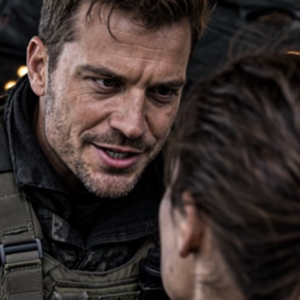
Captain Marcus Stone knew her immediately. He snapped to attention before his mind caught up with what he was seeing.
But General Hart was not looking at him.
She crossed the firing line, passed the target still hanging from its carrier, and stopped in front of Linda Ward.
Then the general raised her hand in a crisp salute.
“Good afternoon, Colonel Ward.”
The silence that followed was different from the one after Linda’s shooting. This silence had weight.
Linda returned the salute, but there was no performance in it. “General.”
Marcus felt the blood leave his face.
Colonel Ward.
Not retired visitor. Not someone who had wandered into the wrong place. A colonel—though the civilian clothes and the absence of rank had hidden it perfectly.
The specialist who had laughed first took one step backward. The young range officer stared at the tight cluster in the target’s center, then at Linda, as though the paper had become a piece of classified evidence.
Marcus forced his voice to work. “Ma’am, I was not informed—”
General Hart turned her gaze on him. “That much is obvious, Captain.”
Linda removed her protective glasses and folded them with deliberate care. “No one was supposed to be informed.”
Marcus looked between them. “Ma’am?”
Hart’s expression did not soften. “Colonel Ward is here as an evaluator for the new Advanced Marksmanship and Decision Leadership Program. Her identity was deliberately withheld.”
The words struck Marcus harder than a shouted reprimand.
He had mocked the evaluator.
Worse, he had done it in front of the soldiers whose trust he was supposed to protect.
Linda regarded him quietly. “The program is not only about shooting.”
Marcus’s mouth had gone dry. “I understand.”
“No,” she said. “You don’t. Not yet.”
General Hart gestured toward the target. “Captain Stone, do you recognize that grouping?”
He did. The holes formed a narrow seven-pointed star, every round touching one another except for a single precise gap at the top. It was impossible to forget once you had seen it. In the classified lessons taught during officer training, the pattern had been shown without a name attached. The instructor had called it the Ward Star—a signature left by a legendary sniper who had completed an impossible rescue in the Karsk Mountains twenty-seven years earlier.
The official record said the sniper’s identity had been permanently sealed.
Marcus looked at Linda’s silver hair, her plain sneakers, her calm hands.
“The Ghost of Karsk,” he whispered.
Someone inhaled sharply behind him.
Linda did not deny it. Her eyes moved past Marcus to the mountains on the horizon.
“That name belonged to a very frightened young officer who wished people would stop making stories out of the worst night of her life.”
The range emptied under orders. General Hart directed the company leadership to the conference room, then told everyone else to return to training as though an army legend had not just appeared in civilian clothes and dismantled a captain’s arrogance with twelve rounds.
Marcus walked behind Hart and Ward through the operations building, his boots sounding too loud on the polished hallway floor.
He had been preparing for this evaluation for three months. His company had the highest qualification scores in the brigade. His soldiers passed inspections, made their times, kept their gear spotless. His reputation was built on standards.
At least, that was what he had told himself.
He remembered the pleased looks on the soldiers’ faces when he had made Linda the day’s amusement. He remembered how easily he had accepted their laughter as proof that he belonged at the center of the group.
Inside the conference room, Hart shut the door.
“Sit down, Captain.”
Marcus sat.
Linda remained by the window. In daylight, the line at the corner of her mouth looked less like sternness than grief that had learned to stand upright.
“Explain what happened,” Hart said.
Marcus could have lied in small ways. He could have said he was correcting unsafe handling. He could have said the crowd had misunderstood his tone. He could have wrapped the truth in the kind of language officers used when they wanted a mistake to become an incident instead of a decision.
But the target hung in his mind: that impossible, exact star.
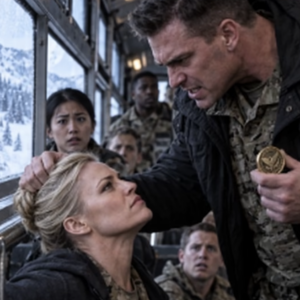
“I assumed Colonel Ward was inexperienced,” he said. “I publicly insulted her. I took her weapon without permission. I encouraged soldiers to laugh at her.”
Hart’s expression remained unreadable. “Why?”
“Because I thought I knew what competence looked like.”
“Did you?”
Marcus looked down. “No, ma’am.”
Linda turned from the window. “What did you see when you looked at me?”
He hesitated.
“Answer honestly,” she said.
“I saw an older civilian who looked uncertain.”
“And what did that make you feel?”
The question was more difficult than any accusation.
Marcus heard his father’s voice from years ago: Never let them think you are the least capable man in the room. He had spent his career following that command as though it were doctrine. He had become the kind of leader who corrected people in front of others because private correction did not give him the same feeling of safety.
“Superior,” he admitted.
“Exactly.” Linda’s voice was low. “And you mistook that feeling for leadership.”
General Hart placed a thin file on the table. “The evaluation has only begun. Colonel Ward will spend the next forty-eight hours with your company. We will observe your training, your safety culture, and your decisions.”
Marcus lifted his eyes. “Am I being relieved?”
“Not yet,” Hart said. “That will depend on whether you are capable of learning from what happened.”
Linda picked up the file. “Tomorrow morning, your company will run a field exercise in the eastern training area. You will receive the scenario at 0500.”
Then she walked out, leaving Marcus with the terrible certainty that the easiest part of the evaluation had already been the shooting.
That night, Marcus found Linda sitting alone on a bench outside the base chapel. The air had cooled quickly after sunset. Beyond the parade field, lights made the foothills look like the backs of sleeping animals.
He had rehearsed an apology all the way there. None of the sentences survived the sight of her.
She held a paper cup of coffee between both hands. Her gaze was fixed on the dark outline of Pikes Peak.
“Colonel Ward,” he said.
“Linda is fine when I’m not wearing the uniform.”
He remained standing. “May I sit?”
She gestured to the far end of the bench.
For a while, neither spoke.
“I’m sorry,” Marcus finally said. “Not because you are Colonel Ward. I’m sorry because I treated someone with contempt to make myself feel important.”
Linda nodded once. “That is closer to an apology.”
“Closer?”
“A real apology is a beginning, Captain. Not a payment.”
He accepted the rebuke. “I’ll prove it.”
“You may get the chance.”
The words made him look at her.
Linda took a sip of coffee. “Do you know why the Ward Star has a gap in it?”
Marcus shook his head.
“Because on the night they made that story about me, I missed one shot.”
Her tone did not invite pity, but it demanded attention.
“I was twenty-nine. My team was pinned in an abandoned observatory above the Karsk pass. We had two wounded soldiers, no air support, and a narrow escape route across a frozen lake. The hostile force had a machine gun on the far ridge.”
Marcus had heard fragments of the mission in an advanced tactics course. The official version was clean: an unnamed sniper had held off forty attackers so a trapped unit could withdraw. No mention of what that had cost.
“I took seven shots to make a firing corridor,” Linda continued. “Six found their mark. One did not. A young corporal named Daniel Ruiz was running for cover when the gunner fired. Daniel died before we could reach him.”
The gap in the star suddenly seemed enormous.
“Every magazine afterward,” she said, “I left that gap. Not as a signature. As a reminder. Accuracy is not the same thing as perfection. And a leader who pretends never to fail becomes dangerous, because everyone around him starts hiding failure too.”
Marcus lowered his eyes.
“You don’t need to be flawless tomorrow,” Linda said. “You need to be honest enough to see what you are missing.”
At 0500, rain hammered the windows of the company briefing room.
The field exercise was called Silent Ridge. A simulated convoy had been stranded in the eastern training area after a communications failure. Marcus’s company was to locate the team, secure a route, evacuate two role-players with critical injuries, and prevent an opposing force from accessing a mock data terminal.
It sounded straightforward. That was what worried him.
Linda stood against the wall, wearing standard field gear with no insignia. General Hart watched from the rear beside two evaluators.
Marcus looked at his platoon leaders. “Questions?”
Specialist Owen Park raised a hand. Park was the same soldier who had chuckled behind Marcus at the range.
“Sir, the weather is getting worse. The north gulch floods fast. If that’s our route, should we wait for the engineers?”
Normally Marcus would have answered immediately. Waiting cost time. Timetables mattered. He felt the old instinct rise: dismiss the concern, drive the company forward, prove decisiveness.
Then he remembered Linda asking what competence looked like.
“Good question,” he said. “Let’s get the terrain report before we commit.”
Park blinked, surprised to be taken seriously.
The report confirmed the gulch was unsafe. The alternate route added forty minutes and passed through more exposed ground. Marcus changed the plan.
The convoy was found at 0730 in a narrow valley slick with rain. The simulated casualties were trapped in a disabled Humvee, and the opposing force had already occupied the slopes. What the scenario did not say was that the communications failure was real.
Every radio in the company gave a burst of static and died.
At first Marcus thought it was part of the exercise. Then a soldier sprinted from the rear element, soaked and breathless.
“Captain! Private Sloan fell on the rocks. He’s not moving his leg.”
The weather had turned the fictional mission into a real emergency.
Marcus looked toward the valley. The casualties in the Humvee were actors—but he could not know whether some had been injured by the sudden storm. The opposing-force cadre were still in position, and the company was scattered along a narrow, slippery route.
General Hart stood apart, making no move to intervene.
This was not an exercise anymore.
Marcus began to issue orders, then stopped.
“Sergeant Bell,” he said, “what do you see?”
The older NCO crouched near the slope. “Sloan needs a medic now. If we send people down this ridge, we’ll create more casualties. And that Humvee’s fuel line is leaking.”
“Lieutenant Cho?”
“Opposing force is on the northern shoulder. They might not know this is real. We need to signal them or risk someone firing blanks too close to the injured.”
Marcus turned to Linda. “Colonel?”
She did not rescue him. “Your command, Captain.”
He understood. The answer was not in his own head because leadership was never meant to be a one-man performance.
“Bell, take the medic team to Sloan. Slow and secured. Cho, use runners to reach opposing-force control—no weapons fire. Park, you and your squad establish a safety perimeter around the Humvee. Nobody enters until the fuel line is shut down. I’ll coordinate the evacuation point.”
The company moved.
For twenty minutes, the rain made every decision expensive. A medic slipped and was caught by Park before she hit the rocks. One of the role-players in the Humvee had a real panic attack after smelling fuel. Marcus crawled through the mud to help calm him while Bell’s team splinted Sloan’s leg.
No one was glamorous. No one was invulnerable.
And because people were allowed to say what they saw, nobody got left alone with a problem.
By 0915, the company had reached the improvised evacuation site. An actual emergency helicopter lifted Sloan out. The rest of the exercise was canceled.
Marcus stood in the rain, soaked through and shaking with the delayed fear of what could have happened. Linda walked toward him, carrying a medical kit she had used to help the panicking role-player.
“You did well,” she said.
“I nearly drove them through the gulch.”
“But you didn’t.”
“Because Park spoke up.”
“Because you listened.”
Marcus looked at the soldiers clustering around Sloan’s discarded pack. The company had been built to follow his orders. That day, it had saved itself by refusing to let one voice be the only one that mattered.
They returned to base under a sky finally beginning to clear.
Marcus expected a formal debrief, perhaps a decision about his command. Instead, General Hart summoned him and Linda to the same range where he had humiliated her the previous afternoon.
The Ward Star target was still clipped to the carrier. Someone had covered it with plastic against the rain.
Hart stood beside it, hands clasped behind her back.
“Captain Stone,” she said, “your evaluation report will not be flattering.”
Marcus nodded. “Understood.”
“It will say you displayed arrogance, poor judgment, and a damaging example of public humiliation.”
“Yes, ma’am.”
“It will also say that when circumstances exposed the limits of your judgment, you changed your behavior in real time. You invited expertise. You protected people over appearances.”
He could not breathe for a moment.
“You will remain in command,” Hart said. “On probation. You will also begin a leadership review program in this company, with a weekly anonymous safety forum and rotating enlisted advisers in all major planning sessions.”
“I will, ma’am.”
Linda stepped toward the target and touched the plastic covering the cluster of holes.
“There is one last thing,” General Hart said. “Colonel Ward was not assigned here only to evaluate you.”
Marcus turned toward Linda.
Hart’s voice lowered. “The original Karsk mission was compromised from inside the Army. The inquiry was buried, but new evidence was uncovered this month. Colonel Ward agreed to return because she believed the person responsible was connected to this installation.”
Marcus felt the ground shift beneath him.
“Who?”
Linda’s gaze moved past him, toward the operations building.
“Colonel Henry Stone,” she said.
Marcus’s father.
For a second, the rainwater on the range seemed to rise around his boots.
His father had been a lieutenant colonel at the time of Karsk. A decorated officer, now retired, whose framed medals had filled the hallway of Marcus’s childhood home. The man who had taught him never to look weak.
“That’s impossible,” Marcus said, but even as he spoke, memories rearranged themselves: his father’s sudden anger whenever Karsk appeared in the news; the sealed cardboard box in the basement marked only with a date; the nights he had woken from dreams and shouted a name Marcus had never known.
“He did not order the ambush,” Linda said. “But he received the intercepted warning and chose not to pass it along. He believed the operation might expose an unauthorized weapons transfer. He protected his career. Daniel Ruiz died because of that choice.”
Marcus’s knees weakened.
“Why tell me now?”
“Because a special investigator will speak to him this evening,” Hart said. “And because a legacy is not a sentence. Your father taught you to confuse fear with respect. What you do next is yours.”
Marcus stared at the target. At the six shots and the deliberate seventh absence.
“Can I see the file?” he asked.
Linda nodded.
Three months later, Marcus stood in front of a fresh class of junior officers at the same covered range.
He did not stand at the center of the firing line. He stood beside Specialist Park, who was explaining his own preferred stance to a nervous civilian volunteer from the local veterans’ program.
The volunteer was an older woman in a bright blue jacket. Her hands trembled as she checked the unloaded handgun.
One of the lieutenants shifted impatiently.
Marcus saw it. So did Park.
Before the lieutenant could speak, Marcus said, “Take your time. Safety first.”
The woman looked relieved.
Later, Linda came by in civilian clothes, carrying no rank, no file, and no weapon. She watched from behind the line as the woman fired her first careful string.
The shots were wide. One missed the paper completely.
No one laughed.
Marcus walked downrange with her when the target came in. “You know what I see?” he asked.
She looked embarrassed. “That I have a lot to learn?”
“I see someone brave enough to begin.”
From the shade of the range shelter, Linda smiled.
The target held scattered holes, imperfect and honest against the white paper.
And for the first time in his life, Captain Marcus Stone understood that it was not the center of the target that made a leader worthy.
It was what they did when someone else missed.