The first Marine to stand was Gunnery Sergeant Eli Navarro.
He did not raise his voice. He did not touch Lance Corporal Tyler Brant. He only stepped away from his table, broad shoulders squared, and said, “Brant. Back up.”
Two other Marines rose beside him.
Tyler looked from Navarro to Nadia Kessler and laughed once, though the sound had begun to fray at its edges.
“What is this?” he asked. “She got you all scared because she gave me a look?”
Nadia’s eyes never left him.
“I asked you to take one step back,” she said.
The mess hall seemed to hold its breath.
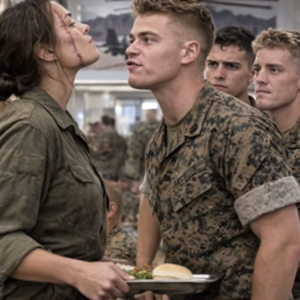
Tyler had arrived at Camp Lejeune four months earlier with a reputation for being loud, physically fearless, and always one insult ahead of anyone who challenged him. His platoon called him Brant the Bull when he was not around. They said it fondly, which was part of the problem.
He had been praised for aggression all his life. His father had worked construction, fought every weekend, and taught Tyler that the worst thing a man could become was someone other men pushed around.
So when Nadia sat alone in a Navy uniform, quiet enough to disappear into the sea of Marines, Tyler saw an opportunity he understood.
He had not expected to become the danger everyone else was measuring.
“Or what?” he asked again, louder this time.
Nadia’s gaze dropped briefly to the spilled water near his boots. Then she looked past him, toward the exits.
“Or you’ll make a decision that changes your life,” she said.
“You threatening me?”
“No.” Her voice was almost gentle. “I’m giving you the last warning I would want someone to give my own brother.”
That answer should have cooled him. Instead, the mention of mercy humiliated him in front of the room.
Tyler grabbed the edge of Nadia’s table and shoved it hard.
It moved six inches.
Nadia moved once.
No one saw the whole thing clearly enough to describe it afterward. Her right hand trapped his wrist before it could swing toward her. Her left palm turned his elbow. Her foot stepped behind his ankle, not violently, but precisely.
Tyler was suddenly on his knees beside the scattered lunch tray, one arm held at an angle that made his face go white.
Nadia did not wrench his shoulder. She did not strike him. She simply controlled the space between pain and injury.
“Breathe,” she said.
He sucked in air.
“I am letting you go in three seconds. When I do, you will stay where you are.”
Tyler’s voice had become small. “Let go.”
“One.”
Navarro stepped forward. “Petty Officer, we’ve got it.”
“Two.”
Tyler tried to pull free. Nadia tightened the hold by the smallest amount. He froze.
“Three.”
She released him.
Tyler stumbled backward and hit the floor on his own. The hall was still silent, but it was no longer the silence he had wanted. Every face around him showed the same terrible realization: Nadia Kessler had not been protected by the Marines near her.
They had been preventing a young man from provoking someone who had spent years learning how not to destroy people.
“Master-at-Arms,” Navarro called.
Two naval security officers entered through the side doors almost immediately. They had been close by because Camp Lejeune had hosted a joint leadership summit that week. Tyler stared at them, then at Nadia, as though the rules had changed without warning.
Nadia bent down and picked up the plastic water bottle. Her hands were steady.
“Please get him medical checked,” she said. “His wrist may be sprained.”
Tyler looked up sharply. “You did that.”
“You did that,” Nadia replied. “I stopped it from being worse.”
Then she walked away from the wrecked table, leaving rice clinging to her sleeve and Tyler Brant surrounded by the audience he had wanted so badly.
Commander Miriam Tate found Nadia in a quiet corridor behind the base clinic twenty minutes later.
Nadia stood before a vending machine, staring at a row of untouched granola bars as if the decision required tactical planning. Her lunch was gone. Her appetite had left with it.
“You all right?” Tate asked.
Nadia gave a small shrug. “He’s young.”
“He assaulted you.”
“He is still young.”
Tate came to stand beside her. She was one of the few people on the base who knew even a fraction of Nadia’s history. She had served in the Navy long enough to understand that people who survived the worst things were often the quickest to minimize what had happened to them afterward.
“The command wants a statement,” Tate said. “There’ll be an investigation.”
Nadia nodded.
“They also want to know whether this had anything to do with the summit.”
That made Nadia look up.
For the past three days, joint intelligence representatives had been reviewing a classified training initiative at Lejeune. Nadia had been assigned as a medical liaison because her name still opened doors in units that did not appear on ordinary rosters. Officially, she was a senior Navy medical readiness specialist. Privately, she had been asked to examine old field reports connected to a missing operations archive from Helmand Province.
The archive had vanished six years ago, after a joint team was trapped in a compound called Darzi House.
Nadia had been one of two survivors.
“No,” she said too quickly. “It was just a stupid Marine making a stupid choice.”
Commander Tate studied her. “Was it?”
Nadia looked down at her left forearm, at the crescent scar the sleeve no longer covered. The mark had been made by flying metal after a breaching charge went wrong. It had healed cleanly. The rest had not.
“I don’t know,” she admitted.
Tate’s phone buzzed. She read the message, and the color left her face.
“The summit server was breached ten minutes ago,” she said. “Someone copied the Helmand archive.”
Nadia’s body went still.
“How?”
“They don’t know. Security cameras went offline during the mess-hall disturbance.”
The words landed like a second tray hitting the floor.
Tyler Brant had not planned the confrontation. Nadia knew that instinctively. He was too careless, too visibly angry. But someone had seen an opportunity in his cruelty and used it.
“Where is Brant?” Nadia asked.
“Being questioned.”
“Find out who he talked to before lunch.”
Tate stared at her. “Nadia, you’re not assigned to this investigation.”
“No,” she said. “But whoever took that file knows I’m here.”
Tyler sat in the provost marshal’s interview room with an ice pack wrapped around his wrist and humiliation burning hotter than pain.
The investigating officer had asked him the same questions three times: Why did he approach Petty Officer Kessler? Had anyone encouraged him? Had he noticed anything unusual in the mess hall?
Tyler had given the same answer every time.
He had approached Nadia because she looked alone.
That was the truth, and saying it aloud made him sick.
When the door opened again, he expected another officer.
Nadia entered instead.
She wore a fresh uniform. Her hair was tightly pinned, and no trace of rice or water remained. Only the faint scar on her arm showed beneath her rolled sleeve.
“Am I allowed to talk to you?” Tyler asked.
“The investigator said I could ask one question.”
He laughed bitterly. “Come to make me feel worse?”
“No.”
She pulled out the chair across from him but did not sit. “Who was at your table before you came over to mine?”
Tyler frowned. “My squad. Everybody.”
“Anyone you didn’t know?”
He shrugged, then winced from his wrist. “A civilian guy. He was talking to Corporal Dane. Said he was here for the contractor briefing.”
“What did he look like?”
“Mid-forties. Gray jacket. No haircut like military. I don’t know.”
“Did he say anything to you?”
Tyler’s eyes flickered.
“He said I looked like I had fire.”
Nadia waited.
“He said sailors thought they were better than us.” Tyler swallowed. “I told him that wasn’t true.”
“And then?”
“He pointed at you. Said, ‘There’s one who thinks so.’”
Nadia closed her eyes briefly.
Tyler’s face twisted. “I know what you think of me.”
“What do you think I think?”
“That I’m a coward.”
The word hung between them.
Nadia finally sat.
“I think you were cruel,” she said. “Cruelty is a choice. Cowardice is what you do after you are shown you were wrong and decide to hide from it.”
Tyler stared at the ice pack.
“I didn’t mean for it to go that far,” he whispered.
“But you pushed someone hard enough to hurt them. You used words you cannot take back. Intent matters, but consequences matter too.”
His eyes filled before he could stop them. “Am I getting kicked out?”
“That isn’t my decision.”
“My dad will say I ruined everything.”
Nadia looked at him for a long moment. “Then make sure he’s wrong.”
Before she left, Tyler said, “Why didn’t you hit me?”
Her hand rested on the door.
“Because I know what it costs to be remembered as the worst thing you ever did.”
The civilian’s name was Victor Harlan, a subcontractor listed in the summit credentials database under a company that did not exist.
By sunset, base security had found the real contractor unconscious inside a maintenance shed, sedated but alive. Harlan had stolen his badge, entered the restricted server room during the mess-hall disturbance, and copied the archive onto an encrypted drive.
But he had not left Camp Lejeune.
The outer gates had been locked down. The base was vast, crowded, and threaded with roads, warehouses, firing ranges, and marshland. A person who knew what he was doing could disappear for hours.
Nadia stood in the operations center beside Commander Tate, staring at the map projected on the wall.
“The archive contains the Darzi House roster,” Tate said. “Names of local sources, liaison officers, everyone who assisted us.”
“Some of those people are still alive,” Nadia said.
“And Harlan is connected to the same network that sold out the operation.”
Six years earlier, Nadia’s team had entered Darzi House at night to extract a local interpreter and his daughter. Intelligence had said the compound was empty except for two guards. It had been a trap.
The breaching charge had triggered a secondary explosive. The building had folded inward. Nadia had crawled from the rubble with her arm bleeding and a terrified child pressed against her chest. For seventy-two hours, she and Chief Petty Officer Aaron Vale had hidden in a dry irrigation channel while enemy fighters combed the fields above them.
Aaron had given Nadia his water when she was delirious.
On the third night, he had stepped into the open to draw attention away from her and the child.
He had not come back.
The archive was the only proof that Aaron had not abandoned the mission, as the official report claimed.
“He wants to destroy the file,” Nadia said.
“Or sell it.”
“No. If Harlan has the whole roster, he has leverage. But he cannot use it while everyone knows he is trapped. He needs a place to transmit.”
Her finger moved across the map to the old coastal communications range, abandoned after a hurricane damaged its relay tower. It stood near the marshes at the far end of the base, far enough from the main buildings to make a signal interception difficult.
“There,” she said.
Tate followed her gaze. “You’re sure?”
Nadia looked toward the darkening window. “People like him always choose places where they think no one will hear them.”
Tyler insisted on coming when he overheard Corporal Dane mention the contractor’s gray jacket.
“I know which way he went,” he told the duty officer. “After lunch, I saw him leave through the service corridor. I thought he was trying to avoid the crowd.”
“You are restricted to quarters,” the officer said.
“Then put me in cuffs afterward. But I can show you.”
Nadia heard the argument from the operations door. She stepped into the hallway.
Tyler stood with his injured wrist splinted, face pale but determined.
“You don’t owe me anything,” he said when he saw her. “I know that. I just… I helped him without knowing it. Let me help stop him.”
Commander Tate started to refuse. Nadia lifted one hand.
“You stay with security. You do exactly what you are told.”
Tyler nodded quickly.
“And if you see him?” she continued.
“I don’t try to be a hero.”
“Good.”
Rain began as they reached the old relay tower. It came down hard over the marsh, turning the boardwalk slick and black. Security teams approached through the reeds, while Nadia, Tate, and Tyler followed the service path in darkness.
Halfway there, Tyler stopped.
“He’s inside,” he whispered. “That’s his jacket.”
The gray shape moved behind the cracked windows of the relay station.
Nadia raised her fist. Everyone froze.
“He’ll have a signal jammer,” she murmured. “No radios once we’re close.”
Tate nodded.
They crept to the station door. Inside, Harlan stood at a portable transmitter, the encrypted drive plugged into a rugged laptop. His back was to them. A pistol lay on a table within reach.
Nadia saw a second wire running beneath the floorboards.
“Trap,” she whispered.
The boardwalk creaked behind them.
Harlan turned.
His eyes landed on Nadia and widened with pleased recognition.
“Kessler,” he said. “I wondered whether they would send you.”
“Step away from the laptop.”
He smiled. “You still give orders like someone who thinks they can save everybody.”
Tyler stiffened. Nadia sensed it beside her.
“You used a Marine to make a distraction,” she said.
“I gave an angry boy a reason to be angry. The world did the rest.”
Tyler’s face crumpled with rage. He began to move forward.
Nadia caught his good arm.
“Don’t,” she breathed.
Harlan reached for the laptop.
“The drive is encrypted,” Tate said. “You can’t transmit it in time.”
“I don’t need the whole file.” His finger hovered over a key. “One name will do. One old liability.”
Nadia knew which name he meant.
Aaron Vale.
If Harlan destroyed the final evidence, Aaron would remain in the record as a deserter. His daughter, now sixteen, would keep carrying a lie she had been too young to understand.
“Your operation needed a scapegoat,” Harlan said. “Your Navy needed one too.”
Nadia’s throat tightened.
“You know nothing about him.”
“I know he died because he believed you were worth saving.”
The sentence cut cleanly through her.
For one dangerous heartbeat, the old kill zone returned: the dust, the blood, Aaron’s hand pushing her toward the channel, his last order—Go, Nadia. Don’t let her hear you cry.
Harlan saw the moment and smiled.
Then Tyler spoke.
“You’re wrong.”
Everyone turned toward him.
His voice shook, but it did not stop. “You told me she thought she was better than us. You wanted me to hurt her because you thought I was easy to use.”
Harlan’s smile faded.
Tyler stepped forward, hands visible, empty. “She isn’t better than me. She’s just stronger than you.”
Harlan grabbed the pistol.
Nadia moved before he could lift it.
She did not strike. She closed the distance, redirected his gun hand into the wall, and swept his leg from beneath him. The pistol skidded under a desk. Harlan reached for the laptop instead.
Tyler dove past Nadia, not toward Harlan but toward the exposed wire beneath the floorboards. He yanked the power lead free.
The transmitter died.
Security flooded the station seconds later.
Harlan was pinned to the wet concrete, cursing into the darkness. The drive remained on the table, intact.
Nadia stood breathing hard, one hand pressed over the scar on her forearm.
Tyler looked at her, soaked through and trembling.
“You all right?” he asked.
Nadia almost laughed at the question. Instead, she nodded.
“I am now.”
The investigation lasted months.
Victor Harlan was charged with espionage, assault-related conspiracy, and the murder of Aaron Vale and the other members of Nadia’s team. The recovered archive exposed the network that had arranged the Darzi House ambush and the officials who had erased its aftermath.
Chief Petty Officer Vale’s record was corrected. At a small ceremony in Virginia, his daughter received the medal and citation that should have been presented years earlier.
Nadia stood in the back, unable to bear the front row. When the girl found her afterward, she did not say thank you. She simply hugged Nadia with both arms and held on until Nadia finally let herself cry.
Tyler faced nonjudicial punishment for assault and hateful conduct. He lost rank, completed anger-intervention counseling, and spent weeks on restricted duty. There was no easy pardon, and Nadia never asked for one.
But he did not run from it.
On his final day of counseling, he found Nadia outside the base clinic. She was sitting on a bench with a paper cup of coffee, wearing the same quiet expression she had worn in the mess hall before he changed both their days.
He stopped several feet away.
“Petty Officer Kessler.”
She looked up.
“I owe you an apology,” he said. “Not because you can hurt me. Not because of what you did in the relay station. I owe it because I treated you like you were less than human.”
Nadia waited.
“I was wrong,” he continued. “And I’m trying to be different.”
For a moment, she said nothing. Then she pointed to the empty space beside her.
“Sit down, Lance Corporal.”
He sat.
“Being different is not something you say once,” she told him. “It is something you choose when no one is watching.”
Tyler nodded. “I know.”
Nadia took a sip of coffee. “Good.”
Across the base, a lunch bell sounded. Marines began moving toward the mess hall in loose, noisy groups.
Tyler watched them for a moment, then glanced at Nadia.
“Are you going in there?”
“Eventually.”
“Want company?”
She considered him.
Then Nadia Kessler stood, straightened her uniform, and started walking toward the building where she had once chosen not to move for three long seconds.
Tyler fell into step beside her—not ahead, not behind, and not close enough to crowd her.
Just beside her.