The night before my daughter was supposed to be born, I learned that some families don’t break apart because of what happens in a moment.
They break apart because of what has been hidden for years.
My hospital bag sat by the front door like a promise. A soft gray duffel with my slippers tucked into the side pocket, a folded going-home outfit for the baby wrapped in tissue paper, and a tiny yellow hat my husband, Ethan, had bought because he said no child of ours should enter the world in “boring white.”
The nursery smelled faintly of fresh paint, baby powder, and lavender. The crib stood under a hand-painted moon and stars mural Ethan had spent three weekends perfecting, even though he was terrible at art and had cursed softly every time a star came out looking like a potato.
I had laughed then.
That afternoon, I couldn’t laugh at anything.
My back ached. My ankles were swollen. My nerves felt stretched thin as thread. Every clock in the house seemed louder than usual, ticking me closer to the scheduled delivery the next morning.
“You should nap,” Ethan said, coming into the kitchen with two mugs of tea.
“I can’t,” I said, rubbing the curve of my belly. “She keeps moving like she’s packing her own bags.”
He smiled and knelt in front of me, placing both hands gently on my stomach. “Hey, little moonbeam. Be nice to your mom.”
The baby kicked beneath his palm.
His eyes softened in that way that still made my heart ache with love. “She listens to me.”
“She is humoring you.”
He kissed my belly. “Tomorrow, everything changes.”
Neither of us knew how right he was.
The doorbell rang before I could answer.
Ethan’s face shifted.
We both knew who it was.
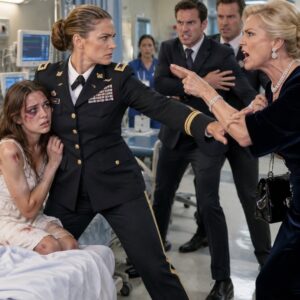
His mother, Vivian Cole, had not waited for an invitation in years. She appeared at birthdays, anniversaries, doctor’s appointments, and once, somehow, at a dinner reservation Ethan had made under my name. She claimed it was because she loved deeply. I had learned that Vivian’s love felt less like warmth and more like a hand closing around your throat.
“I’ll handle her,” Ethan said.
“Please don’t fight,” I whispered.
He hesitated. “I won’t unless she starts.”
Vivian didn’t simply enter a room. She arrived in it, dragging judgment behind her like perfume.
She stepped through the doorway wearing cream-colored trousers, a silk blouse, and a smile sharp enough to cut ribbon.
“There’s my son,” she said, touching Ethan’s cheek before looking past him at me. “And there’s the mother-to-be. Still huge, I see.”
Ethan’s jaw tightened. “Mom.”
“What? She is due tomorrow. It’s a statement of fact.” Vivian held up two paper bags. “I brought things. Since apparently no one asked me what the baby actually needs.”
I forced myself to smile. “That’s kind of you.”
She swept through the hall without waiting to be invited farther. “Kindness is what I’m reduced to now. A grandmother begging for scraps.”
Ethan followed her. “Nobody is keeping you away.”
Vivian turned, eyes bright. “You chose a delivery date without me.”
“The doctor chose it,” I said gently.
Her gaze landed on me. It always did, like a pin finding fabric.
“And you agreed.”
I placed one hand on the counter to steady myself. “Because it was safest.”
“For whom?” she asked.
The question hung there too long.
Ethan took the bags from her and set them down. “Mom, not today.”
“Exactly. Not today. Today is the last day before my grandchild is born, and I had to hear from your aunt that the nursery was finished.”
“You’ve seen the nursery twice,” Ethan said.
“I have seen what your wife allowed me to see.”
My wife.
When Ethan said those words, they sounded like devotion.
When Vivian said them, they sounded like an accusation.
She marched toward the nursery, and though every part of me wanted to sit down, I followed.
The room had been my one quiet place for months. Ethan’s painted moon. The white rocking chair. The shelf of picture books. The mobile of felt clouds spinning above the crib.
Vivian stood in the center and looked around as if inspecting a crime scene.
“Yellow,” she said.
I swallowed. “We wanted something warm.”
“It looks like a clinic.”
Ethan let out a slow breath. “It looks beautiful.”
“And this name.” Vivian picked up the wooden letters from the shelf, each one painted by Ethan in pale gold.
M-A-R-A.
She held the M like it offended her.
“Mara,” Vivian said. “Heavy little name.”
“It means beloved,” I said.
“In one language. Bitter in another.”
I stared at her. “Names can mean many things.”
“So can choices.”
Ethan reached for the letter. “Put it back.”
Vivian did, but not gently.
The wooden M tipped over and knocked against the little framed ultrasound picture beside it.
I moved quickly and caught the frame before it fell.
For one second, Vivian’s expression changed.
It was so quick I almost missed it.
Her eyes fixed on the ultrasound, then on me, then on Ethan. Something cold and frightened moved across her face.
Then it was gone.
“You’re too sentimental,” she said.
I looked down at the grainy black-and-white image. Our daughter’s profile. Her tiny nose. Her curled hand near her cheek.
Ethan had cried when the technician printed it.
Vivian had asked if the baby’s measurements were normal.
“I need to rest,” I said.
The room went silent.
Vivian turned slowly. “Excuse me?”
“I’m tired,” I said, softer than I meant to. “The doctor told me to keep stress low.”
“Stress.” She laughed once. “Of course. I’m stress now.”
“Mom,” Ethan warned.
“No, let her say it. Let her tell me I’m dangerous.”
I didn’t answer.
That was my mistake.
Vivian stepped closer. “You think I don’t see what you’ve done? Before you, Ethan called me every day. Before you, he trusted me. Before you, I knew everything happening in my family.”
“This is my family too,” I said.
Her face hardened.
For years, I had tried to find the wound underneath Vivian’s cruelty. Ethan told me his father had left when he was young. He told me Vivian had raised him alone, had worked double shifts, had given up everything. I had wanted to respect that sacrifice.
But sacrifice can sour into ownership if no one stops it.
“You don’t know what family is,” Vivian said.
Ethan stepped between us. “Enough.”
She looked at him with wet eyes that did not soften her face. “She has turned you against me.”
“No,” he said, voice shaking. “You did that.”
Vivian recoiled as if slapped.
Then everything happened too quickly.
She moved toward me, gesturing wildly, still talking, still accusing. Ethan reached for her arm. She jerked back. Her foot shot forward as she stumbled—or as she claimed later, as she lost her balance.
Pain burst through me.
Not sharp in a way I could describe. Not clean. It was a deep, terrifying force that stole the room from my eyes.
I remember Ethan shouting my name.
I remember Vivian saying, “No. No, I didn’t—”
I remember gripping the edge of the crib and missing.
Then the floor rose up to meet me.
The ambulance siren came from far away at first, like it belonged to someone else’s nightmare.
Ethan held my hand as paramedics moved around us. His face was pale, his hair falling into his eyes, his voice breaking every time he said, “Stay with me, Nora. Please stay with me.”
“I’m here,” I whispered.
But I wasn’t sure I was.
My body had become a country I no longer governed. Every movement frightened me. Every question from the paramedics made Ethan flinch.
“How far along?”
“Tomorrow,” he said. “She’s due tomorrow.”
“Any bleeding?”
“No,” he answered quickly, then looked at me as if asking permission to be relieved.
Vivian stood near the doorway, arms folded tightly around herself.
“It was an accident,” she kept saying. “I lost my balance. Tell them, Ethan. Tell them I lost my balance.”
He didn’t look at her.
At the hospital, the world turned white and blue.
White ceiling tiles. Blue curtains. White coats. Blue gloves. The low beep of monitors. The tight pressure of a cuff around my arm. Ethan’s hand in mine, damp and trembling.
A nurse named Priya leaned over me. “Nora, your baby’s heartbeat is steady right now. That’s good. We’re going to keep checking.”
Right now.
Two words I never forgot.
Vivian arrived twenty minutes later.
I still don’t know who called her. Maybe she followed the ambulance. Maybe fear has its own map.
She entered the exam room with her purse clutched in front of her and her chin lifted.
“I want to speak to the doctor,” she said.
Ethan stood. “Get out.”
“I am the grandmother.”
“You are the reason she’s here.”
Her eyes flashed. “I told you it was an accident.”
“You kicked my pregnant wife.”
Her mouth opened, then closed.
For the first time all day, Vivian looked at me not with anger, but with calculation.
The doctor came in before Ethan could say more.
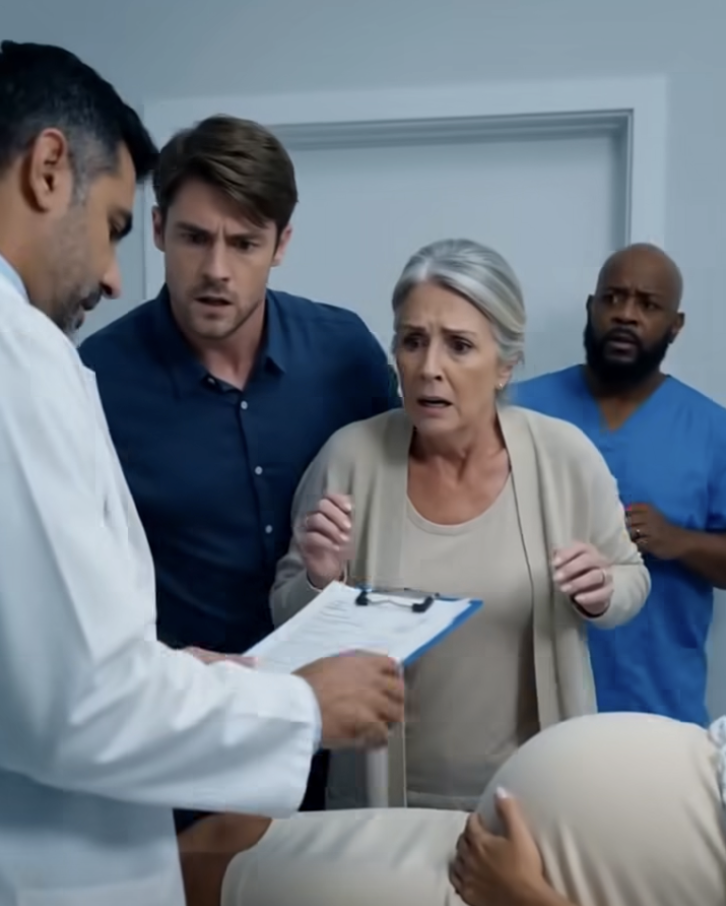
He was a tall man with silver at his temples and kind, tired eyes. “I’m Dr. Kaplan. We’re going to run a full assessment. Nora, I want you to breathe slowly for me.”
“I’m trying,” I said.
“You’re doing well.”
He reviewed the monitor, then ordered more tests. An ultrasound. Bloodwork. A scan to check for internal trauma. More monitoring.
At some point, Vivian sat down.
At some point, Ethan began pacing.
At some point, I realized the pain was not the worst part.
The waiting was.
Minutes stretched. Nurses came and went. Dr. Kaplan’s expression stayed professional, but I saw the small crease between his eyebrows deepen each time he returned.
Then a younger doctor came in carrying a folder.
She whispered something to him.
He looked at the papers.
Then he looked at Vivian.
Not at me.
Not first.
At Vivian.
The air shifted.
“What is it?” Ethan demanded.
Dr. Kaplan didn’t answer immediately. “Mrs. Cole, may I ask you a question?”
Vivian sat straighter. “I don’t know what that has to do with—”
“Have you ever donated blood?” he asked.
The question seemed so strange that for a moment no one reacted.
“What?” Ethan said.
Vivian blinked. “Yes. Years ago.”
“Have you ever had a blood transfusion?”
“No.”
“Were there any complications during Ethan’s birth?”
Vivian’s hand tightened on her purse. “Why are you asking about that?”
Dr. Kaplan’s voice remained calm. “Because something unexpected came up in Nora’s bloodwork, and then in the baby’s screening.”
My heartbeat seemed louder than the monitor.
“The baby?” I asked.
“She is stable,” he said quickly. “But we found a rare blood marker. It is medically important for delivery planning, but it also tells us something about biological inheritance.”
Ethan frowned. “What does that mean?”
Vivian’s face had gone still.
Too still.
Dr. Kaplan looked uncomfortable now, as if he hated the words before he said them. “There is a blood marker present in the baby that cannot have come from Nora. That part is not unusual. It would have come from the father.”
Ethan gripped my hand. “Okay.”
“But when we checked Ethan’s records—records you authorized us to pull from this hospital system earlier in the pregnancy—we found something that does not match.”
The room seemed to shrink.
Vivian whispered, “Stop.”
Ethan turned to her.
Dr. Kaplan looked at him with compassion. “Based on these results, Ethan cannot be the biological father of Nora’s baby.”
The silence that followed was absolute.
I felt Ethan’s hand loosen around mine.
For one terrible second, I thought the floor had opened beneath our marriage.
“No,” I said.
It came out as a breath.
Then stronger.
“No. That’s impossible.”
Ethan stared at me. His eyes were not angry yet. They were stunned, wounded, searching.
“Nora?” he said.
I pushed myself up despite the nurse’s warning. “Ethan, no. I swear to you. I swear on her life. There has never been anyone else.”
Vivian made a sound. Not relief. Not triumph.
Fear.
Dr. Kaplan continued carefully. “There is another possibility.”
Ethan looked back at him.
The doctor glanced again at Vivian. “Ethan’s childhood blood type record may be inaccurate. Or Ethan may not be biologically related to the person listed as his mother.”
Vivian stood so fast her chair scraped the floor.
“That is enough,” she said.
Ethan stared at her. “Mom?”
“I said that is enough.”
Dr. Kaplan held the report but did not move toward her. “Mrs. Cole, this has implications for the baby’s care. We need accurate family medical history.”
“No, you don’t,” she snapped. “You need to deliver the child.”
Ethan’s voice changed. It dropped into something quiet and dangerous. “What is he talking about?”
Vivian looked at him, and for a moment she was not the polished woman who controlled rooms with a glance.
She was cornered.
“Ethan,” she said. “This is not the time.”
He took one step toward her. “Am I your son?”
Her eyes filled instantly.
That was answer enough.
But she still lied.
“Of course you are.”
“Biologically,” he said.
The word sliced through her.
She looked at me then, and hatred returned—not because she believed I had betrayed Ethan, but because I had brought her secret to the edge of daylight without meaning to.
“Ask your wife,” Vivian hissed. “This is her mess.”
“No,” Ethan said. “This is yours.”
Dr. Kaplan quietly asked the nurse to step out and returned his attention to me. “Nora, we need to continue monitoring you. Your baby is doing well, but delivery may need to happen tonight.”
Tonight.
The word should have terrified me.
Instead, all I could see was Ethan’s face.
Everything he thought he knew was breaking inside him, and I couldn’t even get out of the bed to hold him.
Vivian sank back into her chair.
For the first time since I had known her, she looked old.
“I was nineteen,” she said suddenly.
Ethan froze.
Vivian covered her mouth with one trembling hand. “I was nineteen, and my sister was twenty-two.”
Ethan’s brow furrowed. “Aunt Lydia?”
Vivian nodded, tears sliding down her face.
I had met Lydia only twice. She lived in Maine, sent birthday cards with pressed flowers inside, and always hugged Ethan too long, as if memorizing him. Vivian called her unstable. Too sensitive. Dramatic.
Now I remembered the way Lydia had cried at our wedding when Ethan danced with Vivian.
Not loudly.
Silently, with her hand pressed to her lips.
“Lydia was pregnant,” Vivian said. “The father was engaged to someone else. Our parents were ashamed. They said she had ruined herself. She wanted to keep the baby, but she had no money, no support. I had just lost—”
She stopped.
“Lost what?” Ethan asked.
Vivian’s shoulders shook. “My son.”
The room went cold.
“I gave birth to a boy,” she whispered. “He lived two days.”
Ethan’s eyes widened.
“I couldn’t bear it. I couldn’t go home without him. Then Lydia had you three weeks later, and my parents said there was a way to save everyone. Lydia could start over. I could have a child. No one had to know.”
Ethan stepped back as if she had struck him.
“You took me,” he said.
“She gave you to me.”
“Did she?”
Vivian’s mouth twisted.
That was answer enough too.
“She was weak,” Vivian said, but her voice broke over the word. “She changed her mind. She cried and begged for you after papers were signed. But my parents said it was done. Your birth certificate named me. I raised you. I fed you. I held you when you were sick. I was your mother.”
Ethan’s face crumpled.
“You lied to me my entire life.”
“I loved you my entire life.”
“That doesn’t make it right.”
Vivian reached for him. He moved away.
The small motion destroyed her more than any shouting could have.
The monitors beeped steadily beside me. My daughter shifted inside me, alive and present, as if reminding us that truth had come not to destroy us, but to make room.
I thought of Lydia’s pressed flowers.
Her shaking hands at our wedding.
The way she had whispered to me, “Take good care of him,” and then looked embarrassed, as if she had said too much.
All those years, Ethan had believed he had one mother who loved him badly.
He had another who loved him from a distance because distance was all she had been allowed.
Dr. Kaplan cleared his throat gently. “I know this is overwhelming. But right now, Nora and the baby need calm.”
Ethan turned immediately.
Whatever had broken in him, his love did not.
He came back to my side and took my hand again, tighter than before.
“I believe you,” he said.
Tears spilled down my cheeks. “You do?”
“I should have said it faster.” His voice cracked. “I’m sorry.”
I shook my head. “Don’t be.”
Vivian whispered, “Ethan.”
He did not turn around.
The next hour became a blur of decisions.
The baby’s heartbeat dipped once, then recovered. Dr. Kaplan recommended delivering that night. He said it calmly, but everyone moved faster afterward.
They wheeled me down a bright hallway, Ethan walking beside me in scrubs, his hand never leaving mine. Vivian tried to follow until a nurse stopped her.
“Immediate support person only,” the nurse said.
“I’m his mother,” Vivian said.
Ethan looked back then.
“No,” he said softly. “You’re not coming in.”
Vivian’s face folded.
I should have felt satisfaction.
I didn’t.
I felt the terrible weight of consequences finally arriving.
Mara was born at 11:47 p.m., thirteen minutes before her due date.
She entered the world with a fierce cry that made Ethan sob openly. The nurses placed her near me, warm and furious and impossibly real, her tiny fists waving as if she had fought her way into the story and intended to edit the ending herself.
“She’s here,” Ethan whispered. “Nora, she’s here.”
I looked at her face and forgot pain, fear, Vivian, everything.
Mara had Ethan’s dark hair.
She had my chin.
And on her left shoulder, just above her collarbone, she had a small crescent-shaped birthmark.
Ethan stared at it.
“What?” I whispered.
He touched the air above it, not quite touching her skin. “I have one like that.”
I had seen it a hundred times. A pale crescent near his shoulder, usually hidden by his shirt.
The nurse smiled. “Family mark.”
Ethan laughed once through tears.
Family.
The word had changed shape, but it had not disappeared.
The next morning, sunlight poured across the hospital room in soft gold.
Mara slept against my chest. Ethan sat beside us, exhausted, unshaven, and more beautiful to me than he had ever been.
There was a knock.
He stiffened.
A nurse opened the door. “There’s a woman named Lydia here. She says she’s your aunt. She doesn’t want to disturb you, but she came as soon as she got your message.”
Ethan closed his eyes.
After Mara’s birth, while I slept, he had called her.
Not Vivian.
Lydia.
“Let her in,” he said.
Lydia entered like someone stepping into a church after years of exile.
She was thin, with silver-threaded brown hair and gentle eyes already wet. She stopped when she saw Ethan. Then she saw the baby.
Her hand flew to her mouth.
“Oh,” she whispered. “Oh, sweetheart.”
Ethan stood.
For a moment, neither of them moved.
Then Lydia said, “I’m sorry.”
It was not dramatic. It was not enough. It was everything she had carried in two words.
Ethan crossed the room and hugged her.
Lydia made a broken sound and held him with both arms, trembling so hard I thought she might fall.
“I tried,” she cried. “I tried to come back. They told me you were better off. They told me Vivian would ruin me if I fought. I was young and scared, and then years passed, and I thought if I told you, you’d hate me for giving you up.”
Ethan held her tighter.
“I don’t hate you,” he whispered.
Mara stirred on my chest, making a tiny squeak.
Lydia laughed through tears.
Ethan turned. “Do you want to meet your granddaughter?”
Lydia looked as if the word had physically struck her.
“Granddaughter?”
“If you want,” Ethan said.
She came to the bed slowly. I lifted Mara just enough for Lydia to see her face.
“She’s beautiful,” Lydia whispered.
“Her name is Mara,” I said.
Lydia smiled.
“Beloved,” she said.
I stared at her.
She looked embarrassed. “It was the name I wanted for Ethan, if he had been a girl.”
The room went quiet, but this time the silence was gentle.
A circle closing.
Vivian came later that day.
She looked smaller without her certainty. Her hair was pinned neatly, but her face was bare of makeup. There was a bruise of sleeplessness beneath each eye.
A hospital security officer stood outside the door. Ethan had requested it.
Vivian noticed.
She deserved to.
“I’m not here to cause trouble,” she said.
Ethan stood between her and the bed.
“You already did.”
Vivian nodded. Her eyes moved to Mara, and something like longing crossed her face.
“She’s beautiful.”
“She is,” I said.
Vivian looked at me then. “Nora, I hurt you. I could say I lost my balance. I could say I didn’t mean for it to happen that way. But I was angry. I wanted to scare you. That is the truth.”
Ethan’s face tightened.
Vivian swallowed. “I am going to tell the police the same thing.”
I had not expected that.
Neither had Ethan.
“I spent my life terrified someone would take my son from me,” she continued. “So I became the kind of person who made sure everyone wanted to.”
Tears gathered in her eyes.
“I loved you,” she said to Ethan. “But I loved you selfishly. I loved you like proof that my pain had meaning. That was wrong.”
Lydia, standing near the window, said nothing.
Vivian looked at her sister.
For the first time, there was no superiority in her face.
Only shame.
“I stole years from you,” Vivian whispered.
Lydia’s lips trembled. “Yes.”
“I don’t know how to fix that.”
“You don’t,” Lydia said. “You start by not lying anymore.”
Vivian nodded.
Then she reached into her purse and pulled out a small envelope. Her hands shook as she gave it to Ethan.
“I kept these,” she said. “I told myself it was cruel to throw them away. But really, I think some part of me knew you deserved them.”
Ethan opened the envelope.
Inside were photographs.
Lydia, young and pale, holding a newborn wrapped in a blue blanket.
Lydia kissing the baby’s forehead.
Lydia asleep in a hospital bed with the baby curled beside her.
On the back of one photo, in faded ink, were four words:
My beloved little boy.
Ethan sat down heavily.
I watched him stare at the picture of himself in the arms of the mother who had lost him while still alive.
Then Mara woke and began to fuss.
The sound pulled all of us back.
Not to the past.
To the present.
Ethan wiped his face and lifted our daughter carefully. He held her against his chest, her tiny body settling over the crescent birthmark beneath his shirt.
Vivian watched, crying silently.
Lydia watched too, but with a smile that seemed to heal and hurt at once.
“What happens now?” Vivian asked.
Ethan looked at Mara for a long time before answering.
“Now,” he said, “the truth raises her.”
The months that followed were not easy.
Vivian faced legal consequences, though I asked the court for mercy after she accepted responsibility and agreed to treatment, anger counseling, and strict boundaries. Mercy, I learned, is not the same as permission. Forgiveness is not a door you leave unlocked.
For a long time, Vivian saw Mara only through photos Ethan chose to send. Later, when trust had a fragile beginning, visits happened in public places, then in our home, always with clear rules.
She followed them.
Not perfectly at first.
But honestly.
Lydia moved closer before Mara’s first birthday. She rented a small blue house ten minutes away and filled it with plants, wind chimes, and picture frames. She never pushed Ethan to call her Mom. She never corrected him when he called her Aunt Lydia out of habit.
One afternoon, as Mara learned to toddle between the sofa and the coffee table, Ethan stood in Lydia’s kitchen staring at an old recipe card.
“You made these?” he asked.
“Cinnamon rolls,” Lydia said. “You loved them as a baby. Well, for the three weeks I had you.”
His throat moved.
“My whole life,” he said slowly, “I thought I loved cinnamon because Vivian made rolls on my birthday.”
Lydia smiled sadly. “I used to mail her the recipe every year. I don’t know why. Maybe I hoped some part of me would reach you.”
Ethan looked at her.
Then, quietly, he said, “Mom?”
Lydia froze.
He looked nervous, like a child asking for something fragile.
“Would you teach me how to make them?”
Lydia covered her mouth, laughing and crying at the same time.
“Yes,” she said. “Yes, I’d love that.”
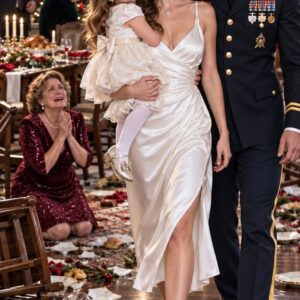
Mara’s first birthday was held in our backyard under strings of warm lights.
Ethan baked cinnamon rolls in the morning. I frosted cupcakes shaped like moons. Lydia brought pressed flower bookmarks for everyone. Vivian came too, wearing a simple blue dress, carrying one gift, and asking before she hugged anyone.
When Mara smashed cake into her hair, Ethan laughed so hard he had to sit down.
Vivian watched from a careful distance.
Lydia stood beside her.
For a while, neither sister spoke.
Then Vivian said, “She has your smile.”
Lydia nodded. “And Ethan’s stubborn chin.”
Vivian’s mouth trembled. “I’m glad he found you.”
Lydia looked at her sister for a long moment.
“So am I,” she said.
It was not forgiveness.
Not yet.
Maybe not ever in the way Vivian wanted.
But it was something.
A beginning.
That evening, after everyone left, Ethan and I sat on the nursery floor while Mara slept in her crib beneath the crooked painted stars.
The wooden letters still sat on the shelf.
M-A-R-A.
Beloved.
Ethan leaned his head against mine.
“I used to think family meant the people who stayed,” he said.
I watched Mara breathe, tiny and steady.
“What do you think now?”
He reached for my hand.
“I think family means the people who stop hiding when the truth arrives.”
Outside, the last birthday balloon bumped softly against the window, glowing silver in the moonlight.
A year earlier, I had believed Vivian’s kick was the worst thing that could happen to us.
I had been wrong.
It was cruel. It was frightening. It was unforgivable for a long time.
But it cracked open a lie that had trapped three generations.
It brought Lydia home.
It gave Ethan back a missing piece of his heart.
And it taught us that our daughter had not been born into a broken family.
She had been born at the exact moment ours finally began telling the truth.
Mara sighed in her sleep, one tiny hand opening like a flower.
Ethan kissed my temple.
In the quiet yellow room, under a moon painted by the man I loved, I realized the happiest endings are not the ones where nothing terrible happens.
They are the ones where love survives the truth.
And ours did.