The laughter started before my mother-in-law even opened the gift.
That was how little respect they had for me.
I stood near the grand marble staircase of the Hawthorne mansion, clutching my hands together while fifty guests stared at the small wooden box I had spent weeks debating whether to bring.
Looking back, I should have known exactly what would happen.
People like them always needed someone to look down on.
And in their eyes, I was perfect for the role.
The poor girl.
The outsider.
The mistake their son married.
My name is Emma Carter.
Three years earlier, I had fallen in love with Daniel Hawthorne.
To me, he was kind, intelligent, and surprisingly humble considering the wealth he came from.
But his family never accepted me.
Not once.
Not ever.
His mother, Victoria Hawthorne, treated me like an employee who had accidentally wandered into the wrong room.
His sister, Vanessa, openly referred to me as “the charity project.”
His brother, Michael, liked to joke that I was the cheapest thing ever brought into the family.
Everyone laughed when he said it.
Everyone except Daniel.
But even Daniel had never truly stood up to them.
Not the way I needed.
Not the way a husband should.
Which was why, on Victoria’s sixty-second birthday, I stood alone while the room prepared to mock me.
Vanessa smirked.
“Come on, Mom. Open it.”
Several guests chuckled.
Victoria examined the box.
Simple oak.
Worn edges.
Nothing flashy.
Nothing expensive.
“How charming,” she said.
The room laughed.
“Maybe it’s homemade,” Michael added.
“Or empty,” someone else said.
“Or maybe she regifted it.”
More laughter.
I felt my cheeks burn.
Daniel shifted uncomfortably.
But he remained silent.
As usual.
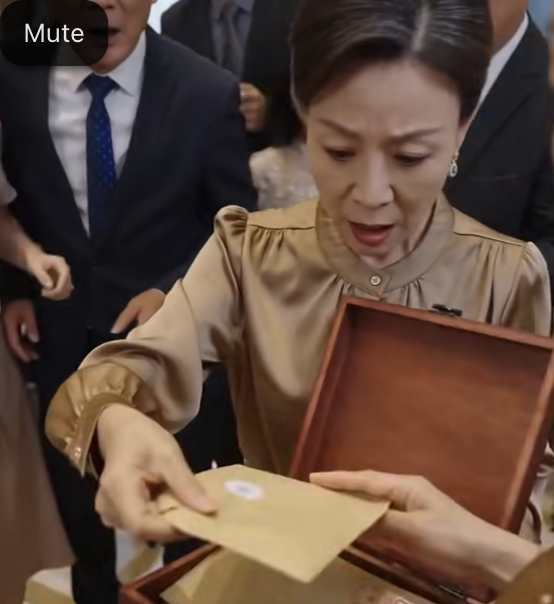
Victoria slowly opened the lid.
Inside sat several folded papers.
Nothing more.
The laughter became louder.
“Oh my God.”
“It’s literally paperwork.”
“Did she bring tax records?”
Someone nearly spilled champagne from laughing.
Victoria pulled out the first document.
Her smile remained.
For exactly three seconds.
Then it disappeared.
I noticed it immediately.
A tiny change.
A flicker.
Confusion.
She unfolded the paper completely.
Read the first paragraph.
Then read it again.
The color began draining from her face.
The room’s laughter weakened.
Vanessa frowned.
“Mom?”
Victoria didn’t answer.
My father-in-law, Charles Hawthorne, stood and walked over.
“What is it?”
She handed him the document.
Charles looked irritated.
Then curious.
Then alarmed.
The transformation was impossible to miss.
“What the hell…” he whispered.
The room became silent.
Guests exchanged confused glances.
Vanessa snatched another paper.
Michael grabbed a third.
Within seconds several family members were reading the contents.
And every one of them reacted exactly the same way.
Shock.
Disbelief.
Fear.
Pure fear.
I finally spoke.
“The documents are authentic.”
Nobody laughed now.
Victoria looked at me.
“Where did you get these?”
“From my grandfather.”
The room remained silent.
Nobody had ever asked about my grandfather before.
Nobody cared.
To them, my family history wasn’t important.
Poor people didn’t have history.
Poor people only had excuses.
At least that was how they saw things.
“My grandfather, Henry Carter, owned that box until he died.”
I nodded toward the papers.
“And those documents belonged to him.”
Charles stared at me.
“That’s impossible.”
“Why?”
His jaw tightened.
“Because Henry Carter had nothing to do with this property.”
I smiled slightly.
“Are you sure?”
Nobody spoke.
I walked forward.
For the first time in years, every eye in the room followed me.
Not with contempt.
With uncertainty.
I picked up one of the documents.
“The original ownership certificate.”
Then another.
“The first land registration.”
Then another.
“The transfer records.”
I laid them across the table.
Like evidence in a courtroom.
“The mansion wasn’t originally owned by the Hawthorne family.”
The room froze.
Vanessa laughed nervously.
“That’s ridiculous.”
I looked directly at her.
“Your family purchased the estate in 1987.”
Her smile vanished.
Because she knew I was right.
I continued.
“The property existed long before that.”
Charles swallowed.
Victoria gripped the papers harder.
I pointed toward the ceiling.
“The mansion standing around us today was built on land partially owned by my grandfather’s family.”
Nobody moved.
Nobody breathed.
Then I said something that shattered the room.
“And according to these records, the sale was never legally completed.”
Chaos erupted.
“What?”
“That’s impossible.”
“No way.”
Guests rushed toward the documents.
People began reading.
Studying.
Comparing dates.
Checking signatures.
Victoria looked ready to faint.
Daniel stared at me.
“Emma…”
I met his eyes.
“I didn’t know any of this until six months ago.”
That part was true.
After my grandfather died, I inherited several boxes stored in an old warehouse.
Most contained ordinary family keepsakes.
Photographs.
Letters.
Receipts.
Forgotten memories.
But one box had been different.
The wooden box.
Inside I found documents connected to land ownership.
At first, I assumed they were worthless.
Then I began researching.
The deeper I dug, the stranger everything became.
Because every trail eventually led back to one place.
The Hawthorne mansion.
The very house where my husband’s family lived.
The house they endlessly bragged about.
The house that formed the foundation of their social status.
Their identity.
Their pride.
Their entire reputation.
And hidden beneath those papers was something even stranger.
A sealed envelope.
One my grandfather had never opened.
One addressed to the future owner of Hawthorne Estate.
No name.
No date.
Just those words.
Victoria’s trembling hands reached toward it.
The envelope.
The final mystery.
The room watched.
Even the waiters had stopped moving.
Victoria ripped the seal open.
Inside sat several handwritten pages.
Very old pages.
Yellowed with age.
The handwriting was elegant.
Precise.
Victorian-era ink.
Charles leaned closer.
Victoria began reading aloud.
At first, her voice was steady.
Then it faltered.
Then it broke.
The letter had been written by Edward Ashcroft.
The original owner of the estate.
A wealthy industrialist who built the first mansion on the property more than a century earlier.
The first page described ownership agreements.
The second page revealed financial arrangements.
The third page contained something nobody expected.
A confession.
Edward Ashcroft admitted that the land never fully belonged to him.
Half the estate had been placed in trust under another family.
A family whose name had been deliberately removed from public records.
The Carter family.
My family.
Gasps filled the room.
Victoria continued reading.
Her voice shook violently now.
Because the letter revealed something worse.
Much worse.
For generations, descendants of both families had agreed to preserve the property together.
Neither family could legally sell their share without approval from the other.
But decades earlier someone had forged signatures.
Destroyed records.
Altered legal filings.
And quietly transferred ownership.
The fraud had remained hidden for nearly forty years.
Until now.
Until tonight.
Until a wooden box opened in front of fifty witnesses.
The room felt colder.
Charles sank into a chair.
His face had become gray.
Victoria reached the final pages.
And suddenly stopped.
Completely stopped.
Her hands began shaking uncontrollably.
“What is it?” Daniel asked.
No answer.
“Mom.”
Nothing.
Charles took the letter.
Read the page.
Then collapsed back into his chair.
Exactly as described.
The room erupted again.
“What?”
“What does it say?”
Victoria covered her mouth.
Tears filled her eyes.
I had never seen that woman cry.
Not once.
Not even at family funerals.
But now she looked devastated.
Daniel grabbed the page.
His eyes moved across the text.
Then widened.
Slowly.
Horrifically.
He looked at me.
Then at his parents.
Then back at me.
“Oh my God.”
The room demanded answers.
Finally Daniel spoke.
“The forged transfer…”
His voice cracked.
“…was signed by Grandfather Hawthorne.”
Silence.
Absolute silence.
The revelation hit like an earthquake.
Family legend portrayed Daniel’s grandfather as a genius entrepreneur.
A visionary.
A respected businessman.
His portrait hung above the fireplace.
His achievements were celebrated constantly.
Yet the letter revealed a different truth.
He hadn’t built the family fortune.
He had stolen it.
The estate.
The land.
The inheritance.
Everything.
He had taken it through fraud.
And hidden the evidence.
For decades.
The guests stared at one another.
Nobody knew what to say.
Then I spoke quietly.
“That’s not the biggest surprise.”
Every head turned.
I reached into the box.
Pulled out a final document.
One I hadn’t shown anyone.
One I had deliberately saved until now.
My hands remained steady.
Unlike theirs.
“This is the reason I gave Victoria the box.”
I handed the paper to her.
She read it.
Then looked up in shock.
“Why?”
My voice softened.
“Because I don’t want the mansion.”
The room froze again.
Victoria stared.
Charles stared.
Everyone stared.
“I don’t understand.”
I smiled sadly.
For years I had imagined revenge.
Imagined exposing them.
Humiliating them.
Making them feel what they had made me feel.
Small.
Worthless.
Unwanted.
But somewhere along the way I realized something.
Their cruelty had already punished them.
People who spent their lives obsessed with status were already trapped.
They lived inside a prison built from appearances.
And they didn’t even know it.
“The document is a settlement agreement.”
Charles blinked.
“A settlement?”
“Yes.”
I nodded.
“My lawyer prepared it.”
Several guests exchanged startled looks.
“I have no intention of taking your home.”
Victoria looked genuinely confused.
“Then why do this?”
The answer had lived inside me for years.
Because I was tired.
Tired of proving myself.
Tired of shrinking.
Tired of apologizing for existing.
“I wanted the truth.”
Nobody spoke.
“I wanted one night where everyone in this room understood that my worth was never measured by money.”
My voice grew stronger.
“You laughed at me because of a wooden box.”
Silence.
“You mocked me because you assumed poor meant insignificant.”
More silence.
“You never bothered to learn anything about me.”
Victoria lowered her eyes.
“You never cared who I was.”
A tear rolled down her cheek.
For the first time, she looked ashamed.
Truly ashamed.
The kind of shame that can’t be hidden behind pride.
The kind that changes people.
Then something unexpected happened.
Victoria stood.
Slowly.
Carefully.
The room watched.
She walked toward me.
And for the first time since I had joined the family…
She apologized.
Not a polite apology.
Not a forced apology.
A real one.
“I was wrong.”
The words seemed painful.
Almost impossible.
“I judged you.”
Her voice trembled.
“I judged your family.”
Another tear fell.
“And I spent years treating you terribly.”
The room remained completely silent.
Victoria looked at everyone.
Then did something nobody expected.
She held up the wooden box.
“This is the most valuable gift I’ve received tonight.”
The guests shifted uncomfortably.
Because they knew she was right.
The diamonds meant nothing.
The watches meant nothing.
The vacations meant nothing.
Every expensive gift in the room suddenly looked small.
Because one inexpensive wooden box had exposed four decades of lies.
And restored a century of truth.
Six months later, something remarkable happened.
The legal investigation concluded.
Historians became involved.
Lawyers reviewed thousands of records.
The Carter family’s ownership claims were confirmed.
The fraud became public.
Newspapers covered the story.
People across the state became fascinated by the mystery.
But I honored the settlement.
The Hawthornes kept their home.
No lawsuits.
No eviction.
No revenge.
Instead, the estate became jointly recognized as part of both families’ history.
A small museum room was even created inside the mansion.
One dedicated to the forgotten Carter family.
The family erased from history.
The family nobody bothered to remember.
Until now.
And the greatest surprise of all?
Victoria changed.
Not overnight.
Not magically.
But genuinely.
Slowly.
She started inviting me to lunch.
Asking questions about my childhood.
Listening.
Actually listening.
One afternoon she confessed something.
“When you first joined the family, I was afraid of you.”
I laughed.
“Afraid of me?”
She nodded.
“You were happy without money.”
I frowned.
“So?”
Victoria smiled sadly.
“Because I realized I wasn’t.”
That was the first truly honest thing she’d ever said to me.
And perhaps the most important.
Because wealth can buy mansions.
Cars.
Status.
Luxury.
But it cannot buy peace.
It cannot buy character.
And it certainly cannot buy the truth.
The wooden box still sits in my office today.
Simple.
Ordinary.
Worth almost nothing.
Yet every time I look at it, I remember the night an entire room laughed at a poor woman’s gift.
Only to discover it contained something more valuable than every diamond in the mansion.
The truth.
And in the end, that truth didn’t just change who owned the estate.
It changed the people living inside it.
