The crying should not have existed.
Not in my house.
Not beneath marble floors polished every morning by women who moved silently in gray uniforms. Not under chandeliers imported from Venice, under oil portraits of dead ancestors who had built railroads, banks, and hotels. Not inside the Ashford estate, where every door had a sensor, every hallway had a camera, and every secret, I believed, was mine to know.
But I heard it.
A child.
Faint. Muffled. Broken.
I stopped halfway down the main staircase with one hand on the banister, my phone still pressed to my ear though the call had ended minutes ago. The house around me was too quiet. My wife, Celeste, had taken our children shopping. The staff had been given the afternoon off because Celeste said she wanted “peace in the house for once.”
Peace.
Then came the sound again.
A sob.
Small and desperate.
My heart hit my ribs so hard it hurt.
“Hello?” I called.
No answer.
The sobbing stopped.
That was worse.
I moved through the mansion, past the music room, past the winter garden, past the long corridor where my daughter Lily’s ballet shoes usually lay abandoned by the wall. I checked the library, the guest wing, the pantry. Nothing.
Then a soft voice drifted upward through the floorboards.
“Please…”
My blood turned cold.
It came from below.
The basement.
I had not gone down there in months. Celeste handled storage. Seasonal decorations. Old furniture. Boxes from my late mother’s estate. I had trusted her with the domestic corners of our life because I was always buried in board meetings, acquisitions, lawsuits, numbers.
I owned half the city, but I had no idea what lived under my own home.
The basement door stood at the end of a narrow service hall.
The moment my fingers touched the handle, the crying stopped.
Too quickly.
Too perfectly.
I opened the door.
The air below smelled of dust, cedar, and something else—something stale and sour, like fear trapped too long in a closed room.
“Lily?” I called. “Noah?”
Silence.
I descended slowly.
The basement looked ordinary at first. Old sofas covered in white sheets. Boxes labeled CHRISTMAS. Wine crates. A cracked mirror leaning against the wall.
Then I heard it.
Tap.
Tap.
Tap.
Three slow knocks.
From behind the far wall.
I froze.
“Who’s there?”
No answer.
I crossed the room, my shoes scraping against concrete. A tall metal shelf stood against the wall, stacked with paint cans and folded tarps. Something about it felt wrong. Too neat. Too heavy. Bolted to the floor.
I pushed it.
It didn’t move.
I found the bolts, grabbed a wrench from a nearby toolbox, and worked like a madman until my palms burned. When the last bolt came loose, I shoved the shelf aside.
Behind it was a door.
A narrow door painted the same gray as the wall.
My hand shook as I pulled it open.
The room behind it was small, windowless, and impossible.
Children’s blankets lay folded in one corner. Plastic water bottles. Crackers. A night-light plugged into an extension cord. Toys lined the floor: blocks, stuffed animals, a doll with one missing shoe.
And on the walls—
Drawings.
Dozens of them.
A blonde woman standing over a crying child.
A blonde woman locking a door.
A blonde woman with sharp red lips and long fingers like claws.
Under every drawing was a date.
The earliest was almost two years old.
I couldn’t breathe.
Celeste was blonde.
My wife’s hair was the same pale gold in every picture.
I stepped deeper into the room and found a small voice recorder tucked beneath a blanket.
I pressed play.
At first, there was static.
Then my daughter’s voice.
“Please let me out. Daddy will be mad. Please, I won’t tell.”
My knees almost gave way.
The next recording was Noah, my son, sobbing so hard his words broke apart.
“I’m sorry. I won’t ask where she is again. Please open the door.”
I gripped the recorder until my fingers hurt.
Then came the final recording.
Celeste.
Calm.
Cold.
“If any of you tell your father what happens down here, I will make sure he never believes you. Rich men believe their wives before frightened children. Remember that.”
The room tilted.
I staggered back into the basement, ran upstairs, and opened the security system from my office. My hands flew across the keyboard. Basement cameras. Motion logs. Door access history.
Deleted.
Disabled.
Over and over again.
Every date matched the drawings.
Every time Celeste entered that hidden room, the cameras had been shut off.
Except once.
One camera had malfunctioned before it died.
Thirty seconds of footage remained.
I opened it.
The video showed Celeste in a white coat, dragging a crying child by the wrist toward the hidden door.
Not Lily.
Not Noah.
A little boy.
Thin. Dark-haired. Maybe six years old.
A child I had never seen in my life.
Then the footage cut to black.
I searched the hidden room again like a man tearing through his own grave. I lifted blankets, ripped open boxes, pulled toys away from the walls.
Beneath a stack of old quilts, I found a locked wooden chest.
I broke it open with a crowbar.
Inside were photographs.
A birth certificate.
Medical records.
And a legal document with my signature forged at the bottom.
The name on the birth certificate made the world go silent.
Elliot Daniel Ashford.
Father: Adrian James Ashford.
My name.
Mother: Marianne Vale.
For a moment, I could not understand what I was reading.
Then I saw the photograph beneath it.
A younger woman with dark hair, tired eyes, and a newborn wrapped in blue. On the back, someone had written:
He has your father’s eyes.
My father’s eyes.
My eyes.
I had a son.
A son I had never met.
And my wife had hidden him beneath my house.
A sound came from behind me.
I turned.
In the doorway stood Lily.
My eight-year-old daughter was pale, trembling, and clutching her stuffed rabbit against her chest.
“Daddy,” she whispered, “you found his room.”
I ran to her, dropping to my knees. “Lily, what is this? Who is Elliot?”
Her lips shook.
“Grandma said he was a mistake.”
My heart stopped.
“Grandma?”
She nodded.
“My step-grandma. Mrs. Ashford.”
My stepmother.
Victoria Ashford.
The woman who had married my father when I was sixteen. The woman who had taught me to smile through grief after my mother died. The woman who had introduced me to Celeste. The woman who sat at the head of our family foundation and kissed my children on the forehead every Christmas.
“She told Mommy what to do,” Lily whispered. “Mommy cried at first. But Grandma said if Elliot stayed, everything would be ruined.”
I pulled Lily into my arms.
She broke.
The story came out in fragments.
Elliot had been brought to the house at night. Celeste said he was “a charity case.” Then he disappeared into the basement. Lily and Noah had found him once. After that, Celeste locked them in the hidden room whenever they asked questions.
Victoria came often.
Victoria had keys.
Victoria had told Elliot that I did not want him.
That I knew.
That I had paid for him to be kept away.
I wanted to tear the house apart with my bare hands.
“Where is he now?” I asked.
Lily cried harder.
“Grandma took him yesterday.”
My phone rang.
Celeste.
I stared at her name until it blurred.
Then I answered.
“Adrian,” she said brightly, “we’ll be home in an hour. Did you eat?”
“Where is Elliot?”
Silence.
Not confusion.
Not shock.
Silence.
Then her voice changed.
“You went into the basement.”
“Where is my son?”
“You don’t understand.”
“No,” I said, my voice shaking. “I understand enough.”
She lowered her voice. “Listen to me carefully. Do not call the police. Do not call anyone. Victoria said if this came out—”
“Victoria said?”
Celeste began crying, but it was not the crying I had heard below the floor. It was frightened, cornered crying.
“She made me,” Celeste whispered. “She said your father’s trust would collapse. She said you would leave me. She said Elliot’s mother was a gold digger, that the child would destroy Lily and Noah’s inheritance.”
“Where is he?”
“At the lake house,” she breathed. “Victoria took him to the lake house.”
I hung up.
I called my head of security, Daniel Cross, a former detective who had worked for me for ten years.
“Get men to the lake house now,” I said. “Quietly. And call the police. Not the local department near the lake—state police. Tell them it involves child imprisonment and kidnapping.”
Then I called my lawyer.
Then my driver.
Then I took Lily upstairs, wrapped her in a coat, and promised her something I should have promised years ago.
“No one will hurt you again.”
By the time we reached the Ashford lake house, rain had begun falling in silver sheets.
Police cars hid without lights along the tree line. Daniel met me at the gate, his face grim.
“He’s inside,” he said. “We saw movement upstairs. Victoria is there too.”
“And Elliot?”
“Small boy. Alive.”
Alive.
The word nearly broke me.
Officers moved in.
The front door opened before they knocked.
Victoria stood there in pearls and a cream cashmere sweater, looking mildly annoyed, as though we had interrupted tea.
“Adrian,” she said. “This is dramatic.”
“Where is he?”
Her eyes flicked to the officers.
“You always were emotional like your mother.”
I stepped toward her, but Daniel held my arm.
Victoria smiled.
“That child is not yours.”
I lifted the birth certificate.
“Then why forge my signature?”
For the first time, her face changed.
Only for a second.
But I saw it.
Fear.
A noise came from upstairs.
A small cry.
I ran past her.
“Adrian!” Victoria snapped.
I took the stairs two at a time.
At the end of the hallway, a bedroom door was locked from the outside.
An officer broke it open.
Inside, a little boy sat curled beside the bed, clutching a blanket to his chest.
Dark hair.
Wide blue-gray eyes.
My father’s eyes.
My eyes.
He stared at me like he expected punishment.
I knelt slowly.
“Elliot?”
He flinched.
I felt something inside me split open.
“I’m Adrian,” I said softly. “I’m your father.”
His mouth trembled.
“She said you hated me.”
“I didn’t know about you.”
He stared at me for a long time.
Then he whispered, “Did you come to take me out of the dark room?”
I could not answer.
I just opened my arms.
He moved slowly at first.
Then all at once he ran into me and clung to my neck so hard I could barely breathe.
I carried him downstairs.
Victoria was in handcuffs now, but her chin remained high.
Celeste had arrived and stood in the rain outside, mascara running down her face, looking not like a villain but like a coward who had obeyed one for too long.
When she saw Elliot in my arms, she collapsed.
“I’m sorry,” she sobbed. “I’m so sorry.”
Elliot hid his face against my coat.
Victoria laughed once.
“Oh, please. Spare me this performance. I protected this family.”
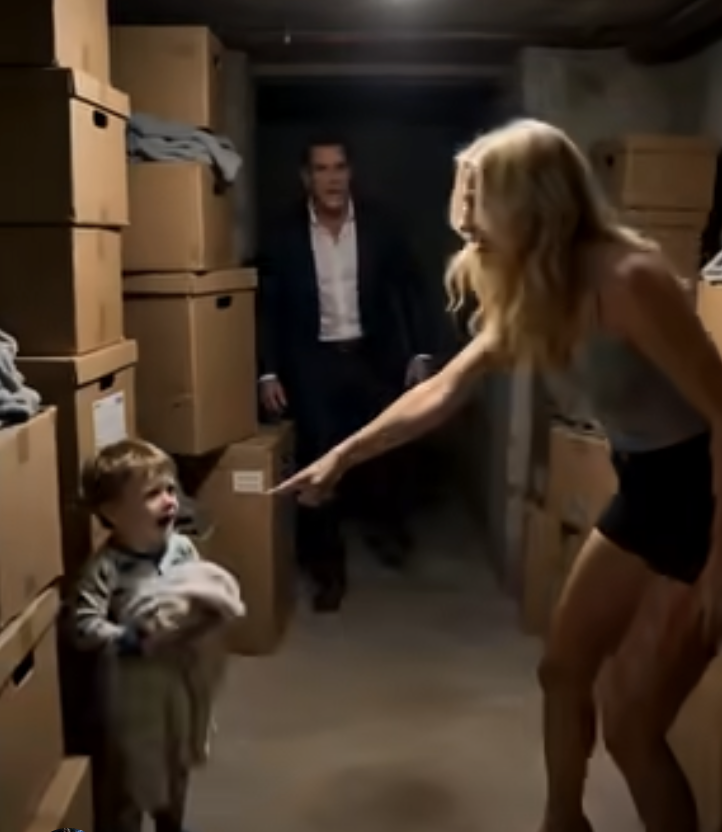
“You destroyed it,” I said.
She looked at me with cold triumph. “Your father knew.”
The world seemed to pause.
“What?”
Victoria smiled wider.
“Not everything. But enough. Marianne came to him first when she discovered she was pregnant. He paid her to disappear.”
The officers exchanged glances.
My lawyer, who had arrived behind me, stiffened.
Victoria tilted her head.
“Your sainted father was very clear. No scandal. No illegitimate heir. No threat to the Ashford name.”
I looked down at Elliot.
His small fingers were twisted into my lapel.
For years, I had worshipped my father’s memory. Built hospitals in his name. Repeated his advice in interviews. Tried to become the kind of man I thought he had been.
But the truth has a way of choosing fire over marble.
“Where is Marianne?” I asked.
Victoria’s smile faded.
Celeste answered through tears.
“She’s alive.”
My head snapped toward her.
“She came back,” Celeste said. “Three years ago. She tried to see you. Victoria told me she was unstable. Dangerous. She said Marianne would take everything.”
“Where is she?”
Celeste covered her mouth.
“Victoria had her committed.”
For the first time, Victoria shouted.
“That woman was hysterical!”
My lawyer stepped forward. “Where?”
Celeste gave us the name of a private psychiatric facility two counties away.
By midnight, the police had enough to arrest Victoria on charges that would ruin every polished room she had ever entered. Celeste was taken in too, though she cooperated, shaking and broken, confessing everything Victoria had ordered, everything she had allowed.
I did not stop them.
Love without courage is not love.
And whatever Celeste had been to me, she had chosen silence while children cried beneath our feet.
Two days later, I stood in a private hospital corridor holding Elliot’s hand.
He had not let go of me since the lake house.
Lily and Noah were with Daniel and a child therapist in the waiting room. They had both hugged Elliot that morning, crying apologies children should never have needed to make.
The doctor led us to a sunlit room.
A woman sat by the window.
Dark hair streaked with gray. Thin hands. Hollow cheeks.
But when she turned, her eyes filled with such fierce recognition that I knew her before she spoke.
“Adrian.”
The name broke on her lips.
Marianne Vale.
A memory returned then, sharp and painful.
A charity gala twelve years ago. A young violinist hired to play during dinner. Dark hair pinned loosely. Laughter in the service hallway after I escaped speeches and champagne. One night of tenderness during the loneliest year of my life, before Celeste, before duty swallowed me whole.
I had looked for Marianne afterward.
Victoria told me she had left the country.
I believed her.
God help me, I believed her.
Marianne’s eyes dropped to Elliot.
For one frozen second, mother and son stared at each other.
Then Elliot let go of my hand.
“Mommy?”
Marianne made a sound that was half sob, half prayer.
He ran to her.
She fell from the chair to her knees and caught him, rocking him, kissing his hair, saying his name again and again as if each repetition stitched life back into her body.
I turned away because some moments are too holy to watch directly.
But Marianne reached for me too.
“You didn’t know,” she whispered.
“No.”
“I wrote letters.”
“I never got them.”
“I came to the house.”
“I was told you were gone.”
She closed her eyes.
“Victoria.”
I nodded.
A week later, my father’s old private vault was opened by court order.
Inside were sealed letters from Marianne.
Hospital records.
A trust amendment my father had prepared but never filed.
And a video.
My father, months before his death, pale and frail, looking into the camera.
“If you are seeing this, Adrian,” he said, “then I failed to fix what I allowed. Victoria convinced me the child was not yours. I wanted to believe her because believing her was easier. By the time I learned the truth, I was dying, and Victoria controlled too much. I am sorry. The boy is yours. His name is Elliot. Find him. Protect him. Be better than I was.”
The recording ended.
I sat in the vault for a long time.
Not crying.
Not angry.
Just emptied.
Then Lily came in quietly and slipped her hand into mine.
“Daddy?”
“Yes, sweetheart?”
“Can Elliot have the room next to mine?”
That was when I cried.
Not because of what had been lost.
Because of what might still be saved.
The months that followed were not easy.
Happy endings, I learned, do not arrive like fireworks. They arrive like dawn—slowly, unevenly, after the longest night.
Celeste pleaded guilty and testified against Victoria. She lost custody, though the children were allowed supervised contact only after therapists agreed. I did not hate her. Hatred would have kept her too close. I simply let the law take her where my heart no longer could.
Victoria fought until the end.
She hired lawyers, claimed confusion, claimed stress, claimed devotion to the family. But the drawings, the recordings, the forged documents, the disabled cameras, and Marianne’s records buried every lie.
For the first time in Ashford history, our family name appeared in headlines not beside donations or mergers, but beside shame.
I did not pay to bury it.
I stood before cameras and told the truth.
“My wealth did not protect my children,” I said. “My power did not make me wise. I failed to see what fear had hidden inside my own home. From today forward, the Ashford Foundation will fund legal and psychological support for children trapped in abusive homes, no matter how wealthy or powerful those homes appear.”
Marianne watched from the side of the room, Elliot’s hand in hers.
When I stepped down, Elliot ran to me.
In front of every camera, he hugged my waist.
The photograph went around the world.
But the real miracle happened quietly.
It happened the first night Elliot slept with his door open and did not wake screaming.
It happened when Noah built a blanket fort and invited him in.
It happened when Lily taped a new drawing to the refrigerator.
In it, there was no blonde woman.
No locked door.
No basement.
Just five people standing under a yellow sun.
Me.
Lily.
Noah.
Elliot.
And Marianne.
At the bottom, in purple crayon, Lily had written:
No more dark rooms.
One year later, I sold the mansion.
People thought I would demolish it.
I didn’t.
I turned it into a children’s recovery center.
The basement was filled with windows cut into the foundation walls. Sunlight poured into the place where my children had once cried. The hidden room became an art studio.
On opening day, Elliot stood beside me holding a pair of oversized scissors for the ribbon.
“Are you ready?” I asked.
He looked up at me.
“Will kids be safe here?”
I swallowed hard.
“Yes.”
He nodded seriously.
“Then I’m ready.”
Marianne smiled from behind us. She was healthier now, stronger, though some sadness never fully leaves the eyes. We were not rushing into a fairy tale. Life had taught us too much for that. But we had dinner together every Sunday. We took the children to the park. We learned each other again, slowly, honestly.
Some love stories begin with flowers.
Ours began with evidence bags, courtrooms, and a child asking to be taken out of the dark.
But it was real.
That evening, after the ceremony, I found Elliot alone in the new art studio.
He was drawing.
I sat beside him.
“What are you making?”
He turned the paper toward me.
A house.
A smaller house than the mansion.
With blue shutters, a garden, and four children playing outside.
“Four?” I asked gently.
He pointed to the smallest figure.
“That’s a kid who hasn’t found us yet.”
My throat tightened.
“And what happens when they do?”
Elliot picked up a yellow crayon and drew the sun bigger.
“We open the door.”
I looked at my son, at the boy stolen from me by greed, fear, and lies.
Then I looked around the bright room that had once been built for darkness.
For the first time in years, I felt no ghost behind me.
Only light.
And when Elliot slipped his small hand into mine, I understood the truth my father had learned too late.
A family is not protected by hiding shame.
A family is saved by opening the door.
