The slap echoed louder than the music.
For one impossible second, nobody moved.
The backyard had been full of laughter a moment earlier. Children had been chasing each other around the folding tables. Someone’s uncle had been arguing with the grill. Plastic cups clinked. Music floated over the fence into the warm evening air.
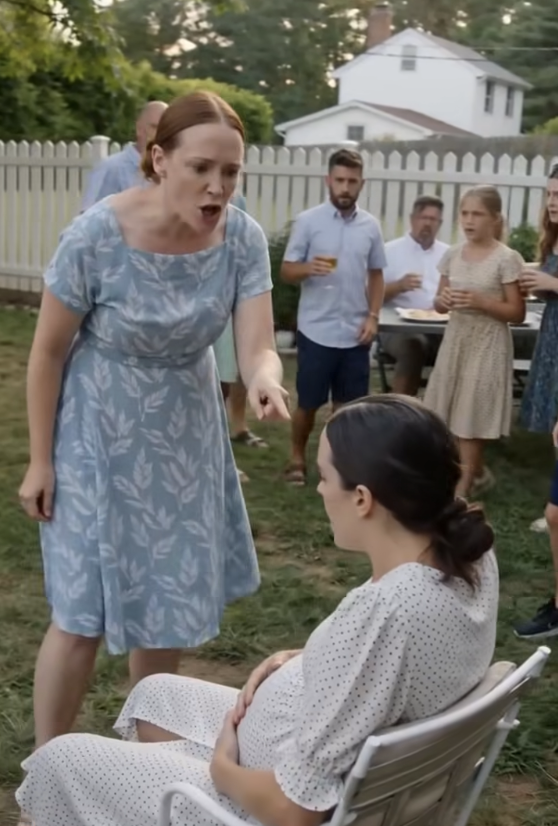
Then my mother-in-law’s hand struck my face.
And the whole world stopped.
I stood there with one palm pressed against my burning cheek, six months pregnant, dizzy from humiliation and pain, staring at the woman who had spent three years pretending I was the problem in her family.
“Marianne,” someone whispered.
But nobody stepped forward.
Not even my husband.
Daniel stood beside the drink table with his hands half-raised, like he had started to do something and forgotten how. His mouth was open. His eyes were wide. But he said nothing.
That silence hurt more than the slap.
My mother-in-law, Marianne Whitaker, stood over me in her cream linen dress, her pearl necklace trembling at her throat. She was seventy years old but carried herself like a queen who believed the whole neighborhood belonged to her. Even now, after hitting her pregnant daughter-in-law in front of forty people, her first expression was not shame.
It was outrage.
“How dare you talk back to me in my own home?” she snapped.
I tasted blood where my teeth had cut the inside of my lip.
“I sat down because my back hurt,” I said quietly.
“You sat in my chair.”
The absurdity of it made my eyes sting.
One chair.
An old cushioned patio chair with faded green stripes.
That was all it took.
I had arrived two hours earlier to help set up the backyard celebration for Daniel’s cousin, Andrew, who had just graduated from law school. I had hung string lights until my arms ached. I had arranged flowers. I had carried trays of sandwiches while Marianne corrected the angle of every napkin and told me pregnancy was not an illness.
By the time the guests arrived, my lower back felt like someone had tied a rope around my spine and pulled it tight.
So when I saw the empty chair beside the patio, I sat.
I did not know it was Marianne’s throne.
At first, when she came outside holding a glass of iced tea and froze at the sight of me, I thought she was joking.
“That is my chair,” she said.
“Oh, I’m sorry,” I replied, already starting to push myself up.
But moving while pregnant was not graceful. I needed a second.
That second offended her.
“Do not sit there like you own this house.”
I looked around at the dozens of empty chairs.
“Marianne, there are other seats. I just need to rest for a few minutes.”
Her eyes hardened.
The relatives nearby stopped talking.
“You do not tell me where I can sit in my own home.”
“I’m not telling you anything. I’m just tired.”
“Tired?” She laughed sharply. “You have been acting fragile since the day you married my son.”
Daniel heard that.
I knew he heard it.
He looked over.
And still, he stayed silent.
Marianne stepped closer.
“You think carrying a Whitaker child makes you important?”
My hand moved instinctively to my stomach.
“My baby is not a family trophy.”
The words came out before I could stop them.
That was when her face changed.
“You ungrateful outsider,” she hissed.
Then she slapped me.
The sound cracked through the backyard like a plate breaking.
My body swayed. Someone gasped. A child started crying.
And then, as Marianne jerked her hand back, her purse slipped from her elbow.
It hit the grass.
A folded document slid out and landed beside my sandal.
For some reason, my eyes went to it.
Maybe because everyone else was too stunned to move. Maybe because I needed something to focus on besides the heat spreading across my cheek. Maybe because fate sometimes waits for the cruelest moment to drop the truth at your feet.
I bent slowly and picked it up.
“Give me that,” Marianne said.
Her voice had changed.
The anger was gone.
Fear had taken its place.
I looked at the paper.
Across the top, in bold black letters, was the name:
ROSE ELLIOT WHITAKER.
My breath caught.
Rose.
That was my name.
My maiden name was Rose Elliot.
But I had never been Rose Elliot Whitaker.
Not until I married Daniel.
The date on the document was twenty-seven years old.
Older than my marriage.
Older than my relationship.
Older than the first time I had ever stepped into this family’s house.
I unfolded the paper with shaking hands.
Marianne lunged toward me, but Daniel finally moved.
“Mom,” he said, grabbing her wrist. “What is that?”
“Nothing,” she snapped. “Private family business.”
Private family business.
Those words landed strangely.
Because my name was on the page.
I read the first line.
Then the second.
Then the third.
The backyard blurred around me.
It was an adoption petition.
Not mine.
Daniel’s.
My husband’s full birth name was printed there.
Daniel Rose Elliot.
Changed to Daniel James Whitaker.
I stared at him.
He stared back at me.
His face had gone pale.
“What is this?” he asked.
Marianne’s lips parted, but no sound came out.
Daniel took the document from my hand.
His eyes moved across the page.
I watched the man I loved read his own life for the first time.
“No,” he whispered.
His father, Harold, came forward from near the grill. Harold was a quiet man, always soft-spoken, always standing behind Marianne as if her shadow had swallowed him years ago.
But now he looked older than I had ever seen him.
“Marianne,” he said, voice breaking. “You kept that?”
“Harold, be quiet.”
Daniel turned to him.
“Dad?”
Harold closed his eyes.
That was answer enough.
The crowd began murmuring.
Cousin Andrew stepped closer.
“Aunt Marianne, what is going on?”
Marianne straightened, clutching her purse against her chest.
“This is not for public discussion.”
“You hit my wife in public,” Daniel said.
His voice was low.
For the first time that day, he sounded like a husband.
For the first time in years, Marianne looked at him and did not see an obedient son.
She saw a man about to leave her control.
“Daniel,” she said, softening instantly. “Come inside. We will talk.”
“No. We’ll talk here.”
My heart pounded so hard I could feel it in my stomach.
The baby moved, a small kick beneath my palm.
Daniel looked at me, then at the red mark on my face.
Something shattered behind his eyes.
“I’m sorry,” he whispered.
It was not enough.
But it was the first crack in the wall.
Harold took a trembling breath.
“Daniel, your biological mother was named Rose Elliot.”
I stopped breathing.
Daniel looked at me again.
My name.
My exact name.
“That’s impossible,” he said.
Harold shook his head.
“She was young. Seventeen. She worked at the old pharmacy downtown. She got pregnant and disappeared after giving birth. Marianne and I had been trying for a child for years. We adopted you.”
“Why didn’t you tell me?”
Marianne snapped, “Because you were ours.”
“No,” Daniel said. “You lied.”
“I protected you.”
“From what?”
Her eyes flicked toward me.
It was so quick most people missed it.
I did not.
A chill went through me.
Harold saw it too.
“Marianne,” he warned.
But she was unraveling now.
She looked at me with hatred so old and deep that it seemed impossible I had only been in her life for three years.
“You have no idea what that name did to me,” she said.
“My name?” I asked.
“You walked into my house with her face.”
Silence fell again.
Daniel stepped closer to me.
“What does that mean?”
Marianne laughed once, bitter and broken.
“The first time you brought her home, I knew. Same eyes. Same mouth. Same quiet little wounded expression. Rose Elliot had come back to take from me again.”
My legs weakened.
I gripped the back of the cursed chair.
Harold whispered, “Stop.”
But Daniel did not let her.
“Take what?”
Marianne’s eyes filled with tears, but they were not soft tears. They were sharp, selfish tears.
“You,” she said. “She gave birth to you, and then everyone treated her like a saint. Poor Rose. Brave Rose. Beautiful Rose. Even after she vanished, your father kept her picture.”
Harold flinched.
Daniel turned to him.
“You had a picture?”
Harold looked at the grass.
“She was your mother.”
Marianne’s voice rose.
“She was a girl who abandoned him!”
“She was a girl your family threatened,” Harold said suddenly.
The words came like thunder.
Marianne froze.
Harold’s face twisted with years of swallowed shame.
“I stayed silent long enough.”
“Harold,” she said dangerously.
“No.” His voice shook, but he did not stop. “You told everyone Rose left because she didn’t want Daniel. That was never true.”
Daniel’s hand found mine.
Cold fingers. Trembling.
“What happened?” he asked.
Harold looked at me, then at my stomach, then at Daniel.
“Rose wanted to keep you.”
The backyard seemed to tilt.
“She came to the house after you were born,” Harold continued. “She begged to see you. Marianne’s mother told her she was unfit. Marianne told her that if she ever came near you again, the family would accuse her of neglect and have her arrested. Rose was poor. Alone. Terrified.”
Marianne’s face hardened again.
“She would have ruined his life.”
“You ruined hers,” Harold said.
For the first time, Marianne had no quick answer.
Daniel’s voice was barely audible.
“Did she know where I was?”
Harold nodded slowly.
“She wrote letters.”
My stomach dropped.
“Letters?” Daniel said.
Marianne clutched her purse tighter.
“She was unstable.”
Harold pointed at the purse.
“Is that why you still carry the documents? Because you were afraid someone would find what you did?”
Daniel stepped toward his mother.
“Where are the letters?”
Marianne backed away.
“There are no letters.”
Harold said, “There were boxes of them.”
A sound escaped Daniel that I had never heard before.
Not a sob.
Not a shout.
Something in between.
All the years of being told his mother’s love was sacrifice. All the years Marianne made him choose her feelings over everyone else’s. All the times she called me an outsider, a threat, a woman trying to steal her son.
Now we knew why.
She had built motherhood on theft.
And every day since, she had lived terrified the truth would sit down in her favorite chair.
Daniel turned to me.
“Rose…”
My own name sounded different in his mouth now.
I looked at the adoption petition again.
Rose Elliot.
I had been named after my grandmother.
My father’s mother.
A woman nobody talked about much because, according to family stories, she had died young after “a hard life.”
My father rarely spoke of his sister.
His missing sister.
My chest tightened.
“What was Daniel’s birth mother’s full name?” I asked Harold.
He looked at me carefully.
“Rose Marianne Elliot.”
I covered my mouth.
Marianne.
My grandmother had named her daughter after the woman who destroyed her?
No.
Not grandmother.
I searched memory like a drawer full of broken glass.
My father once showed me an old photograph when I was little. A teenage girl sitting on a porch, dark hair blowing across her face, laughing at something outside the frame.
“That’s Aunt Rosie,” he had said. “She disappeared before you were born.”
Aunt Rosie.
Rose Elliot.
Daniel’s biological mother.
My knees almost buckled.
Daniel gripped my arm.
“What is it?”
I looked at him, horror and wonder colliding inside me.
“Daniel,” I whispered. “Rose Elliot was my aunt.”
The words rolled across the backyard like a storm.
People gasped.
Someone said, “Oh my God.”
Daniel stared at me.
For one terrifying second, I saw the same question in his eyes that flashed through mine.
Were we related too closely?
Harold understood immediately.
“No,” he said quickly. “Rose was your aunt?”
I nodded, tears spilling now.
“My father’s sister.”
Harold’s face crumpled.
“Then Daniel is your cousin.”
The world narrowed.
My husband.
My baby.
My marriage.
My breath came in shallow bursts.
But then Harold added, “Not by blood.”
Everyone looked at him.
Marianne made a strangled noise.
Harold swallowed.
“Rose was adopted into the Elliot family as a toddler. She was not biologically related to them.”
My hand pressed harder to my stomach.
The baby kicked again, as if demanding the truth arrive faster.
“How do you know that?” I asked.
“Because Rose told us when she signed the papers,” Harold said. “She said the Elliots were the only real family she had ever known.”
I closed my eyes.
Not blood.
But family.
Lost family.
Stolen family.
Daniel was the child my family had searched for in whispers for twenty-seven years.
My father had once cried in the garage on Rose’s birthday.
I had never understood why.
Now I did.
Marianne suddenly moved.
She turned toward the house.
Daniel blocked her.
“Where are the letters?”
“You will not speak to me like I am a criminal.”
“You hit my pregnant wife,” he said. “You lied about my mother. You stole her letters. Where are they?”
Her mask finally slipped completely.
Her mouth twisted.
“She gave you away.”
“No,” I said.
My voice surprised even me.
It was calm.
Clear.
Deadly.
“You took him.”
Marianne looked at me as if she wanted to slap me again.
But this time, Daniel stood between us.
And behind him stood Harold.
Then Andrew.
Then Daniel’s sister, Claire.
Then half the family.
The silence was no longer fear of Marianne.
It was judgment.
Marianne saw it.
Her kingdom had collapsed in her own backyard.
Harold removed a small key from his pocket.
“She keeps old papers in the cedar chest upstairs.”
Marianne screamed his name.
But Daniel was already walking toward the house.
I followed.
Every step felt like walking through someone else’s nightmare.
The cedar chest sat at the foot of Marianne’s bed, polished and locked, like a coffin for buried truths. Harold opened it.
Inside were photo albums, yellow envelopes, baby blankets, and a bundle of letters tied with blue ribbon.
Daniel reached for them like they might burn him.
The first envelope was addressed in careful handwriting.
To my son, Daniel, for when they finally tell you the truth.
Daniel sat on the edge of the bed.
His hands shook so badly he could barely open it.
I sat beside him.
Outside, the party murmured like a distant sea.
He read silently at first.
Then aloud.
“My sweet boy, if you are reading this, then someone was kinder than they promised to be…”
His voice broke.
Rose had written every year.
On birthdays.
On Christmas.
On the day he started kindergarten, though she had never seen him walk through the school doors.
She wrote that she had not abandoned him.
She wrote that she had been told she would ruin him.
She wrote that she was saving money.
That she was trying to become someone worthy enough to return.
Then the letters changed.
The handwriting weakened.
The pages became shorter.
“My heart is tired,” one said.
“I do not know how much time I have.”
The final letter was dated two months before her death.
Daniel could not read that one aloud.
He handed it to me.
I unfolded it.
My dear son,
I have loved you every day they kept you from me.
If you ever feel unwanted, remember this: I wanted you so much it almost killed me to walk away.
There is one thing I left for you. Your grandmother helped me hide it because she was afraid the Whitakers would take that too.
A small house on Bell Street.
It is not much, but it is yours.
A home should belong to the child, not the people who control him.
I hope one day you sit in it freely.
I hope nobody ever makes you stand up from a place where you deserve to rest.
Rose Elliot.
I covered my mouth and sobbed.
The chair.
The favorite chair.
The whole day had circled back to one sentence from a dead woman.
A home should belong to the child.
Nobody should make you stand up from a place where you deserve to rest.
Daniel took the letter and held it to his chest.
Then he looked at me.
“I spent my whole life thinking love meant obedience.”
I touched his face gently.
“So did I, for a while.”
He looked toward the door, where Marianne stood frozen in the hallway.
No tears now.
Only defeat.
“What happened to the house on Bell Street?” he asked.
Marianne’s face gave the answer before her mouth did.
Daniel rose slowly.
“What did you do?”
Harold whispered, “Marianne…”
She lifted her chin.
“We used it.”
“For what?”
“To pay debts.”
Daniel stared at her.
“She left me a house?”
“You were a baby.”
“It was mine.”
“You had everything you needed!”
“I needed the truth.”
That finally silenced her.
The legal aftermath could have destroyed Marianne completely.
And maybe part of me wanted it to.
But life, I learned, has a strange way of delivering justice in layers.
Andrew, the cousin whose celebration had become a courtroom, quietly contacted a real attorney the next morning. Not a family friend. Not one of Marianne’s admirers. Someone outside the Whitaker circle.
Within weeks, we learned that the Bell Street house had not been sold cleanly. Marianne had forged documents. Harold had suspected but never proven it. The property had been transferred through a chain of family accounts, then rented out for years.
The current value was far beyond what anyone expected.
And because Daniel had never legally signed away his rights, the case was strong.
Marianne fought at first.
She called Daniel ungrateful.
She called me manipulative.
She told relatives I had staged the whole thing, as if I had somehow planted a twenty-seven-year-old adoption file in her purse and made her slap me in front of everyone.
But nobody believed her anymore.
The crowd had seen the truth fall out with their own eyes.
Three months later, Daniel and I stood outside the house on Bell Street.
It was small.
White siding. Blue shutters. A porch with two wooden chairs.
One of them had faded green cushions.
Daniel laughed when he saw them, then cried so suddenly I had to hold him.
“This was hers,” he said.
“Our baby’s great-aunt,” I whispered. “Your mother.”
He nodded.
“And your aunt.”
Life had folded in a way too strange to explain simply.
But there was no darkness in it now.
Only a family finding its missing branch.
My father came with us that day.
He stood on the porch for a long time, holding Rose’s letters. When Daniel opened the door, my father touched his shoulder.
“You have her eyes,” he said.
Daniel broke down.
So did my father.
They held each other like two pieces of the same grief finally reunited.
We restored the house slowly.
Not as a museum.
As a home.
Daniel insisted on putting Rose’s final letter in a frame near the entryway.
Not the whole letter.
Just one sentence.
Nobody should make you stand up from a place where you deserve to rest.
When our daughter was born, we named her Lily Rose.
She arrived on a rainy morning in October with a furious cry and tiny fists that seemed ready to fight the world.
Daniel held her like she was made of light.
“I will never make you earn your place,” he whispered to her. “Never.”
Marianne never met Lily in those first months.
That was Daniel’s decision.
Not mine.
He went to therapy. So did Harold. So did I.
Healing was not dramatic. It was quiet. It looked like Daniel learning to say no without shaking. It looked like me learning that forgiveness did not require access. It looked like Harold moving into a small apartment and cooking dinner for himself for the first time in forty years.
Marianne eventually wrote a letter.
Not an apology.
A performance.
Daniel read three lines and set it down.
“She still thinks losing control is the same as being abandoned,” he said.
I took his hand.
“Maybe one day she’ll understand the difference.”
“Maybe,” he said. “But not at our daughter’s expense.”
A year after the slap, we hosted Lily’s first birthday in the backyard of the Bell Street house.
Not Marianne’s backyard.
Ours.
There were string lights, paper lanterns, bowls of fruit, children running across the grass, and music drifting into the warm air.
My father brought an old photo of Aunt Rose.
Harold brought a wooden rocking horse he had made by hand.
Claire brought cake.
Andrew made a toast and joked that no one was allowed to claim a favorite chair unless they were over ninety or under two.
Everyone laughed.
Daniel looked at me from across the yard.
I was sitting on the porch in one of the green-cushioned chairs, Lily asleep against my chest.
For a second, the memory returned.
The slap.
The silence.
The paper at my feet.
But then Daniel came over, knelt beside me, and touched Lily’s tiny hand.
“You comfortable?” he asked.
I smiled.
“Yes.”
He looked at the chair, then at the house, then at our daughter.
“Good,” he said. “Stay as long as you want.”
And for the first time in years, I did not feel like an outsider in someone else’s family.
I felt rooted.
I felt chosen.
I felt home.
Later that evening, after the guests had left and the lanterns swayed gently in the dark, Daniel found one final envelope hidden inside the lining of the cedar chest Harold had given us.
It was not addressed to Daniel.
It was addressed to me.
To the woman who carries his future.
My hands trembled as I opened it.
Inside was a small pressed flower and one short note in Rose Elliot’s handwriting.
If my son ever finds love, I pray she is braver than I was allowed to be.
I pray she sits down when she is tired.
I pray she stays.
Daniel read it over my shoulder.
Neither of us spoke for a long time.
Then Lily stirred in her crib, making a tiny sound from the next room.
Daniel kissed my forehead.
“She knew you,” he whispered.
I looked at the note, at the flower, at the house that had waited decades to breathe again.
“No,” I said softly. “She hoped for me.”
And that was the real twist.
The paper that fell at my feet did not just expose Marianne’s cruelty.
It gave Daniel back his mother.
It gave my father back his sister.
It gave my daughter a legacy.
And it gave me the one thing Marianne had tried hardest to deny me.
A place.
Not borrowed.
Not tolerated.
Not conditional.
Mine.
