The first time the backyard flooded, I thought it was bad luck.
The second time, I thought it was neglect.
By the fifth time, standing barefoot in three inches of muddy water while rain drummed against the kitchen windows, I understood the truth.
No one in that house cared what happened to me as long as I kept quiet.
Water had swallowed the entire yard again. It pooled against the back steps, crept under the laundry room door, and soaked the cardboard boxes I had stacked there because my husband, Daniel, said we would “organize the garage later.”
Later was Daniel’s favorite word.
Later, he would fix the leaking faucet.
Later, he would talk to his mother about respecting boundaries.
Later, he would stop letting her treat me like a guest in my own marriage.
His mother, Evelyn Whitmore, had lived with us since her hip surgery two years earlier. At least, that was the official story. The truth was that she had never really left the house.
She had raised Daniel there. She knew every floorboard, every cabinet hinge, every old rosebush planted along the fence. She called it “my home” even though Daniel’s name was on the deed.
And me?
I was the woman who had married her son and ruined the arrangement.
That Saturday morning, after another storm, I found Daniel in the kitchen scrolling through his phone.
“The yard is flooding again,” I said.
He didn’t look up. “I’ll call someone next week.”
“You said that last month.”
“I’ve been busy.”
I stared at him. His coffee steamed between us. Behind him, Evelyn sat at the table in her robe, spreading marmalade on toast as if she were queen of a country nobody else could enter.
“You shouldn’t touch the yard anyway,” she said.
I turned toward her. “The water is coming into the house.”
“It has survived worse than you.”
Daniel sighed. “Claire, don’t start.”
That was when something inside me went very still.
Not angry.
Not loud.
Just still.
I went upstairs, changed into old jeans and boots, tied my hair back, and walked to the shed.
The shovel was rusted, heavy, and colder than I expected.
By the time I dragged it across the grass, Evelyn was already on the porch.
“What do you think you’re doing?” she demanded.
“Digging a drainage trench.”
“You have no right.”
“This is my home too.”
Her mouth twisted. “That is something women like you love to say.”
I ignored her.
The first cut into the earth was satisfying. Wet soil peeled apart beneath the shovel blade. The trench only needed to guide the water toward the gravel ditch beyond the fence. It was simple. Practical. Fixable.
Unlike my marriage.
Evelyn kept talking.
“You’ll ruin the grass.”
I dug.
“You don’t even know where the old pipes are.”
I dug deeper.
“Daniel’s father would never have allowed this.”
At that, my hands paused.
Daniel’s father, Harold, had died when Daniel was twelve. In that house, he was spoken of like a saint and a warning. According to Evelyn, Harold had worked himself to death to buy the property. Harold had loved the yard. Harold had wanted Daniel to keep the house forever.
Whenever I suggested selling it and moving somewhere that felt like ours, Evelyn would touch the wall as if comforting a wounded animal.
“His father died for this place,” she would whisper.
And Daniel would close the conversation.
I struck the shovel down harder.
An hour later, my back ached and my palms burned. The trench had begun to take shape, a dark line opening through the soaked lawn.
Then the shovel hit something.
Clang.
The sound was wrong.
Not stone.
Metal.
I crouched and scraped mud away with my gloved fingers. A corner emerged. Blackened. Rusted. Flat.
A box.
It was buried deep, wrapped in roots and packed soil, as if the earth had spent years trying to swallow it whole.
“What is that?” Evelyn called from the porch.
I didn’t answer.
I dug around it, heart beginning to pound.
The box was larger than a shoebox, with a corroded latch and a dented lid. When I pulled it free, mud released it with a wet sucking sound.
That was when Evelyn screamed.
“Leave it!”
I looked up.
She was no longer on the porch.
She was running.
I had never seen Evelyn run. Not with her bad hip. Not with her proud, stiff posture. But she crossed that yard like a woman chased by fire.
“Put it back!” she shrieked.
“What is it?”
“Garbage!”
“Then why are you terrified?”
Her face changed.
For one second, I saw something naked in her expression.
Fear.
Then her hand flew.
The slap cracked across my cheek so hard my vision flashed white. I slipped backward and fell into the trench, one boot twisting under me, mud soaking through my jeans.
The shock hurt worse than the slap.
For a moment, all I could do was stare up at her.
Evelyn stood over me, breathing hard, her fingers trembling.
Then the back door burst open.
“What the hell is going on?” Daniel shouted.
I pushed myself up slowly. Mud ran down my arms. My cheek burned.
“Your mother hit me,” I said.
Evelyn pointed at the box. “She’s destroying the yard! She dug up trash!”
Daniel looked at me, then at the box.
Something about his face shifted. Maybe it was the mud on me. Maybe it was the red mark on my cheek. Maybe, finally, he heard the fear in his mother’s voice.
“What’s in it?” he asked.
“Nothing,” Evelyn said quickly. “Leave it alone.”
Daniel stepped closer.
“Daniel,” she whispered. “Please.”
That word stopped him.
Please.
His mother never begged.
He knelt beside the box and pulled at the latch. It resisted. He grabbed the shovel and struck the rusted edge twice. The lid groaned open.
Inside were envelopes.
Dozens of them.
Old photographs.
And a stack of legal documents wrapped in thick plastic.
The rain had preserved nothing above ground, but beneath the soil, the box had kept its secrets dry.
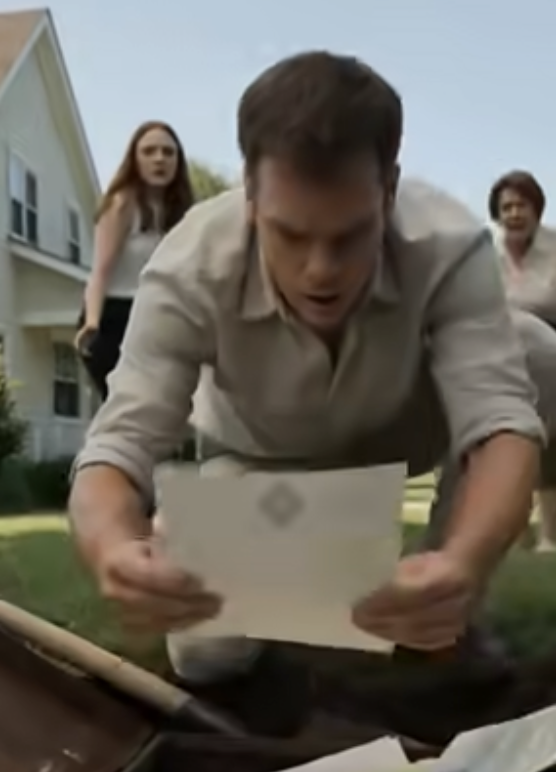
Daniel picked up the first photograph.
A younger Evelyn stood beside a man none of us recognized. He was tall, with dark hair, gentle eyes, and one arm around her shoulders. Behind them was the same backyard, decades younger. The oak tree was thinner. The porch was painted blue.
On the back, in faded ink, someone had written:
Evelyn and Samuel, summer 1989.
Daniel frowned. “Who is Samuel?”
Evelyn said nothing.
He opened the top document.
His fingers went rigid.
I watched his eyes move across the page once, then again, as if the words might rearrange themselves into something less devastating.
“What is it?” I asked.
He looked at his mother.
“If Dad bought this house,” he said slowly, “why does this document say it belonged to someone else until the day he died?”
Evelyn backed away.
The yard went silent except for dripping water.
Daniel pulled out another page. Then another.
A deed.
A will.
A birth certificate.
A marriage certificate.
The name Samuel Whitmore appeared again and again.
Not Harold.
Samuel.
Daniel’s face turned gray.
“Mom,” he said. “Who was Samuel Whitmore?”
Evelyn’s lips parted, but no sound came out.
Then I saw the birth certificate in Daniel’s hand.
His name was printed there.
Daniel Samuel Whitmore.
Father: Samuel Whitmore.
Mother: Evelyn Whitmore.
Daniel staggered back as if the paper had struck him.
“No,” he whispered.
Evelyn began crying.
Not her usual theatrical tears. Not the soft sobs she used to win Daniel’s sympathy.
These were ugly, broken sounds.
“I did it for you,” she said.
Daniel stared at her. “What did you do?”
She covered her mouth.
“What did you do?” he shouted.
The words spilled out of her in pieces.
Samuel had been Daniel’s real father. He had owned the house. He had been kind, quiet, and deeply in love with Evelyn.
Harold had not been Daniel’s father.
He had been Samuel’s older half-brother.
When Samuel died suddenly in a “boating accident,” Harold moved in to help the grieving widow. Six months later, Evelyn married him.
But the documents in the box told a different story.
Samuel had known something was wrong before he died.
He had written a will leaving the house not to Evelyn, but to Daniel, held in trust until adulthood. He had also written letters to an attorney, saying he feared Harold was pressuring Evelyn to sign away property Samuel had inherited from his grandmother.
Daniel opened one of the envelopes.
The handwriting was careful, slanted, full of tenderness.
My son,
If you are reading this, then I was not allowed to tell you myself. This house is yours. Not because of money, but because every nail, every tree, every morning light through the kitchen window belongs to the life I hoped to build with you.
Trust the woman who comes into your life and tells you the truth, even if the truth hurts.
Daniel stopped reading.
His eyes lifted toward me.
My breath caught.
Evelyn sank onto the porch steps.
“I didn’t kill him,” she whispered.
Nobody had said she did.
Daniel’s voice dropped. “Then why did you say that?”
Her face crumpled.
That was when the final envelope slipped from the stack.
It was sealed in plastic. On the front, written in the same handwriting, were three words:
For Claire someday.
My blood went cold.
Daniel turned toward me.
“For Claire?” he said.
I shook my head. “That’s impossible.”
I had never met Samuel. I had not even known his name until five minutes earlier.
Daniel tore the plastic open.
Inside was a photograph.
Not of Evelyn.
Not of Samuel.
Of a baby wrapped in a yellow blanket.
On the back:
Clara, born March 3. Keep her safe.
The world tilted.
My full name was Claire Clara Bennett before marriage. Clara had been my grandmother’s name. My mother had always said she chose Claire because Clara felt “too old-fashioned,” but my birth certificate listed both.
Daniel pulled out a letter.
His voice broke as he read.
Evelyn,
If anything happens to me, you must tell Daniel the truth. And you must tell him about Clara. She is not my shame. She is my daughter. Her mother cannot raise her safely, and I have arranged for the Bennett family to take her in until I can bring her home.
I know Harold hates what he cannot control. I know he watches you. I know you are afraid.
But one day Daniel and Clara may find each other.
If they do, do not punish them for surviving what we could not.
The yard spun around me.
“No,” I whispered.
Daniel looked at me with horror.
Evelyn began shaking her head violently. “I didn’t know who she was when you brought her home. I swear I didn’t know at first.”
“At first?” Daniel said.
The words were sharp enough to cut.
Evelyn sobbed harder.
She had discovered it three months before our wedding.
She had found my old adoption paperwork while helping Daniel move boxes. My birth date. My middle name. The Bennett family. It had all matched Samuel’s letter.
She realized I was Samuel’s daughter.
Daniel’s half-sister.
My stomach turned.
I stumbled backward.
“No,” I said again, because it was the only word I had.
Daniel dropped the papers as if they burned him.
For several seconds, no one moved.
Then Evelyn screamed, “I was trying to protect you!”
“From what?” Daniel roared. “From marrying my sister?”
Her face twisted.
“No. From losing everything.”
That sentence landed strangely.
Daniel froze.
“What?”
Evelyn wiped her face with muddy hands.
“You don’t understand. Samuel was not your father either.”
The silence after that was worse than the scream.
Daniel looked at her as if she had become a stranger wearing his mother’s skin.
Evelyn reached into the box with trembling fingers and pulled out the last document.
A DNA report.
Old, yellowed, dated before Samuel’s death.
Daniel took it.
Read it.
Stopped breathing.
Samuel Whitmore was not Daniel’s biological father.
Harold was.
Evelyn confessed the rest.
She had been married to Samuel, but Harold had assaulted and controlled her long before Daniel was born. When she became pregnant, Samuel chose to raise Daniel as his own. He loved him completely. Harold, however, discovered the truth and used it like a weapon.
Samuel planned to leave everything to both children: Daniel, whom he loved as his son, and Clara, his biological daughter from a brief relationship during a separation from Evelyn.
Then Samuel died.
Evelyn always suspected Harold had something to do with it, but she had no proof. Harold forced her to bury the box and told her that if Daniel ever learned the truth, he would destroy her, expose her, and take Daniel away.
So she buried the box.
Then she buried the truth.
And over the years, fear hardened into cruelty.
Daniel sat down in the wet grass.
I did too.
We were not siblings.
But something almost worse had happened.
We had built a marriage inside a house full of ghosts, while Evelyn silently punished me for being Samuel’s daughter—the child who reminded her of the man who had loved her better than the man she had obeyed.
Daniel looked at me, tears in his eyes.
“I should have protected you.”
I wanted to be angry. Part of me was. But beneath it was grief so large it left no room to speak.
Sirens arrived twenty minutes later.
Not because we called them.
Because our elderly neighbor, Mrs. Alvarez, had seen Evelyn slap me and had called the police.
When the officers came, Evelyn did not resist. She looked small now, smaller than I had ever seen her, wrapped in a shawl on the porch while rain began again.
The legal investigation took months.
The documents proved Samuel’s will had been hidden. The house had legally belonged to Daniel in trust, then partially to me once my identity as Samuel’s biological daughter was confirmed. Harold had stolen, forged, and manipulated everything before his death.
But the greatest shock came from Mrs. Alvarez.
She had kept something too.
A cassette tape.
Samuel had given it to her the week before he died, afraid his letters might disappear. On it, he spoke calmly about Harold’s threats, Evelyn’s fear, Daniel’s future, and the baby girl named Clara.
At the end, his voice softened.
“One day,” he said, “the truth will come up from the ground. Things buried with love do not rot. They wait.”
I listened to that line again and again.
Then I cried for a father I never knew.
A year later, the backyard no longer flooded.
Daniel dug the new drainage system himself.
I stood beside him, holding a glass of lemonade, watching him work under the same oak tree Samuel had planted.
We had nearly lost each other in that yard.
But the truth, terrible as it was, had not destroyed us.
It had freed us.
Evelyn moved into a small assisted-living home after pleading guilty to fraud connected to the hidden estate documents. Daniel visited her sometimes. I did not.
Not because I hated her.
Because peace had boundaries.
The house was restored under Samuel’s name. Half belonged to me. Half belonged to Daniel. Together, we turned the old porch blue again, just like in the photograph.
In the spring, I planted yellow flowers along the trench.
Daniel watched me from the steps.
“Why yellow?” he asked.
I smiled, touching the petals.
“Because of the blanket.”
He understood.
That evening, as sunset spilled gold across the yard, Daniel brought out the metal box. Cleaned now. Empty except for one new envelope.
“What’s that?” I asked.
He handed it to me.
On the front, he had written:
For the child who comes next.
Inside was a letter.
Not about secrets.
Not about fear.
About truth.
About love.
About the grandfather named Samuel who had waited beneath the soil until the right woman picked up a shovel and refused to stop digging.
I looked at Daniel through tears.
For the first time since I had entered that house, it felt like home.
Not Evelyn’s home.
Not Harold’s lie.
Not even Samuel’s unfinished dream.
Ours.
And when rain fell that night, the water flowed exactly where it was supposed to go.
Away from the house.
Away from the past.
Leaving the ground clean enough for something new to grow.
