The first thing I heard after my body hit the bottom step was my mother-in-law screaming my name.
Not because she was afraid for me.
Because she was afraid someone had seen.
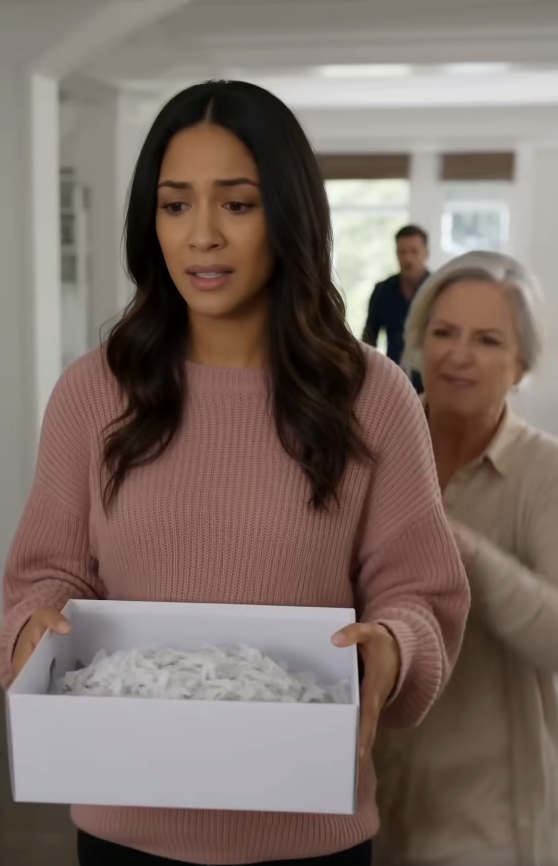
For one frozen second, the whole house seemed to stop breathing. The box I had been carrying lay split open beside me, old baby clothes spilling across the marble floor like tiny ghosts. My hand was pressed against my stomach. My ears rang. My mouth tasted like metal.
And above me, at the top of the staircase, Margaret Whitmore stood with both hands clutched dramatically to her chest.
“Oh my God,” she cried. “She slipped! I tried to catch her!”
I could not speak.
I could barely think.
All I knew was pain.
Pain in my hip. Pain in my ribs. Pain tearing through my lower back. But worse than all of it was the cold terror pulsing under my palm.
My baby.
Seven months pregnant, and all I could do was whisper, “Please. Please move. Please.”
My husband, Daniel, reached me first.
“Emily!” His voice cracked as he dropped to his knees beside me. “Don’t move. Don’t move, okay? Look at me.”
I tried. His face blurred above me.
Behind him, relatives crowded the hallway. Aunt Claire was crying. Uncle Robert kept saying someone should call an ambulance. Daniel’s cousin Vanessa stood frozen with both hands over her mouth.
And Margaret kept sobbing.
“She lost her balance,” she said. “I told her not to carry that box. I told her!”
The lie was so bold that even through the pain, I felt something inside me shatter.
She had asked me to carry it.
She had insisted.
She had looked me directly in the eyes and called me lazy in front of everyone.
And then, when I reached the top step, she had followed me.
Two hands.
Hard against my back.
Daniel turned toward her, his face pale with shock. “Mom… what happened?”
Margaret pressed a trembling hand to her forehead. “She wouldn’t listen to me. I told her the stairs were dangerous. I reached for her, but she slipped before I could—”
“No,” I breathed.
The word was so weak nobody heard it.
Daniel leaned closer. “Em?”
I swallowed against the pain. “She pushed me.”
The hallway went silent.
Margaret’s crying stopped for half a second.
Then she exploded.
“How dare you?” she shrieked. “How dare you say that after I tried to save you?”
Aunt Claire gasped. Someone muttered my name in disbelief.
Daniel looked between us, torn in a way that almost hurt more than the fall. He loved me. I knew he did. But Margaret had spent thirty-two years training him to doubt anyone who stood against her.
Especially me.
From the moment Daniel brought me home, Margaret decided I was not good enough. I was too quiet, then too opinionated. Too thin, then too swollen. Too independent, then too needy. When I became pregnant, her dislike sharpened into something colder.
She called the baby “my grandchild,” never “your baby.”
She rearranged the nursery without asking.
She threw away the name list I made and replaced it with one full of Whitmore family names.
Once, when Daniel was out buying groceries, she placed her palm on my stomach and whispered, “You’re just the vessel.”
I told Daniel.
He confronted her.
She cried for three hours and said pregnancy hormones were making me cruel.
After that, I stopped telling him everything.
The ambulance sirens wailed in the distance.
Daniel held my hand, but his eyes kept flicking toward his mother.
Margaret noticed.
She softened her voice instantly. “Danny, sweetheart, you know me. I would never hurt the baby.”
The baby.
Not me.
Never me.
Daniel’s jaw tightened.
Then something shifted in his expression.
His eyes moved past Margaret, past the staircase, toward the upper corner of the hallway wall.
At first, I didn’t understand.
Then I remembered.
The camera.
Two weeks earlier, Daniel had installed a small security camera after packages kept disappearing from our porch. He had tested extra angles inside the house too, including one near the staircase, because Margaret had been complaining that delivery workers were “wandering around.”
She had laughed at it.
“What kind of people need cameras inside their own home?” she had said.
Then she forgot it existed.
Daniel slowly stood.
Margaret followed his gaze.
Her face changed so completely that the room seemed to notice before she spoke.
“Daniel,” she said carefully. “Don’t.”
He stared at her. “Don’t what?”
Her lips trembled. “This is not the time.”
“You said she slipped.”
“She did.”
“Then the camera will show that.”
Margaret reached for his arm. “Your wife is hurt. You should ride with her.”
“I will,” Daniel said. “After I see what happened.”
The paramedics arrived before he could touch the remote. They placed me on a stretcher, checked my vitals, asked questions I answered through clenched teeth. Was I bleeding? Could I feel movement? Did I hit my head?
Daniel stayed beside me until they lifted me toward the door.
But as they rolled me past the living room, I saw him grab the remote from the coffee table.
The television flashed on.
The room filled with shaky silence.
Even the paramedics paused for half a breath.
The footage appeared in grainy color: the upstairs hallway, the staircase, me standing at the top with both hands around the box.
Margaret behind me.
Not reaching to help.
Not warning me.
Waiting.
The whole family watched as she glanced over her shoulder to make sure no one else was upstairs.
Then she stepped forward.
Both hands rose.
She shoved me.
Hard.
A collective sound broke from the room.
Aunt Claire screamed.
Vanessa said, “Oh my God.”
Daniel did not move.
His mother staggered backward as if the footage had struck her.
“No,” she whispered. “No, that’s not—”
But the video kept playing.
And then the second thing happened.
The thing none of us expected.
After I disappeared down the stairs, Margaret did not rush after me.
She bent down.
Picked something up from the floor.
A small white envelope that had fallen from the box.
She looked inside it.
And smiled.
Not a nervous smile.
Not a shocked smile.
A satisfied one.
Then she tucked the envelope into the waistband of her skirt and ran down the stairs screaming my name.
Daniel froze the footage.
“What was that?” he asked.
Margaret’s face turned gray.
“What was in the envelope, Mom?”
She shook her head. “Nothing.”
Daniel’s voice dropped. “What. Was. It.”
The paramedic touched his shoulder. “Sir, we need to go.”
He looked at me then, and all his anger collapsed into fear.
“I’m coming,” he said.
But before he left, he turned to Vanessa. “Call the police. Save that footage. Do not let her leave.”
Margaret screamed after him as he followed my stretcher outside.
“Daniel! Daniel, you don’t understand!”
For the first time since I married him, he did not turn back.
At the hospital, everything became bright lights, cold hands, and machines.
Doctors moved quickly around me. Daniel stood beside the bed, white-faced, answering questions when I couldn’t. I heard words like monitoring, contractions, trauma, fetal distress.
Then a sound filled the room.
Fast.
Steady.
The baby’s heartbeat.
I started sobbing.
Daniel bent over me and pressed his forehead against my hand.
“She’s okay,” he whispered. “Emily, she’s okay.”
She.
We had not told anyone.
Not Margaret. Not the family. We had kept one secret just for ourselves after months of feeling like my pregnancy belonged to everyone else.
Our daughter was still with us.
Hours passed before the doctors were comfortable. I had bruised ribs, a sprained wrist, and a hairline fracture in my hip, but the baby remained stable. They wanted to keep me overnight. Maybe longer.
Daniel did not leave my side.
Not when the police came.
Not when Aunt Claire called crying.
Not when his phone lit up again and again with his mother’s name.
Near midnight, he finally spoke.
“I’m sorry.”
I looked at him. “For what?”
His eyes were red. “For making you prove it.”
I closed my eyes.
That hurt because it was true.
“I wanted you to believe me before the camera,” I said.
He flinched.
“I know.”
“I have been telling you she hated me.”
“I know.”
“No, Daniel. You heard me. But you didn’t know.”
He bowed his head.
For a long time, neither of us spoke.
Then he pulled something from his jacket pocket.
A clear evidence bag.
Inside was the white envelope.
“My cousin found it in Mom’s purse before the police took her statement,” he said quietly. “She tried to hide it.”
My heartbeat quickened. “What is it?”
Daniel’s hand trembled as he opened the bag.
Inside was an old photograph and a folded medical document.
The photo showed a newborn baby wrapped in a blue hospital blanket.
On the back, written in faded ink, were three words:
Daniel. Not Margaret’s.
I stared at it, not understanding.
Daniel unfolded the paper.
It was a maternity ward discharge record from thirty-two years ago.
Mother’s name: Laura Bennett.
Father’s name: Unknown.
Infant: Male.
Daniel Whitmore.
I felt the room tilt.
“Daniel…”
He gave a broken laugh with no humor in it. “Margaret isn’t my biological mother.”
The words hung between us like a door opening into darkness.
For years, Margaret had built her entire identity around being Daniel’s mother. She controlled him with sacrifice, guilt, and ownership. She called him her miracle. Her only reason for living. Her blood.
But the paper said otherwise.
“Why was that in the box?” I whispered.
Daniel sat heavily in the chair beside me. “The box belonged to my grandmother. Mom brought it from storage last week. She said it had old baby clothes for us to use.”
I remembered Margaret’s insistence.
Bring the box down, Emily.
Don’t be lazy.
Everyone is waiting.
Had she known?
No. Her face on the video said she hadn’t known until she opened the envelope.
But once she saw it, she smiled.
Because while I lay at the bottom of the stairs begging my baby to move, she realized the secret that could destroy her had almost been lost forever.
Daniel rubbed both hands over his face. “My grandmother died before we got married. She always told me there were things I needed to know, but Mom never let me visit her alone near the end.”
A chill moved through me.
The twist was not that Margaret had pushed me.
It was why she became so desperate afterward.
The next morning, Detective Harris came to my hospital room. He was calm, careful, and kind in the way people become when they have seen too many families destroy themselves.
He told us Margaret had been arrested.
She was still claiming I slipped.
Then he watched the video.
After that, she claimed she had panicked.
Then he asked about the envelope.
After that, she stopped talking.
Daniel gave the detective permission to investigate the birth record. By afternoon, the truth began unfolding faster than any of us could absorb.
Laura Bennett had been a young nurse who worked for Daniel’s father, Richard Whitmore, at a private clinic. She became pregnant and disappeared from town shortly before giving birth. Officially, Margaret and Richard adopted Daniel through a private arrangement.
Unofficially, there were no clean adoption records.
Laura had never signed a final consent form.
She had filed one police report months later, claiming her baby had been taken from her under false pretenses.
The report vanished.
Laura vanished too.
Daniel listened to all of this without blinking.
I watched the boy inside him die a little.
The mother he had defended his entire life had not only lied.
She had stolen the foundation of who he was.
That evening, Aunt Claire came to the hospital. Her eyes were swollen. She carried a paper bag full of muffins I couldn’t eat.
“I should have said something years ago,” she whispered.
Daniel stood by the window. “You knew?”
Claire’s face crumpled. “Not everything. Just enough to be ashamed.”
She told us Richard had wanted to help Laura. He planned to support her and the baby quietly. Margaret found out. She could not have children after several miscarriages, and grief had twisted into obsession. When Laura went into labor early, Margaret was there.
Somehow, by the end of that week, Laura was gone and Margaret had a newborn.
“My mother suspected,” Claire said. “Your grandmother. She kept records. She said one day you deserved the truth.”
“The envelope,” I said.
Claire nodded. “She must have hidden it in the baby clothes.”
Daniel’s voice was hollow. “Where is Laura Bennett now?”
Claire looked at him with tears spilling down her cheeks.
“I don’t know.”
But someone did.
Three days later, Detective Harris returned.
He carried a folder and wore the expression of a man about to change someone’s life.
“We found Laura Bennett,” he said.
Daniel grabbed my hand.
“She lives two towns over,” the detective continued. “She changed her last name years ago. She has been looking for you for thirty-two years.”
Daniel sat down before his knees gave out.
I had imagined many endings to that nightmare.
Margaret in handcuffs.
Daniel finally choosing me.
Our daughter surviving.
But I had never imagined this.
A week later, Laura came to the hospital.
She was small, silver-haired, and shaking so badly that the flowers in her hands trembled. She stopped at the doorway when she saw Daniel, as if afraid he might disappear.
He stood slowly.
For a moment, neither of them spoke.
Then Laura covered her mouth and whispered, “You have his eyes.”
Daniel’s face broke.
Not dramatically. Not loudly.
Just one quiet fracture after another.
Laura stepped forward. “I’m so sorry. I tried. I never stopped trying.”
Daniel crossed the room and folded into her arms like a child who had been lost in a crowd for thirty-two years.
I cried so hard the nurse brought tissues.
Laura visited every day after that.
She did not try to replace anyone. She did not demand love. She simply showed up, gentle and patient, bringing pieces of Daniel’s life that had been stolen from him: a tiny knitted blanket she had made while pregnant, birthday cards she wrote every year and never sent, photographs of herself at twenty-two with one hand on her belly.
One afternoon, she sat beside my bed and placed a hand near mine.
“I owe you my son,” she said.
I shook my head. “No. The camera did.”
She smiled sadly. “No, Emily. You survived long enough for the truth to come out.”
I thought of the stairs. The box. The envelope.
My daughter kicking softly beneath my ribs.
Maybe survival was sometimes the first act of justice.
Margaret’s trial months later was brutal.
She pleaded not guilty at first. Her lawyer tried to suggest pregnancy had made me unstable, that I had resented Margaret, that the video lacked context.
Then prosecutors played the full footage in court.
Not just the shove.
The smile.
The envelope.
The silence afterward was devastating.
Daniel testified.
His voice shook only once, when he said, “I spent my whole life believing love meant loyalty without questions. My wife taught me love means protecting the truth, even when it costs you the lie that raised you.”
Margaret finally looked at him then.
For a second, I saw not a monster, but a woman who had mistaken possession for motherhood until there was nothing human left.
She was convicted.
Prison did not feel like victory.
But it felt like a door closing.
Two months later, our daughter was born on a rainy Thursday morning.
Daniel held my hand through every contraction. Laura waited outside with Aunt Claire. When the baby’s first cry filled the room, Daniel lowered his forehead to mine and sobbed.
“She’s here,” he whispered.
Our daughter was placed on my chest, warm and furious and perfect.
We named her Grace.
Not after any Whitmore.
Not after any family tradition.
Because grace was what remained when everything else had been stripped away.
When Laura came in to meet her, she stood at the foot of the bed and cried silently.
Daniel placed Grace in her arms.
“My daughter should know her grandmother,” he said.
Laura looked at him, startled.
Then she looked down at Grace.
“My beautiful girl,” she whispered.
A year later, we moved out of the Whitmore house.
Daniel sold it.
He said too many ghosts lived in the walls.
Before the sale, we returned one final time to collect the last boxes. I stood at the bottom of the staircase, holding Grace against my hip, and looked up at the place where my life had almost ended.
The camera was still mounted above the hallway.
Small. Silent. Ordinary.
Daniel came up behind me.
“You okay?” he asked.
I nodded.
But Grace suddenly reached toward the stairs and laughed.
A bright, fearless sound.
The kind of sound that makes a house feel innocent again.
Daniel kissed the top of her head. “Ready to go home?”
I looked around one last time.
At the staircase.
At the wall.
At the corner where truth had been watching all along.
Then I smiled.
“Yes,” I said. “Let’s go home.”
And outside, waiting by the car, Laura waved with tears in her eyes, holding the same blue baby blanket she had made thirty-three years earlier.
Only this time, no one could take her family from her.
Only this time, the child was safe.
Only this time, the truth did not arrive too late.
