Everyone laughed when my glasses were ripped off my face.
Not the nervous kind of laughter people make when they do not know what else to do.
Not the small, awkward kind that disappears as soon as someone realizes a line has been crossed.
This was loud laughter.
Cruel laughter.
The kind that fills a room like smoke and makes it hard to breathe.
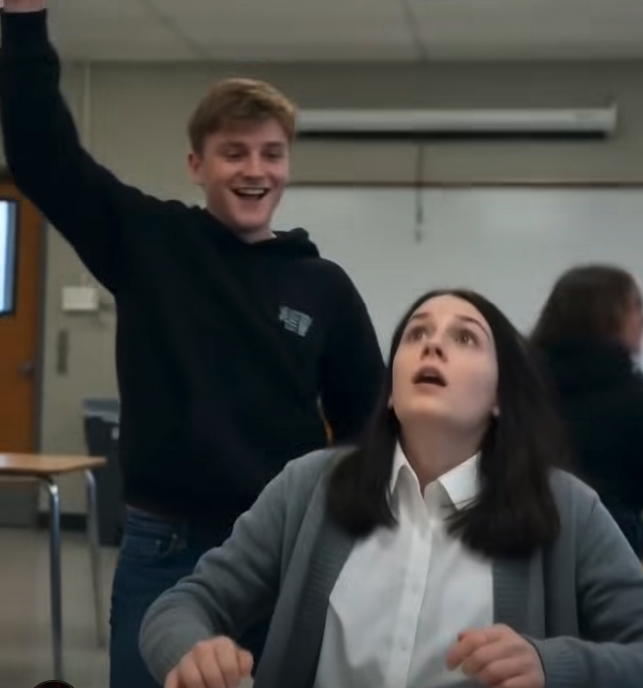
One second, I was sitting at my desk in the back row of Room 214, trying to copy the last equation from the board before the bell. The next second, cold fingers hooked around the frame of my glasses and yanked them off my face so hard that the metal arm scraped my temple.
My world vanished.
The classroom dissolved into colorless fog.
Faces became pale ovals.
The whiteboard became a glowing rectangle.
The rows of desks stretched and bent like shadows underwater.
I reached forward on instinct.
“Please,” I said. “Give them back.”
That was all I could manage.
Please.
One word.
But it was enough to make them laugh harder.
“Look at her,” someone said. “She’s panicking.”
“She looks like a lost grandma.”
“Can she even see us?”
A boy’s voice answered from somewhere above me.
“Hey, Nora. How many fingers am I holding up?”
More laughter.
I blinked rapidly, but blinking never helped. Without my glasses, I could see only a few inches in front of my face. Everything beyond that became shapes, light, and movement. I had learned to walk carefully, to count steps, to memorize where doors and desks were, to pretend I was not scared whenever my vision blurred.
But pretending was impossible when half the class was laughing and someone had my eyes in his hand.
“Evan, stop,” I whispered.
I knew it was him.
Evan Walsh.
Basketball captain.
Student council vice president.
The kind of boy teachers called “a natural leader” because he smiled at adults and destroyed people when they were not looking.
He had been doing it for months.
Sometimes it was small.
My pencil case missing.
My chair pulled back.
A note taped to my locker that said FOUR-EYED FREAK in black marker.
Sometimes it was worse.
A shoulder slammed into mine in the hallway.
My lunch tray tipped just enough to spill milk down my shirt.
My homework disappearing before class, then reappearing after I got a zero.
But today felt different.
Today, he sounded excited.
“Come get them,” Evan said.
His voice came from above and to the right.
I stood slowly, keeping one hand on the edge of my desk.
The classroom tilted around me.
“Please,” I said again, hating how weak my voice sounded. “I can’t see.”
Someone snorted.
“Sure you can’t.”
A girl laughed. “She’s so dramatic.”
I took one step.
My hip hit the corner of a desk. Pain shot down my leg. My hand slipped off the smooth surface, and I reached blindly for balance.
The room exploded with laughter again.
Somewhere, a phone camera clicked on.
“Do it again,” someone said. “This is perfect.”
My cheeks burned.
I wanted the floor to open.
I wanted to disappear.
But more than anything, I wanted my glasses back.
Those glasses were not just metal and lenses.
They were my mother’s overtime shifts.
They were the winter coat she did not buy for herself.
They were the grocery coupons stacked on our kitchen table.
They were her tired smile when she placed the case in my hands and said, “Now you’ll see the world clearly, baby.”
I reached toward Evan’s voice.
Then another voice said, “Throw them.”
“No,” I gasped.
There was movement.
A blur crossing the room.
A sharp sound.
Then a crack.
Small.
Final.
The kind of sound that does not seem loud enough to ruin your life, but does.
The laughter died instantly.
My stomach dropped.
I turned toward the sound, though I could not see anything clearly.
“Where are they?” I whispered.
Nobody answered.
I lowered myself to the floor, hands trembling, palms sliding over cold tile.
My fingers found the frame first.
Bent.
Wrong.
Then something sharp bit into my fingertip.
I pulled back, breath catching.
A broken lens.
For a moment, nobody moved.
Then someone muttered, “It was an accident.”
I knew that voice too.
Mia Calder.
Perfect hair.
Perfect grades.
Perfect smile when teachers looked her way.
She had watched Evan torment me for months. Sometimes she laughed. Sometimes she whispered ideas. Sometimes she pretended she was innocent because she never touched me herself.
I knelt on the floor, feeling for the pieces.
My eyes stung.
Do not cry, I told myself.
Not here.
Not in front of them.
But tears came anyway, blurring what little I could see.
The teacher, Mrs. Alden, was still gone. She had stepped out ten minutes earlier after the office called her. The class had waited exactly thirty seconds before Evan stood up and walked toward me.
Nobody stopped him.
Nobody ever stopped him.
Then the classroom door opened.
The sound was quiet, but every head turned.
I heard footsteps.
Slow.
Heavy.
Certain.
The room went still in a way I had never heard before.
No whispers.
No phones.
No laughter.
A man walked inside.
I could not see his face.
Only a tall dark shape in the doorway.
But I knew the silence before I knew him.
My father had that effect on rooms.
Not because he was loud.
He was never loud.
My father’s anger was not fire.
It was ice.
“Nora,” he said.
His voice cut through the room, and something inside me broke.
“Dad?”
I tried to stand, but my knees shook.
He was beside me in seconds.
His hands found my shoulders gently.
“Don’t move,” he said softly. “There’s glass.”
He took my wrist, checked my finger, then picked up the broken frame from the floor.
I could hear his breathing change.
Slow in.
Slow out.
Then he stood.
And when he spoke again, his voice was no longer soft.
“Who touched my daughter’s glasses?”
No one answered.
The silence stretched until it became unbearable.
I heard someone shift.
A chair leg scraped.
My father repeated the question.
“Who touched my daughter’s glasses?”
Then a student whispered, barely loud enough to hear.
“Evan.”
The name hung in the air.
And my father froze.
Not because he was surprised Evan had done it.
Not because he was afraid.
But because that name meant something to him.
I felt it before anyone else did.
The change.
The sharp stillness in him.
“Evan Walsh?” my father asked.
Evan’s voice came out smaller than I had ever heard it.
“Sir, it wasn’t like that.”
My father did not answer him.
Instead, he said, “Where is your teacher?”
“She stepped out,” Mia said quickly. “And Nora was overreacting. Evan was just joking.”
My father turned toward her voice.
“Joking?”
Mia went silent.
He crouched beside me again and carefully gathered the broken pieces into his palm. Then he helped me stand, guiding me away from the glass.
His hand was steady.
Mine was not.
“Dad,” I whispered, “I’m sorry.”
“For what?”
“The glasses.”
He was quiet for one second.
Then he said, “Never apologize for something someone else broke.”
The words landed in me like a promise.
The door opened again.
Mrs. Alden hurried in, breathless.
“I’m so sorry, class. The office—”
She stopped.
The room must have told her everything before anyone spoke.
My father turned toward her.
“Mrs. Alden, I need the principal. Now.”
Her voice shook. “Mr. Hayes, what happened?”
“My daughter was assaulted in your classroom. Her glasses were taken from her face and broken while other students filmed and laughed.”
Someone whispered, “Assaulted?”
Evan said quickly, “I didn’t assault her.”
My father’s voice lowered.
“You removed a medically necessary device from a child who cannot safely function without it. Then you humiliated her until it broke.”
Nobody spoke after that.
Mrs. Alden rushed to the office phone.
Ten minutes later, I was sitting in the principal’s conference room with a tissue wrapped around my bleeding finger and the broken glasses on the table in front of me.
The room smelled like coffee and polished wood.
I hated that room.
I had sat there twice before.
Once after my notebook was thrown into a toilet.
Once after someone wrote blind rat on my locker.
Both times, Principal Whitmore had folded his hands and told me he needed “clear evidence.”
Both times, Evan had walked out smiling.
Now Evan sat across from me with his parents.
His father, Graham Walsh, wore a navy suit and an expensive watch. His mother kept rubbing Evan’s shoulder like he was the victim.
Mia sat beside her mother, looking pale but still composed.
Mrs. Alden stood near the wall.
My father sat next to me.
He had not changed out of his work clothes.
He was a maintenance supervisor for the district, though most students still called him “the janitor” because they thought it sounded lower. His gray shirt had his name stitched over the pocket: Daniel Hayes.
To me, that name meant safety.
To them, it meant someone invisible.
Principal Whitmore cleared his throat.
“I’m sure this was an unfortunate misunderstanding.”
My father looked at him.
“No.”
The principal blinked. “Excuse me?”
“It was not a misunderstanding.”
Graham Walsh leaned forward. “Now, Daniel, let’s not make this bigger than it needs to be.”
My father’s jaw tightened.
Daniel.
Not Mr. Hayes.
Not sir.
Daniel.
Like they knew each other.
Like there was a history I did not understand.
My father looked at him slowly.
“You don’t get to decide how big this is, Graham.”
The room changed again.
Principal Whitmore’s eyes flickered between them.
Mrs. Alden looked down.
Evan’s face went pale.
That was when I realized the whispered name had not made my father freeze because Evan was powerful.
It had made him freeze because Evan’s father was.
Graham Walsh sat back, smiling in a way that did not reach his eyes.
“My son made a mistake. We’ll pay for the glasses.”
I clenched my fists.
Pay for the glasses.
As if that fixed the months of fear.
As if money could erase laughter.
My father reached into his pocket and placed something on the table.
A small black flash drive.
Principal Whitmore stared at it.
“What is that?”
“The evidence you kept saying you needed.”
My heart stopped.
“What evidence?” Graham asked.
My father looked at me briefly.
His expression softened.
Then he turned back to the table.
“For months, Nora reported bullying. For months, this school dismissed her. So I checked the maintenance logs. I checked hallway camera blind spots. I checked who had access to classrooms after hours. And when I noticed the same students always appeared near incidents involving my daughter, I submitted a formal request to review security footage.”
Principal Whitmore’s face drained of color.
“You had no authority to—”
“I had every authority,” my father said. “I maintain the security system.”
The room went dead silent.
He continued.
“And because I knew this school would protect certain students, I made copies of every relevant clip before they could disappear.”
Graham Walsh stood abruptly.
“You copied footage of minors?”
My father stood too.
“No. I preserved evidence of harassment, theft, vandalism, and endangerment that the administration ignored.”
Mia’s mother whispered, “Oh my God.”
Evan stared at the flash drive like it was a bomb.
My father looked at him.
“Tell the truth now.”
Evan swallowed.
“I didn’t mean to break them.”
My father’s voice was cold.
“But you meant to take them.”
Evan said nothing.
“You meant to make her stumble.”
Silence.
“You meant to make people laugh.”
Evan’s eyes dropped.
My father turned to Principal Whitmore.
“Play it.”
The principal hesitated.
Then, under my father’s stare, he plugged the drive into the conference room computer.
The screen lit up.
I could not see it clearly, but I could hear everything.
The first clip was from the hallway.
Evan bumping into me.
My books scattering.
Mia stepping over them.
Laughter.
The second clip showed my locker.
A hand taping a note to it.
Mia’s bracelets flashed as she smoothed the paper flat.
The third clip showed my science project being shoved off a table.
The fourth showed Evan holding my backpack while another boy emptied it into a trash can.
Each clip had a date.
A time.
A truth.
By the fifth clip, Mrs. Alden was crying.
By the sixth, Mia’s mother had covered her mouth.
By the seventh, Principal Whitmore had stopped pretending.
Then the final video played.
Room 214.
Today.
Evan walking toward me.
His hand grabbing my glasses.
My body going rigid.
The laughter.
My voice begging.
My stumble.
The throw.
The crack.
Nobody in that room moved.
When it ended, my father turned to the principal.
“This is not a discipline issue anymore.”
Graham Walsh’s voice turned sharp.
“Be careful, Daniel.”
My father looked at him.
“Why? Because last time I wasn’t?”
Last time.
The words stirred something in the room.
Principal Whitmore whispered, “Mr. Hayes…”
But my father did not stop.
He looked straight at Graham Walsh.
“Twenty-two years ago, you and your friends did this to another girl.”
Graham’s face hardened.
“That has nothing to do with this.”
“It has everything to do with this.”
My chest tightened.
Another girl?
My father’s voice changed then.
It was not angry anymore.
It was wounded.
“She wore thick glasses too. She was quiet. Brilliant. Poor. You called her names. You hid her books. You stole her glasses before a chemistry lab because you thought it was funny.”
Graham’s wife stared at him.
“What is he talking about?”
My father did not look away.
“You remember her name?”
Graham said nothing.
My father’s voice dropped.
“Say it.”
Graham’s mouth opened, but no sound came.
My father said it for him.
“Lydia Hayes.”
My mother.
The room seemed to tilt beneath me.
I turned toward him blindly.
“Dad?”
He took my hand.
His fingers trembled for the first time that day.
My mother had died when I was six.
I remembered pieces of her.
Lavender soap.
Soft humming.
Her hands guiding mine over picture books.
The way she kissed the bridge of my nose and said my glasses made me look wise.
But there were things my father never talked about.
Her school years.
Her fear of hospitals.
Why he hated the smell of bleach in science rooms.
My father swallowed.
“Your mother didn’t just have bad eyesight, Nora. She had a genetic condition. Her vision was fragile. Stress made it worse. Trauma made it worse.”
He looked at Graham.
“They took her glasses during a lab assignment. She reached for the wrong bottle because she couldn’t see the labels. There was a chemical reaction. She was injured. Not enough to kill her. Not then. But the damage started a chain of complications she lived with for the rest of her life.”
Graham whispered, “It was an accident.”
My father’s eyes flashed.
“No. The injury was an accident. The cruelty before it was a choice.”
Nobody breathed.
My father continued.
“She never named everyone involved. She was afraid. But she named one boy. One boy who held her glasses above his head and laughed.”
He looked at Evan.
“Your father.”
Evan looked at Graham.
“Dad?”
Graham’s face had gone gray.
“That was years ago.”
“And now your son did the same thing to my daughter.”
The words struck like thunder.
I understood then why my father had frozen.
Not because of power.
Because of history repeating itself.
Because he had walked into a classroom and heard the echo of the day that helped destroy the woman he loved.
But the twist was not finished.
Mia suddenly started crying.
“I didn’t know,” she said.
Her mother grabbed her arm. “Mia, be quiet.”
“No,” Mia said, shaking. “I didn’t know it would go this far.”
Evan snapped, “Shut up.”
My father turned.
“What did you know?”
Mia looked at Principal Whitmore, then at Graham Walsh.
Her voice broke.
“My mom told me not to say anything.”
“Mia,” her mother hissed.
But Mia was already unraveling.
“She said Mr. Walsh needed Evan’s record clean for the scholarship committee. She said if Nora kept complaining, it could ruin everything.”
Principal Whitmore stood.
“That’s enough.”
My father’s eyes narrowed.
Mia pointed at the principal.
“He knew. They all knew. My mom said the school couldn’t afford another scandal before the district audit.”
My father slowly turned toward Principal Whitmore.
The principal’s face was slick with sweat.
Graham Walsh slammed his hand on the table.
“This is ridiculous.”
Then the conference room door opened.
A woman stepped inside.
She wore a dark suit, silver hair pinned neatly behind her ears, and a badge clipped to her jacket.
Behind her stood a man with a camera and another woman carrying a folder.
Principal Whitmore nearly collapsed.
“Superintendent Reeves,” he whispered.
My father exhaled.
Not in surprise.
In relief.
“You came.”
She nodded. “You said it involved a repeated civil rights complaint and possible evidence suppression.”
Graham Walsh turned on my father.
“You called the superintendent?”
My father looked at him calmly.
“No. I called her last week.”
Last week.
Before the glasses.
Before today.
Before the classroom.
My father had known something was coming.
He had been collecting evidence because he believed me even when no one else did.
Superintendent Reeves looked around the room.
“Mr. Hayes submitted a formal complaint regarding a pattern of ignored disability-related harassment. Today’s incident appears to confirm his concerns.”
Disability-related harassment.
The words sounded official.
Heavy.
Real.
For the first time, what happened to me had a name.
I was not dramatic.
I was not weak.
I was not making trouble.
I had been harmed.
And someone finally said it out loud.
Evan began to cry.
Not loudly.
Not dramatically.
Just enough for his mother to pull him close.
“I’m sorry,” he whispered.
At first, I hated the sound of it.
Because it came too late.
Because he was only sorry now that adults were watching.
Because my broken glasses lay between us like proof.
But then he looked at me.
Really looked.
And his voice cracked.
“I didn’t know you really couldn’t see.”
My father’s face hardened, but I raised my hand slightly.
He stopped.
I turned toward Evan’s blurry shape.
“You shouldn’t have needed to know,” I said. “You shouldn’t have done it even if I could see perfectly.”
The room went silent.
Evan lowered his head.
Superintendent Reeves took control after that.
Phones were collected.
Statements were taken.
Parents were called.
The videos were copied into official records.
Principal Whitmore was placed on administrative leave before the final bell.
Mrs. Alden apologized to me in the hallway with tears in her eyes. I did not know whether I forgave her yet, but I believed she was sorry.
Mia confessed everything.
The group chat.
The plans.
The warnings from parents.
The quiet agreement that I was an easy target because my father worked in maintenance and my mother was gone.
By the end of the day, the whole school knew something had happened, but not the whole truth.
That came two weeks later.
At an emergency assembly.
I walked onto the auditorium stage wearing temporary glasses donated by an eye clinic after Superintendent Reeves personally called them. The frames were too big, sliding down my nose every few minutes, but I could see.
The auditorium was packed.
Students shifted nervously.
Teachers lined the walls.
My father stood in the front row.
Beside him was an empty chair.
For my mother, he told me.
I held my speech in shaking hands.
I had written it the night before, then cried over it, then rewritten it.
When I looked out at the crowd, I saw Evan sitting near the front with his parents. He had been suspended, removed from student council, and assigned community service with the district accessibility office. His scholarship review was postponed.
Mia sat three rows behind him, eyes red.
I took a breath.
“My name is Nora Hayes,” I began. “For most of this year, I thought being quiet would protect me.”
The microphone carried my voice across the room.
“It didn’t.”
No one moved.
“I thought if I didn’t react, they would get bored. I thought if I didn’t complain too much, adults would believe me when it really mattered.”
I looked at the teachers.
“Some didn’t.”
A few lowered their heads.
“My glasses were broken in class. But the truth is, they were not the first thing broken. My trust was broken long before that. My sense of safety was broken. My belief that being kind would be enough was broken.”
My voice trembled.
Then steadied.
“But something else happened too. My father believed me. He listened when everyone else asked for proof. And because he listened, the truth survived.”
I looked at Evan.
He looked back, ashamed.
“I’m not here to say every person who hurts someone is a monster forever. I’m here to say cruelty becomes dangerous when everyone treats it like entertainment.”
Somewhere in the crowd, someone sniffled.
“If you laugh, you are part of it. If you film, you are part of it. If you stay silent because the victim is not popular, you are part of it.”
My fingers tightened around the paper.
“And if you are the one being hurt, I want you to know this: you are not dramatic. You are not weak. You are not invisible.”
My father covered his mouth.
“You deserve to be believed before something breaks.”
When I finished, the auditorium was silent.
Then one person stood.
Mrs. Alden.
Then another.
Then another.
Soon the entire room was standing.
Not cheering wildly.
Not like a game.
Standing quietly.
Respectfully.
Like an apology.
After the assembly, Evan approached me in the hallway.
My father stepped closer, but I shook my head.
Evan held out a small envelope.
“I know this doesn’t fix it,” he said. “But it’s from my savings. Not my parents’ money. Mine.”
I did not take it right away.
His hands shook.
“I’m also writing letters,” he added. “To everyone I did this to. Not just you.”
“Why?” I asked.
He looked ashamed.
“Because my dad said what he did to your mom was just a stupid teenage mistake. And for a while I believed mistakes were things you could bury if you had enough money.”
He swallowed.
“But I saw his face when your dad said her name. That wasn’t buried. It was waiting.”
I took the envelope.
Not because it fixed anything.
Because accountability had to begin somewhere.
Mia apologized too.
Her apology was messier.
Less rehearsed.
She cried so hard I barely understood her.
I did not hug her.
I did not tell her it was okay.
But I told her I hoped she became someone braver than the girl who laughed.
Months passed.
The school changed.
Not magically.
Not perfectly.
But honestly.
Cameras were reviewed.
Reporting rules changed.
Teachers received training.
A student accessibility council was formed, and somehow, unbelievably, I became its first chair.
My new glasses arrived in a velvet-lined case from the clinic.
They were lighter than my old ones.
Clearer too.
When I put them on, the world snapped into focus so sharply that I cried.
My father cried too, though he pretended he had dust in his eye.
That night, we visited my mother’s grave.
He placed my broken old frame beside the flowers.
For a long time, neither of us spoke.
Then he said, “I should have told you about her.”
I leaned against him.
“You told me the parts that mattered.”
He looked down.
“Which parts?”
“That she was kind. That she was brave. That she loved me.”
His arm tightened around my shoulders.
The sun was setting, turning the cemetery gold.
For the first time in years, my father smiled without sadness covering it.
“She would have been proud of you today.”
I looked through my new lenses at my mother’s name carved into stone.
Lydia Hayes.
The girl they once blinded with cruelty.
The woman who taught me, even in memory, to see clearly.
“I think she would have been proud of both of us,” I said.
My father nodded.
And there, in the quiet evening light, I finally understood the real twist.
The day Evan broke my glasses was supposed to make me smaller.
It was supposed to humiliate me.
It was supposed to prove I was helpless without them.
Instead, it revealed everything.
The lies.
The history.
The silence.
The strength my father had carried for years.
And the truth my mother had never been able to speak loudly enough.
They had taken my glasses because they thought I could not see.
But by the end, I saw them all clearly.
And this time, so did everyone else.
