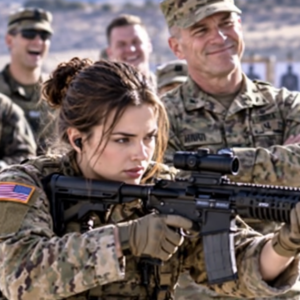
Commander Nathan Ward’s salute remained in the air for one impossible second.
Every Marine in the Little Creek training mess stared at Avery Bennett as if the room had shifted beneath their boots.
Lieutenant Commander.
The title did not fit the quiet woman who had spent four days carrying folders, drinking coffee alone by the windows, and politely accepting every dismissive comment without correcting anyone.
Corporal Ryan Maddox looked from Ward to Avery, then back again.
The anger had drained from his face.
In its place was something far worse.
Fear.
Ward lowered his hand.
“Lieutenant Commander Bennett,” he said, his voice firm and formal, “the recovery team is ready.”
Avery nodded once.
“Secure the exits. No one leaves until the initial review is complete.”
Ryan let out a short, hollow laugh.
“You cannot be serious.”
Avery turned toward him.
“I have been serious since I walked through that door.”
The six uniformed personnel moved quietly into position around the mess hall.
No one reached for a phone.
No one dared whisper.
Even Sergeant Marcus Reed, who had always seemed unshakable, stood rigidly beside the tables with his eyes fixed on the floor.
Ward walked toward the stainless-steel counter where Avery’s thin folder rested.
“You may begin whenever you are ready,” he said.
Avery opened it.
The first page held a list of names.
The second held times, locations, and witness accounts.
The third contained photographs from security footage.
Four days of observations.
Four days of small cruelties that had been treated like tradition.
Avery looked around the room.
“I was assigned to conduct an independent command-climate assessment,” she said. “The purpose was to evaluate cohesion, professionalism, readiness, and the ability of this unit to operate under pressure.”
Ryan folded his arms.
“And you decided to provoke us?”
“No,” Avery replied. “I decided to enter the environment exactly as I was instructed to enter it. Without a visible rank. Without a special introduction. Without anyone knowing whether I had influence, authority, or protection.”
Her gaze settled on him.
“You chose how to respond.”
Ryan’s jaw tightened.
“You were pretending to be helpless.”
“I was observing what happened when you believed someone was.”
The sentence hit the room like a door slamming shut.
Lance Corporal Tyler Boone looked toward Ryan.
Then quickly looked away.
Avery lifted the first page.
“During the past four days, I documented fourteen incidents of public humiliation, eleven instances of intentional exclusion, seven occasions where junior personnel were assigned punitive work without cause, and multiple examples of personnel being discouraged from asking questions.”
Sergeant Reed raised his head slowly.
“Ma’am,” he said, “we were trying to build resilience.”
Avery’s expression did not change.
“Resilience is not built by making people afraid of their own team.”
No one answered.
Ward stepped closer to the table.
“Sergeant Reed, do you know why this review was authorized?”
Reed hesitated.
“No, sir.”
“Because three Marines from this unit requested transfers in the last six months,” Ward said. “Two more declined advanced training opportunities. One submitted an anonymous statement saying that leadership here had become a performance, not a responsibility.”
The words seemed to travel through every corner of the room.
Ryan stared at the floor tiles.
The same tiles where Avery had lowered him safely only minutes earlier.
Ward opened a second folder.
“And because our readiness numbers did not match our retention numbers.”
Avery reached into her pocket and placed the tiny blue-lit recorder on the table.
“This device recorded thirty-eight minutes in this room,” she said. “But the assessment did not begin today.”
She opened her folder to a photograph.
It showed a young Marine named Private Ethan Wallace standing beside a supply locker.
Ryan recognized him immediately.
Wallace had arrived in the unit three months earlier.
He was quiet, careful, and constantly apologizing for taking up space.
Ryan had called him “Professor” because he wore glasses.
The name had caught on.
Everyone used it.
At first, Wallace laughed along.
Then he stopped laughing.
Avery looked toward the back of the room.
“Private Wallace, please step forward.”
The young Marine froze.
For a moment, he did not move.
Then he slowly walked through the silent room.
His hands shook at his sides.
Avery’s voice softened.
“You are not in trouble.”
Wallace nodded, though his face suggested he did not fully believe it.
Avery held up another report.
“Private Wallace submitted a request for reassignment two weeks ago.”
Ryan’s eyes narrowed.
Wallace had told the unit he wanted to be closer to family.
That was all anyone knew.
Avery continued.
“In his request, he stated that he no longer trusted himself to speak during training because every question he asked became a joke.”
A terrible stillness fell over the room.
Wallace stared at the table.
Ryan remembered it now.
The navigation drill.
Wallace had pointed out a timing discrepancy in the exercise plan.
Ryan had laughed and told him perhaps he should become a librarian.
Everyone had laughed.
Even Reed.
Especially Boone.
The exercise had continued without correction.
Three hours later, the unit had discovered the timing discrepancy was real.
But no one had apologized to Wallace.
They had simply adjusted the plan and moved on.
Avery placed the report down.
“Private Wallace was correct that day,” she said. “His observation prevented a serious operational failure.”
Wallace’s eyes filled.
He blinked hard and looked away.
Ryan felt something inside his chest shift.
Not a clean realization.
Not relief.
Something colder.
The understanding that he had seen another person diminish in front of him and had helped it happen because making someone smaller had made him feel larger.
Ward turned to Ryan.
“Corporal Maddox, do you have anything to say?”
Ryan opened his mouth.
Nothing came out.
Every excuse sounded thin before it even formed.
Everyone jokes.
Nobody meant it.
That is just how Marines talk.
He had used those excuses before.
But looking at Wallace now, he understood that the words had always been meant to protect the people who said them.
Not the people who endured them.
“I was wrong,” Ryan finally said.
Avery’s gaze stayed steady.
“Yes.”
Ryan flinched.
He had expected outrage.
A lecture.
A threat.
Instead, her quiet agreement left him nowhere to hide.
“I was wrong,” he said again, louder this time. “I treated people like they did not matter. I thought it made me look strong.”
Wallace looked up.
Ryan swallowed.
“It did not.”
No one moved.
Then Ryan looked directly at Wallace.
“I am sorry.”
Wallace’s lips pressed together.
For a long moment, he said nothing.
Then he replied, “I do not know what to say.”
“You do not have to say anything,” Ryan told him.
Avery closed the first folder.
“That is an honest answer,” she said. “Trust is not repaired because someone asks for it once.”
The black vehicles outside reflected in the large windows.
The afternoon sky had become gray.
Ryan had entered the mess hall expecting another ordinary day.
A few jokes.
A few people laughing because he was loud enough to lead them.
Now he stood surrounded by the evidence of who he had become.
Commander Ward picked up the second folder.
“This is the command assessment,” he said. “But it is not the only reason Lieutenant Commander Bennett was sent here.”
A nervous murmur moved through the room.
Ryan looked at Avery.
Her expression changed for the first time.
Only slightly.
A shadow crossed her eyes.
Ward opened the folder and removed a sealed envelope.
“The recovery operation concerns missing materials from a classified training archive.”
Sergeant Reed stiffened.
“What kind of materials, sir?”
“Archived field evaluations,” Ward replied. “Personnel recommendations. Mentorship reports. Files connected to a selection program that was paused seven years ago.”
Ryan frowned.
He had never heard of such a program.
Avery stepped toward the center table.
“Seven years ago,” she said, “a small pilot program was created to identify service members whose leadership potential could not be measured by scores alone.”
Boone shifted uncomfortably.
“What does that have to do with us?”
“It was intended to find people who made difficult choices when no one was looking,” Avery answered. “People who protected the dignity of others even when it cost them something.”
Ward placed a photograph on the table.
It showed a group of young recruits standing in the rain outside a training facility.
Among them was a thinner, younger version of Sergeant Reed.
Beside him stood another Marine with dark hair and a bright, fearless smile.
Reed took one step forward.
His face lost color.
“Daniel Bennett,” he whispered.
Avery looked at him.
“You knew my brother.”
The room went silent again.
Reed stared at the photograph.
“I served with him during basic training,” he said quietly. “He was the best person I knew.”
Avery’s hand rested on the edge of the table.
“Daniel was part of the pilot program. He believed in it. He believed units could be better when leaders paid attention to the people everyone else ignored.”
Reed’s eyes lowered.
“He used to say that the loudest person in the room was not always the strongest.”
Avery’s face softened for one brief moment.
“That sounds like him.”
Ryan watched the exchange, confused.
“What happened to the program?” he asked.
Ward looked toward the sealed envelope.
“The files vanished from the archive after the program was suspended. The official explanation was an administrative failure.”
“But it was not?” Avery asked.
Ward shook his head.
“No.”
Avery opened a small tablet and placed it on the table.
The screen showed a scanned report dated seven years earlier.
At the bottom was a signature.
Sergeant Marcus Reed.
Reed stared at it.
His face went pale.
“I wrote that,” he said.
“You did,” Avery replied.
Ryan looked from the screen to Reed.
The report described a training incident, an early warning about a senior instructor who repeatedly silenced recruits and altered evaluations.
Daniel Bennett had submitted a formal complaint.
Reed had corroborated it.
But the report had never reached the proper office.
Instead, it disappeared.
Along with dozens of related files.
Ward’s voice sharpened.
“Someone buried the evidence because the pilot program threatened people who had built careers on appearances.”
Reed looked sick.
“I thought Daniel had withdrawn it,” he said. “He told me he would handle it.”
“He tried,” Avery replied. “For seven years, my family believed he had failed.”
The grief in her voice was quiet, but it filled the room.
“Daniel left service shortly after that. He spent years believing that he had not been strong enough to make a difference. Two months ago, he sent me a box of his old papers. Inside was a copy of his original report.”
Avery looked toward the group of Marines.
“That copy led us here.”
Ryan stared at the screen.
“So this unit was connected to it?”
Ward nodded.
“The senior instructor named in Daniel’s report later became an adviser to several commands. His methods spread. The idea that humiliation creates discipline. That fear creates loyalty. That silence means respect.”
Ryan felt every word settle against his ribs.
He had never met that instructor.
Yet he had learned the same habits.
Copied the same tone.
Repeated the same cruelty.
Not because anyone had forced him.
Because it was easier to imitate what looked powerful than to ask whether it was right.
Avery turned the tablet toward him.
“And that is why I came here under a lower profile.”
Ryan looked at the screen.
At Daniel Bennett’s report.
At the handwriting of someone who had tried to speak before anyone listened.
“You wanted to see whether it was still happening,” Ryan said.
“Yes.”
“And it was.”
“Yes.”
The truth was unbearable because it was simple.
Ward reached for the sealed envelope.
“The recovery operation was successful this morning,” he said. “The missing archive was located.”
Everyone looked at him.
“Where?” Boone asked.
Ward’s gaze moved to the storage wing beyond the mess hall.
“On this base.”
The room seemed to stop breathing.
“Behind a false panel in an unused records room,” Ward continued. “The files had been hidden for years. They include original reports, recommendations, and names of people who were overlooked because they refused to become part of the culture around them.”
Avery’s face tightened.
“And my brother’s file?”
Ward smiled slightly.
“It was there.”
For the first time, Avery looked unprepared.
“What?”
“The original review board completed Daniel Bennett’s evaluation before the materials disappeared,” Ward said. “His recommendation was approved.”
Avery stared at him.
Ward slid a document from the envelope and handed it to her.
“Daniel was selected for the leadership fellowship.”
Her fingers trembled as she took the paper.
Ryan watched Avery read the words.
Her eyes moved slowly.
Then stopped.
For a long time, she said nothing.
“What does that mean?” Reed asked.
Ward looked toward him.
“It means Daniel did not fail.”
Avery closed her eyes.
A single tear slipped down her cheek before she could stop it.
She wiped it away quickly, almost angrily.
But there was no hiding what it meant.
Seven years of doubt.
Seven years of believing her brother had been forgotten.
Seven years of carrying a wound created by other people’s silence.
And now, in a mess hall filled with witnesses, the truth had finally returned to her.
Reed stepped closer.
His voice broke.
“I should have done more.”
Avery looked at him.
“I know.”
He nodded, tears gathering in his eyes.
“I was scared. I was a junior Marine. I thought if I kept my head down, I could survive it.”
“You did survive it,” Avery said. “But you brought the fear with you.”
Reed looked at Ryan.
Then Wallace.
Then the rest of the unit.
“I did,” he whispered.
Avery placed the recovered document back in its envelope.
“Today is not about destroying people for what they did not understand years ago,” she said. “It is about deciding whether they will keep repeating it now.”
Ward stepped forward.
“Sergeant Reed, pending review, you will remain on duty. But you will not lead by old habits again.”
Reed stood straighter.
“Yes, sir.”
Ward turned to Ryan.
“Corporal Maddox, you will receive formal consequences for your conduct.”
Ryan nodded.
“Yes, sir.”
“You will also be given a choice.”
Ryan looked up.
Ward’s expression remained unreadable.
“You can treat this as the end of your path. Or you can accept responsibility and begin the far more difficult work of becoming someone worthy of trust.”
Ryan looked toward Avery.
He expected her to look away.
She did not.
“I want to do the work,” he said.
Avery studied him for several seconds.
Then she gave one small nod.
“Then start by listening.”
That night, the mess hall was empty except for Ryan, Wallace, Reed, and Avery.
No commander had ordered them to stay.
No one had asked them to return.
They came because they had unfinished words.
Ryan sat across from Wallace with his hands folded on the table.
“I do not expect you to forgive me,” he said.
Wallace looked at him cautiously.
“Then why are you here?”
“Because I should have said this before you ever asked to leave. You were right about the navigation plan. You were right about the supply schedule last week too. I knew it, but I did not want to admit it.”
Wallace stared at him.
Ryan continued.
“I thought admitting you were right would make me look weak.”
“And now?”
“Now I think pretending I was always right made me useless.”
Wallace looked down at his hands.
Then, slowly, he smiled.
Only a little.
But it was real.
Across the room, Reed sat with Avery.
“I remember your brother’s laugh,” he said quietly. “He laughed like the world had not taught him to be afraid yet.”
Avery’s eyes glistened.
“He was like that at home too.”
Reed nodded.
“I want his name restored.”
Avery looked at him.
“It will be.”
“I want every person who was silenced to know their report mattered.”
Avery’s voice softened.
“Then make sure the next report is heard.”
The following morning, Commander Ward gathered the unit in formation.
But this time, no one waited to see who would be embarrassed.
No one scanned the line for an easier target.
Avery stood beside Ward in full uniform.
Her auburn hair was tied back neatly.
Her rank was visible now.
Yet the Marines did not look at her differently because of the insignia.
They looked at her differently because they had seen what calm strength actually looked like.
Ward addressed the formation.
“Effective immediately, this unit will participate in a leadership restoration program. Every Marine will have an opportunity to speak privately with the review team. Every concern will be documented. Every person will be treated as someone whose voice matters.”
He paused.
“Not because someone important is watching.”
His eyes swept across the formation.
“Because that is the standard.”
Ryan stood at attention.
His uniform was orderly again, but he no longer felt proud of appearances.
Not yet.
Pride, he had learned, could be borrowed too easily.
Respect had to be earned.
Weeks passed.
The formal review continued.
Ryan accepted his consequences without argument.
He completed additional leadership training.
He volunteered for the work nobody wanted, but this time he did not do it alone.
When the barracks needed cleaning, he made a roster where every person shared the responsibility.
When Wallace raised a concern during an exercise, Ryan listened before anyone else could speak.
When Boone made a cruel joke about another Marine, Ryan stopped him.
Not with shouting.
Not with humiliation.
Just one quiet question.
“Who are you trying to become when you say that?”
Boone had no answer.
Eventually, he apologized.
Then he changed.
Not all at once.
Not perfectly.
But genuinely.
Months later, a ceremony was held in the base auditorium.
A framed portrait stood near the stage.
Daniel Bennett smiled from the photograph, young and certain, dressed in the uniform he had once loved.
Beneath his name was a new inscription:
FOR THE COURAGE TO SPEAK WHEN SILENCE WAS EASIER
Avery stood beside the portrait with her parents.
Sergeant Reed sat in the front row.
Ryan and Wallace stood nearby with the rest of the unit.
Commander Ward took the podium.
“Today, we restore the Daniel Bennett Leadership Fellowship,” he announced. “It will support service members who lead with integrity, empathy, and the courage to protect the voices around them.”
Applause rose through the auditorium.
Avery looked at Daniel’s portrait.
For years, she had imagined this moment differently.
She had imagined anger.
She had imagined revenge.
She had imagined the people who failed her brother finally being forced to understand what they had taken.
But standing there, surrounded by people choosing to do better, she felt something unexpected.
Peace.
Not because the past could be erased.
It could not.
But because Daniel’s voice had not vanished after all.
It had crossed seven years of silence.
It had reached a quiet young woman with a temporary badge.
It had entered a mess hall full of people who believed rank was the same as worth.
And it had changed them.
After the ceremony, Ryan approached Avery near the exit.
He stopped a respectful distance away.
“Lieutenant Commander,” he said.
Avery turned.
Ryan looked nervous.
More nervous than he had been when Ward entered the mess hall months earlier.
“I wanted to thank you,” he said.
Avery lifted an eyebrow.
“For documenting your behavior?”
“For not letting me stay that person.”
She looked at him for a long moment.
“I did not change you, Corporal.”
“You gave me the chance.”
“No,” Avery said softly. “You gave yourself the chance when you chose to listen.”
Ryan nodded.
Then he glanced toward Daniel’s portrait.
“I will remember his name.”
Avery’s expression softened.
“Make sure someone else does too.”
Ryan stood straighter.
“I will.”
Outside, the late-afternoon sun poured gold across the base.
Wallace waited near the steps, holding a revised training proposal in his hands.
Ryan walked toward him.
“Ready to review it?” Ryan asked.
Wallace smiled.
“You are actually going to read it this time?”
Ryan smiled back.
“Every word.”
Together, they headed toward the operations building.
Behind them, Avery remained beside her brother’s portrait for one final moment.
Then she looked up at the sky, breathed deeply, and walked forward too.
Because sometimes the most powerful thing a person can do is not win an argument.
It is refuse to become the kind of person who makes others feel invisible.
And sometimes, one quiet voice—heard at last—can change an entire room.