The moment my mother-in-law pushed me into the pool, I understood that some families do not keep secrets.
They feed them.
They bury them in polite dinners and framed wedding photos, in casseroles delivered with stiff smiles, in careful pauses whenever an old name comes too close to the surface. They hide them under fresh paint and trimmed hedges and anniversary speeches about loyalty. They let them grow roots beneath the house.
And then one summer afternoon, when the air smells like chlorine and jasmine, when a neighbor says one careless sentence over a fence, the whole thing claws its way out.
I was seven months pregnant when it happened.
My belly was round enough that strangers smiled at me in grocery stores, and my husband, Daniel, had started pressing both hands against it every morning before work as if saying goodbye to me was not enough anymore. He had to say goodbye to our child too.
“You’re enormous,” he whispered once, half-asleep, his cheek against my stomach.
I smacked his shoulder.
“With love,” he added quickly.
“With survival instincts,” I said.
Daniel laughed, and the baby kicked like she agreed.
We had not told his mother the name we had chosen. That was deliberate.
Margaret Vale had opinions about everything: paint colors, dinner temperatures, the “proper” way to fold crib blankets, the danger of letting babies listen to “too much modern music.” She never entered a room without finding something to correct. When Daniel and I moved into the pale blue house on Briar Lane, three streets from where he grew up, Margaret acted less like a mother visiting and more like a general reclaiming occupied land.
“That nursery should face east,” she told me the first time she saw it.
“It faces the backyard,” I said.
“That’s west.”
“I know where the sun sets, Margaret.”
She smiled thinly. “I’m only trying to help.”
That was her favorite sentence. It meant stop arguing before I decide you are ungrateful.
Daniel loved his mother, but he loved her like someone loves the weather in a town they cannot afford to leave. He had learned to prepare for her moods, to laugh off her sharpness, to step between us with a calm hand on my back.
“She’s intense,” he would say.
“She’s a thunderstorm in pearls,” I answered.
“She means well.”
“No, sweetheart. She means control.”
He never had an answer for that.
The strangest thing about Margaret was not her criticism. It was her fear.
I noticed it first the week after we moved in. We were unpacking dishes when she saw Mrs. Lenora Finch watching from the neighboring yard, pruning roses in a wide straw hat. Lenora was in her seventies, small and elegant, with silver hair pinned at the nape of her neck and a way of looking at people that made you feel she knew what you had dreamed the night before.
“She seems nice,” I said.
Margaret dropped a teacup.
It hit the floor and shattered, sending blue porcelain across the kitchen tiles.
Daniel turned. “Mom?”
Margaret’s face had gone the color of flour.
“I’m fine,” she said.
But she was staring through the window at Lenora.
The next day, Margaret warned me not to become “too familiar” with the neighbors.
“Small streets have long memories,” she said.
“What does that mean?”
“It means people talk.”
“About what?”
“Anything they can twist.”
I laughed, thinking she was being dramatic.
I did not know then that Briar Lane had been waiting for my child longer than I had.
The afternoon it happened, the sky was a sharp, spotless blue. Daniel had taken half the day off to assemble the crib, though mostly he had spent two hours lying on the nursery floor surrounded by screws and instructions, insisting the manufacturer had printed them in “ancient code.”
I sat beside him eating peaches from a bowl.
“You’re building a crib, not decoding a tomb,” I said.
“This is how curses begin.”
“The curse is your mother arriving at four.”
He groaned. “Be nice.”
“I am nice. I haven’t locked the gate.”
Margaret arrived at three-thirty.
She wore linen trousers, a cream blouse, and the expression of a woman entering a home she believed had been poorly managed in her absence. She brought lemon cake wrapped in wax paper and three unsolicited opinions before reaching the kitchen.
The mobile above the crib was too colorful. The baby blankets should be washed again. I was standing too much.
“You need to rest, Claire,” she said, placing one hand on my shoulder with just enough pressure to guide me toward a chair.
“I’m fine.”
“At seven months, fine changes quickly.”
There was something almost tender in her voice when she said it. That was what made Margaret difficult. Her cruelty often wore the mask of concern, but sometimes concern slipped through so sincerely that I wondered if I had misjudged her.
Daniel went outside to bring in cushions from the patio, and I followed, grateful for air. The backyard shimmered in the heat. Our pool, which we barely used, glowed blue under the sun. Beyond the fence, Lenora Finch was hanging tea towels on a line.
She smiled when she saw me.
“Afternoon, Claire.”
“Hi, Mrs. Finch.”
“Lenora, please. How’s the little passenger?”
“Very active,” I said, resting a hand on my belly. “She’s either dancing or filing a complaint.”
Lenora laughed. Her gaze softened, settling on the curve of my stomach with an expression I could not read.
Then she said it.
“That baby looks exactly like someone from this street.”
I laughed because I thought she meant Daniel. People said that constantly already, though our daughter was not even born. Daniel had strong features: dark brows, a straight nose, a stubborn chin. The ultrasound technician had once joked that the baby looked determined, and Daniel had declared that proof she took after me.
“I hope she gets Daniel’s eyelashes,” I said.
Lenora’s smile faltered.
Behind me, the patio door opened.
Margaret stepped outside.
“What did you say?” she asked.
The air changed.
I felt it before I understood it. A tightening. A sudden absence of birdsong. The quiet that falls in a room when someone drops a glass and everyone waits to see where the pieces land.
Lenora lowered the towel in her hands.
“I was only saying the baby—”
Margaret moved so quickly I barely saw her cross the patio.
She grabbed my wrist.
Her fingers were cold.
“What did you tell her?” she hissed.
Pain shot up my arm. “Nothing. Margaret, let go.”
“What did you tell her?”
“Mom?” Daniel called from near the shed. “What’s going on?”
Lenora’s face had gone pale. She looked at Margaret not with confusion, but with recognition. With dread.
That frightened me more than Margaret’s grip.
“I don’t know what you mean,” I said.
Margaret’s eyes flicked to Lenora. “You promised.”
Lenora whispered, “I promised because you told me everyone would be destroyed.”
Daniel stepped onto the patio, holding two cushions. “Promised what?”
No one answered.
Margaret’s grip tightened.
“Stop,” I said sharply. “You’re hurting me.”
She leaned close enough that I smelled her perfume, powdery and bitter.
“You should have kept your mouth shut.”
I stared at her.
“My mouth shut about what?”
Her eyes dropped to my belly.
For one terrible second, I thought she might strike me there.
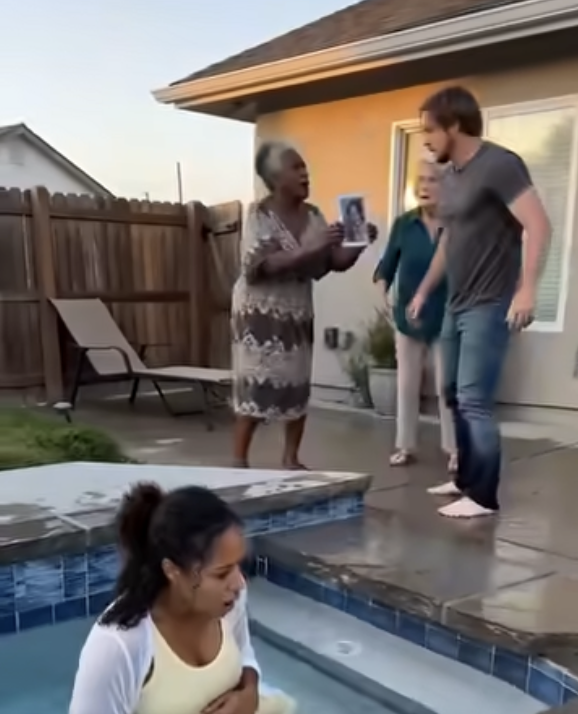
Instead, she yanked me toward the pool.
Everything happened at once.
Daniel shouted. Lenora screamed. I pulled backward, my heel scraping against wet stone near the edge. Margaret’s face twisted, not with anger now, but panic so old and deep it no longer looked human.
Then her hands slammed into my shoulders.
The world tipped.
Blue swallowed everything.
Cold water closed over my head, shocking the breath out of me. My dress billowed around me like a torn sail. For a moment I could not tell up from down. All I knew was the violent thud of my heart and the desperate instinct to protect the child inside me.
My hands clutched my stomach.
Something splashed above me.
Daniel.
His arms wrapped around me, dragging me upward. My head broke the surface, and I gasped so hard my throat burned. He held me against him, one arm around my back, the other under my belly as if he could shield us from the whole world.
“Claire,” he kept saying. “Claire, look at me. Are you hurt? Talk to me.”
I coughed, shaking uncontrollably.
“I’m okay,” I tried to say, though I did not know if it was true.
Above us, Margaret stood at the pool’s edge.
She was trembling.
Not with regret.
With terror.
Daniel looked up at her, water streaming down his face.
“What did the neighbor mean?”
Margaret pressed a hand to her mouth.
Lenora moved to the fence. Her hands shook as she reached into the pocket of her apron.
“Ask her,” Lenora said, voice breaking, “why she made me promise never to mention the man who lived here before you.”
Daniel went still.
“What man?”
Lenora pulled out an old photograph.
Even from the pool, I saw enough.
A younger Margaret stood beside a man in front of our house. Not Daniel’s childhood home. Our house. The blue house on Briar Lane.
The man was tall and dark-haired.
He looked so much like Daniel that my first dizzy thought was impossible.
Daniel climbed out first, then helped me slowly up the steps. Lenora hurried through the side gate, still holding the photograph. Daniel wrapped a towel around me, but his eyes never left the picture.
Lenora handed it to him.
The color drained from his face.
The man in the photo could have been Daniel with different clothes, different hair, and eyes that carried more sadness.
On the back, written in faded blue ink, was a date.
My due date.
August 19.
Daniel looked at his mother.
“Explain.”
Margaret shook her head.
“Daniel—”
“Explain now.”
Her lips parted, but no words came.
That was when the first cramp seized me.
I doubled over.
Daniel caught me.
“Claire?”
Another pain tightened across my stomach, deep and frightening.
Margaret made a strangled sound.
Lenora shouted, “Call an ambulance.”
Everything after that blurred.
The ride to the hospital. Daniel’s wet clothes sticking to him in the waiting room. Nurses speaking gently while checking the baby’s heartbeat. The monitor’s rapid thump-thump-thump became the only sound I cared about.
Alive.
Strong.
Still here.
The doctor said the stress had triggered contractions, but they were able to stop them. I needed rest and observation. No more shocks, she said.
I almost laughed.
By midnight, I was in a hospital bed with Daniel beside me, his hand wrapped around mine. He had not left except to call the police. Margaret had not been allowed inside.
Lenora came the next morning.
She looked smaller without her hat, guilt folding her shoulders inward.
“I should have spoken years ago,” she said.
Daniel stood by the window. “Then speak now.”
Lenora looked at me.
“Are you sure?”
I nodded.
She sat slowly.
“The man in the photograph was named Elias Ward,” she said. “He lived in your house thirty-two years ago. He was kind. Quiet. He repaired clocks. Everyone on Briar Lane loved him.”
Daniel’s jaw tightened.
“My mother knew him?”
“She loved him,” Lenora said.
The words struck the room like a thrown stone.
Daniel closed his eyes.
I felt his hand slip from mine.
Lenora continued, “Margaret was engaged to your father then. Richard Vale. Rich family, good reputation, the kind of future people told her she should want. But Elias was different. He listened to her. He made her laugh. For a while, she was… happy.”
Daniel turned around.
“Are you saying Elias was my father?”
Lenora’s face crumpled.
“I believed so for many years.”
The room went quiet.
Daniel leaned against the wall as if his body had forgotten how to stand.
I reached for him, but he did not move.
“That’s why she panicked,” I whispered. “Because the baby looks like him.”
Lenora nodded. “When you and Claire bought that house, Margaret came to me. She begged me not to tell you anything. She said Richard never knew. She said the truth would ruin everything.”
Daniel laughed once, bitterly.
“Everything was already a lie.”
“There is more,” Lenora said.
I felt cold despite the blanket.
“The date on the back of the photograph,” I said. “Why my due date?”
Lenora took the photo from Daniel and turned it over.
“Elias wrote dates on photographs. Not always when they were taken. Sometimes dates that mattered. Appointments. Promises. Anniversaries.”
“That doesn’t explain why my daughter’s due date is on a thirty-year-old photo,” I said.
Lenora hesitated.
“I don’t know.”
But I could tell she was lying, or at least not telling all of it.
Daniel could too.
He stared at her with his mother’s sharpness and his own wounded heart.
“What else?”
Lenora’s eyes filled.
“Elias disappeared on August 19, thirty-one years ago.”
My breath caught.
“That was the day Daniel was born,” I said.
Daniel looked at her.
No one spoke.
The next three days were the longest of my life.
The police took statements. Margaret was questioned and released pending investigation. Daniel refused her calls. She sent messages that began with please and ended with you don’t understand. He deleted none of them, but answered none either.
I stayed in the hospital for monitoring, and Daniel slept badly in the chair beside me. Sometimes I woke to find him staring at nothing, one hand on my belly, his face hollow.
“I don’t care who my biological father was,” he said once, though his voice cracked on father. “I care that she let me live in a lie.”
“You’re allowed to care about both.”
He looked at me then, and for the first time since the pool, he cried.
I pulled him close, and he rested his head beside our daughter, shaking silently while the monitor counted her heartbeat like a tiny drum of defiance.
On the fourth day, Margaret came.
Daniel told the nurse to let her in.
She entered without makeup. I had never seen her that way. Her face looked older, stripped of its armor.
She stopped at the foot of my bed.
“Claire,” she said. “I am sorry.”
Her voice broke.
Not because it was polite to break, but because something inside her had finally cracked.
“You could have hurt my baby,” I said.
“I know.”
“You could have killed us.”
Daniel flinched.
Margaret covered her mouth.
“I know.”
“Then why?” he asked.
She looked at him, and the love in her face was terrible because it had done terrible things.
“Because I thought she knew.”
“Who?”
“Lenora. Claire. Everyone.” Margaret’s breath shuddered. “I thought the street was laughing at me again.”
“Again?” I asked.
Margaret sat down like her bones had failed.
“I was twenty-four when I met Elias. Your grandfather had arranged my engagement to Richard. Not forced, exactly. In those days, people called pressure guidance when it came from family.”
She stared at her hands.
“Richard was decent in public and cruel in private. Elias was the first person who asked what I wanted and waited for the answer. I loved him. I was going to leave.”
Daniel’s face was unreadable.
“What happened?”
“I became pregnant.”
The room seemed to shrink.
“I told Elias. He was overjoyed. He wanted to marry me. We planned to run away on August 19, after I packed what I could. But Richard found out.”
Daniel’s voice lowered. “Did he hurt Elias?”
Margaret swallowed.
“I thought so.”
My fingers tightened around the blanket.
“What does that mean?”
“Elias vanished. Richard told me he had left town. He showed me a note in Elias’s handwriting saying he wanted nothing to do with me or the child. I believed it because I was young and terrified and because believing it meant I could survive.”
Daniel stared at her.
“So you married Richard.”
“Yes.”
“And passed me off as his son.”
“Yes.”
“Did he know?”
Margaret’s eyes lifted.
“Yes.”
That answer surprised us all.
“He knew?”
“He could count months, Daniel. He knew. But he wanted me anyway. Or wanted to win. I’m still not sure there was a difference to him.”
“Why stay?”
Margaret’s face twisted.
“Because after you were born, he told me if I ever spoke Elias’s name, he would take you from me. His family had money. Mine had shame. I believed him.”
For once, I could see the young woman inside her: frightened, trapped, holding a baby in a house built of threats.
But pity did not erase what she had done.
“You still pushed me,” I said.
Margaret bowed her head.
“Yes.”
“Fear explains it. It doesn’t excuse it.”
“I know.”
Daniel walked to the foot of the bed.
“The date on the photograph,” he said. “Why did Elias write Claire’s due date?”
Margaret frowned.
“What?”
Daniel handed her the photo.
She looked at the back.
All the air left her.
“I didn’t write this.”
“We know.”
Her hands began to tremble violently.
“This isn’t old ink.”
A chill moved through me.
Lenora had said the ink was faded, but looking closer, I saw what Margaret meant. The blue was weathered, yes, but not thirty years weathered. It had been made to look old.
Daniel took the photo back.
“Then who wrote it?”
Margaret whispered, “Richard.”
Daniel’s father, Richard Vale, had died two years earlier.
Or at least that was what we believed.
The official story was a heart attack at a country house upstate. Closed casket because, Margaret said, the illness had changed him. Daniel had been grieving then, too stunned to question the details.
But when Daniel asked to see the death certificate, Margaret went silent.
That silence became the thread that unraveled everything.
By evening, Daniel had called an attorney. By morning, the attorney had called a private investigator. By the end of the week, we learned that Richard Vale had not died of a heart attack.
He had disappeared.
Margaret had lied.
Again.
This time, the lie had teeth.
“I thought he was gone,” she said when Daniel confronted her in our hospital room. “He left papers. Instructions. He wanted everyone to think he was dead. He said if I told you, he would reveal everything and ruin you.”
“Ruin me how?” Daniel demanded.
Margaret looked at me.
Then at my belly.
“He said he had unfinished business with Elias’s bloodline.”
I felt my daughter kick.
A slow, deliberate movement.
As if she had heard.
The private investigator found the truth in a storage unit rented under a false name.
Inside were boxes of photographs, medical records, old letters, and newspaper clippings about Briar Lane. There were pictures of Daniel as a child. Pictures of me from before I had ever met him. Pictures of our wedding.
Pictures of my stomach, growing month by month.
Richard had been watching us.
But that was not the worst part.
The worst part was the final envelope.
Inside was a letter from Elias Ward.
Not a note abandoning Margaret.
A letter begging for help.
Richard had not hurt Elias that night in the way Margaret feared. He had done something more patient and cruel. He had arranged for Elias to be accused of theft from one of Richard’s family businesses. Elias, desperate and ashamed, left town to avoid dragging Margaret into scandal. He wrote letters for months.
Richard intercepted every one.
Elias never knew Daniel had been born.
Years later, Elias returned under another name, trying to find out what had happened. Richard discovered him and drove him away again with threats. But Elias had left something behind with the only person he still trusted on Briar Lane.
Lenora.
A sealed packet.
She had hidden it for decades, too frightened to open it.
Inside was a legal document.
Elias had inherited the blue house on Briar Lane from an uncle. Before he disappeared the first time, he signed a transfer deed leaving the house to “my child, born or unborn, and to that child’s descendants.”
Our house had never truly belonged to the seller.
It belonged to Daniel.
And after him, to our daughter.
Richard had found out. That was why he had resurfaced. That was why he planted the photograph with the due date. That was why Margaret panicked. He wanted the secret exposed in the ugliest possible way, hoping Daniel would break, hoping our marriage would fracture, hoping the house and the inheritance tied to it would be lost in legal chaos.
But Richard made one mistake.
He underestimated the woman he had spent a lifetime frightening.
Margaret agreed to help the police.
For three weeks, she wore a recording device and answered messages from a prepaid phone Richard used. She sounded fragile on the calls, but I watched her eyes harden each time his voice came through.
“You always were stupid when afraid,” Richard told her once.
Margaret looked across the room at me.
Then she said, calmly, “Not anymore.”
They arrested Richard outside a bus station two towns away.
He was older than the photographs, thinner, with silver hair and a mouth that seemed permanently curled in contempt. Daniel insisted on seeing him once, from behind the safety of a police interview room window.
“That’s the man who raised me,” he said quietly.
“No,” I said, taking his hand. “That’s the man who lived in your house. Raising you was the part of your life he failed at.”
Daniel looked at me.
Then he looked down at my belly.
“Our daughter won’t inherit this fear,” he said.
“No,” I answered. “She’ll inherit the truth.”
Our daughter was born on August 19, just after dawn.
Not dramatically. Not in terror. Not with thunder or police sirens or family curses rattling the windows.
She arrived in a warm hospital room while Daniel held my hand and cried openly, while Lenora waited in the hall with flowers, while Margaret sat in the chapel downstairs, praying for the courage to become someone better than the woman she had been.
The baby came out screaming, furious at the world for disturbing her.
The nurse placed her on my chest.
She had Daniel’s dark brows.
My mouth.
And, when she finally opened her eyes, they were neither mine nor his.
They were gray.
Like the man in the photograph.
Daniel touched her cheek with one trembling finger.
“Hello, Elise,” he whispered.
We had chosen the name months earlier because I loved the sound of it.
Only later did we realize how close it was to Elias.
Some names, I think, choose us back.
The final twist came two months later.
By then, Richard was awaiting trial. Margaret had moved into a small apartment and started therapy. Daniel visited her every Sunday, not because forgiveness had arrived neatly, but because healing sometimes begins as a scheduled appointment you keep despite yourself.
I was home with Elise when Lenora knocked.
She carried a small wooden box.
“I should have given you this sooner,” she said, “but I was afraid of what it meant.”
Inside was a clock.
A tiny brass carriage clock, stopped at 8:19.
August 19.
Beneath it lay one last letter from Elias.
Daniel read it aloud that evening while Elise slept between us.
Elias wrote that if his child was ever born, he hoped the baby would grow up loved. He wrote that Briar Lane had taken much from him, but perhaps one day it would give something back. He wrote that the house was not just property, but protection.
Then came the sentence that made Daniel stop breathing.
If Margaret’s child is a boy, and if he one day has a daughter, tell him this: the women in our family have always had gray eyes first.
Daniel lowered the letter.
I stared at Elise.
“What does that mean?”
Lenora, who had stayed for dinner, began to cry.
“Elias had a sister,” she said. “She was forced to give up a baby girl when she was seventeen. No one knew what happened to the child. Elias searched for her for years.”
My skin prickled.
Daniel looked at me slowly.
“What was your mother’s maiden name?”
I knew the answer. Of course I knew it.
But suddenly it felt unfamiliar.
“Ward,” I whispered. “My mother’s maiden name was Ward.”
The room fell silent.
Not with horror.
With awe.
The records confirmed it a week later.
My grandmother had been Elias’s sister.
The baby Margaret had once tried to erase and the woman Richard had watched with suspicion were not outsiders at all. I was Elias Ward’s great-niece. Daniel was his son. Elise was not merely his descendant through Daniel.
She was the point where two broken branches of the same family tree had grown back together.
Richard had believed he was preventing Elias’s bloodline from reclaiming the house.
But love had done what fear could not stop.
It had found its way home.
One year after the pool, we held Elise’s birthday in the backyard.
There were lanterns in the trees, music drifting through the open kitchen windows, and a new fence between our yard and Lenora’s with a gate in the middle because some neighbors become family once the truth is finally allowed to breathe.
Margaret came carrying lemon cake.
She stopped near the pool.
For a long moment, she stared at the blue water.
Then she turned to me.
“I think about that day every morning,” she said.
“So do I.”
“I don’t expect you to forget.”
“I won’t.”
Her eyes filled, but she nodded.
Then I handed Elise to her.
Margaret looked down at her granddaughter as if she had been trusted with sunlight.
“Happy birthday,” she whispered.
Elise grabbed one of her pearl earrings and squealed.
Daniel laughed.
I watched him standing there in the golden evening, no longer a man built from secrets, but from choices. He had chosen truth. He had chosen tenderness. He had chosen not to pass on the silence that nearly drowned us.
Later, after everyone left, he and I sat beside the pool with Elise asleep against my chest.
The water reflected the moon.
For a while, neither of us spoke.
Then Daniel said, “Do you ever wish we had never moved here?”
I thought about the fear, the lies, the cold shock of falling, the months of unraveling pain.
Then I thought about Elias’s letter. Lenora’s gate. Margaret trying. Daniel healing. Our daughter sleeping peacefully in the house that had waited for her.
“No,” I said.
He looked at me.
I kissed Elise’s forehead.
“This place didn’t curse us. It called us back.”
Daniel took my hand.
Across the yard, the little brass clock sat in the kitchen window, repaired at last, ticking steadily into the warm night.
And for the first time in decades, Briar Lane kept no secrets from us.
Only promises.