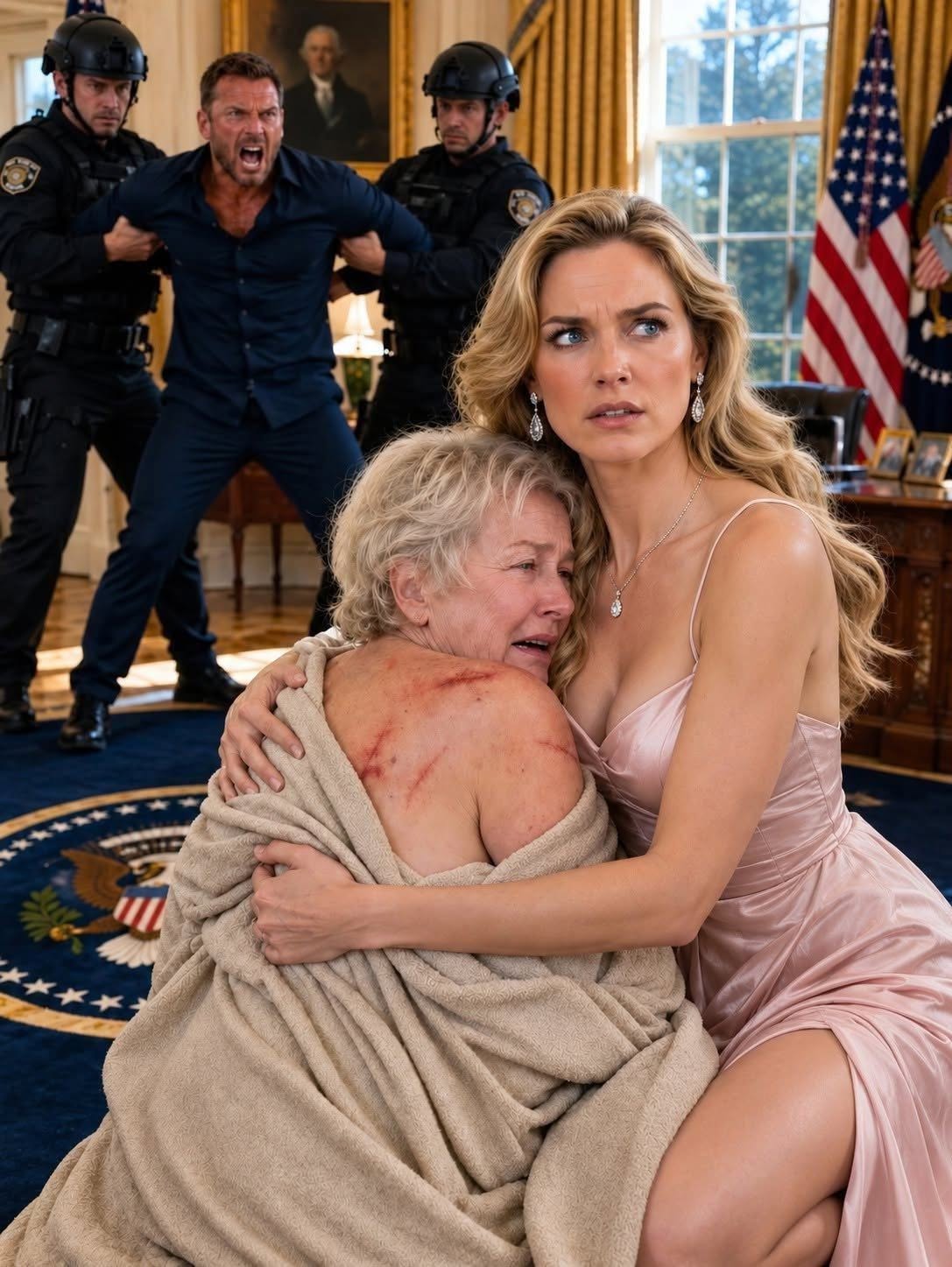
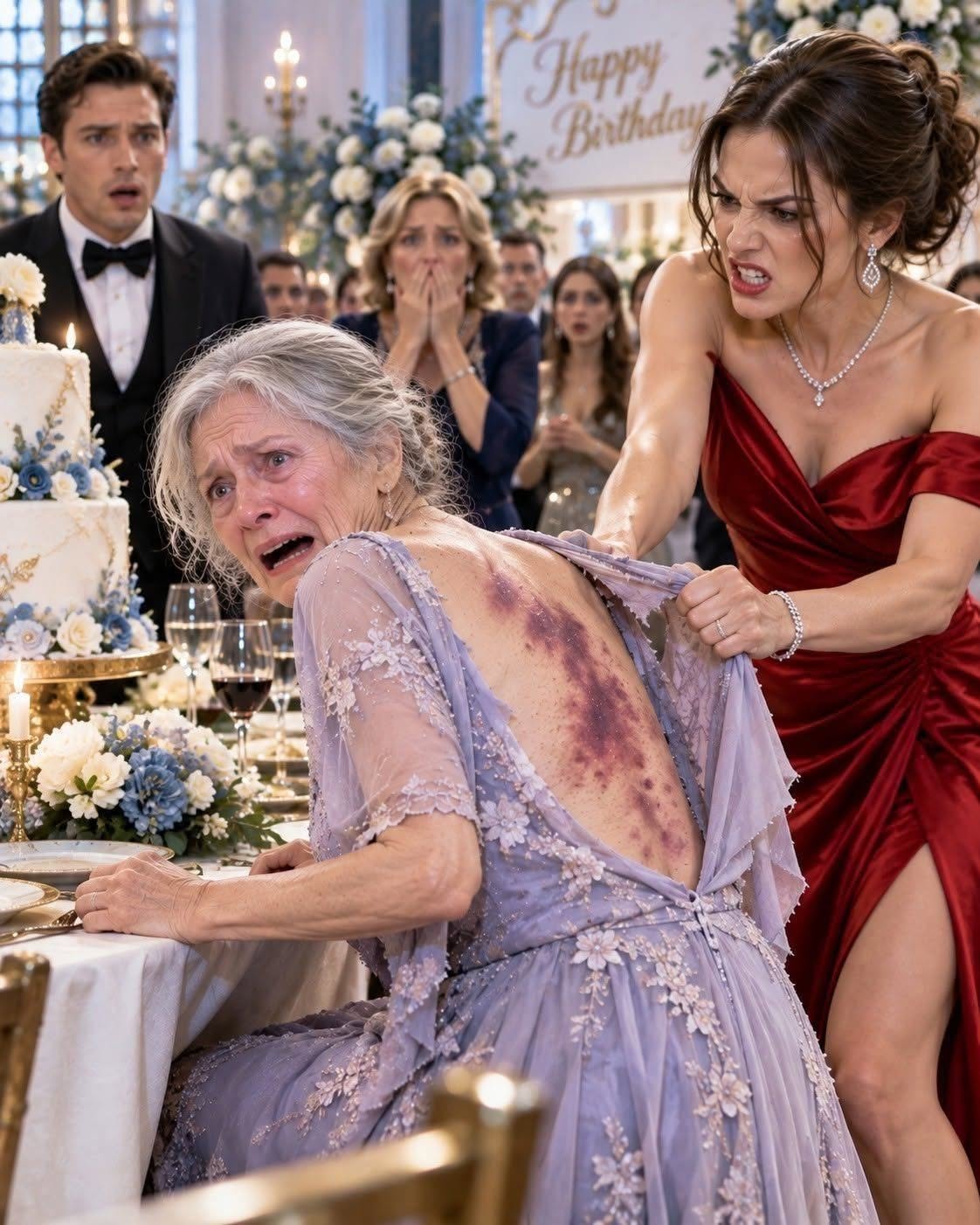
The lawyer did not speak immediately.
He looked first at my mother.
At her red cheek.
At the medicine bag still hanging from her trembling fingers.
Then he looked at my son, standing in the hallway with my phone clutched to his chest like it was the only shield he had.
Only after that did he turn toward my husband.
—Mr. Adrian Cole? —he asked.
My husband swallowed.
—Yes.
The two agents behind the lawyer stepped inside. They did not rush. They did not shout. They simply entered the living room, and somehow their silence felt heavier than any accusation.
My mother-in-law tried to fix her blouse, as if dignity could be buttoned back into place.
—There has been a misunderstanding —she said quickly—. This is a family matter.
The lawyer looked at her.
—A woman was struck in front of a child. Documents may have been altered. Property ownership may have been fraudulently transferred. That is no longer just a family matter.
My sister-in-law, Vanessa, still had her hand raised halfway, as if her body had not accepted that the second slap never landed.
Her face had changed.
The hate was still there, but fear had joined it.
—She provoked me —Vanessa said, pointing at my mother—. She came into this house acting like she owned it.
My mother slowly lifted her eyes.
Her cheek was red, but her voice was steady.
—No, dear. I came because my daughter was sick. I brought medicine, soup, and documents.
The lawyer turned to me.
—Mrs. Elena Cole, may I see the folder?
My hands shook as I passed it to him.
For weeks, I had carried that folder like a secret wound.
Bank transfers.
Screenshots.
Old emails.
Copies of the original deed.
A printed page showing a strange attempt to change the ownership registration.
And a line that had kept me awake for nights:
Beneficiary update request: Margaret Cole.
My mother-in-law.
The same woman who had sat on my sofa, eaten at my table, criticized my mother, and smiled while her daughter called us rubbish.
The lawyer opened the folder and reviewed the first pages.
One of the agents moved closer to my son.
Not too close.
Gently.
—May I take the phone, buddy? —he asked.
My son looked at me.
His little face was wet with tears.
I wanted to run to him, hold him, tell him he should never have had to record adults hurting his grandmother.
But my legs felt locked to the floor.
—It’s okay, Noah —I whispered—. Give it to him.
Noah walked forward.
My husband moved at the same time.
—Noah, give that to me.
My mother stepped between them.
I will never forget that moment.
A woman who had just been slapped.
A woman who could barely stand from exhaustion.
A woman everyone in that room had called old, useless, and in the way.
She stood in front of my child like a wall.
—Don’t you take one more step toward him —she said.
Adrian froze.
For a second, I saw anger flash across his face.
Not shame.
Not regret.
Anger.
Because even then, he thought the problem was that we were resisting.
Not what he had done.
The agent took the phone from Noah and started the recording.
At first, the screen showed the hallway.
My son’s small breathing was loud in the background.
Then Vanessa’s voice came through:
“The old woman must give up her place.”
My mother-in-law’s voice followed:
“Finally someone says it. This house doesn’t need two women running.”
My own voice came faintly, weak from fever, begging them to stop.
Then came the slap.
Even though I had already heard it in real life, hearing it again from the phone made my stomach twist.
My mother closed her eyes.
Noah started crying harder.
The agent stopped the video for a moment and looked at Vanessa.
—You struck her?
Vanessa folded her arms.
—She was interfering in my brother’s marriage.
The agent did not react.
That made it worse.
He simply wrote something down.
The video resumed.
Vanessa’s voice again:
“The second one is for three years lost.”
Then Noah’s cry.
Then Adrian’s voice.
Clear.
Cold.
Close enough to be undeniable.
“Make the old girl go away. If her mom is not around, she signs what we want.”
The room went completely still.
Not silent.
Still.
As if everyone had stopped being people for one second and become statues around the truth.
My mother-in-law gripped the back of the couch.
Vanessa’s lips parted.
Adrian closed his eyes.
The lawyer replayed that sentence.
“Make the old girl go away. If her mom is not around, she signs what we want.”
Then he replayed it again.
I felt something break inside me.
Not the way it had broken when Vanessa slapped my mother.
Not the way it had broken when Adrian told me not to make drama.
This was different.
This was the final breaking of the lie I had tried so hard to keep alive.
The lie that my husband was weak but not cruel.
The lie that he was pressured by his mother but still loved me.
The lie that if I explained enough, cried enough, waited enough, he would finally choose me.
He had chosen.
He chose the house.
The money.
The control.
And maybe, eventually, my son.
I turned to him.
—Noah heard you.
Adrian opened his eyes.
—Elena—
—No —I said.
My voice surprised me.
It was not loud.
But it was no longer shaking.
—No more.
He took one step toward me.
The second agent moved slightly between us.
Adrian stopped.
—You don’t understand. I never meant for Vanessa to hit your mother.
Vanessa turned sharply.
—Don’t put this on me.
My mother-in-law hissed:
—Both of you shut up.
The lawyer looked at her.
—Mrs. Margaret Cole, I recommend everyone in this room stop speaking unless asked a direct question.
She stared at him with offended pride.
—This house belongs to my son.
I laughed.
I did not mean to.
It just came out.
A small, broken, bitter laugh.
The lawyer turned one of the papers around and placed it on the table.
—No. According to the original deed, the property was purchased by Mrs. Elena Cole before the marriage. Her name appears as sole owner. The later modification attempt appears irregular and is currently under review.
My mother-in-law’s face tightened.
—She was supposed to transfer it after the wedding.
The lawyer lifted his eyes.
—Supposed to?
Vanessa whispered:
—Mom.
But Margaret was too angry to notice.
—A wife shares with her husband. That is how family works.
My mother looked at her.
—Family does not forge papers.
Margaret’s eyes snapped toward her.
—You stay out of this, old woman.
This time, my son spoke.
His small voice came from beside me.
—Don’t call my grandma that.
Everyone looked at him.
Noah wiped his face with his sleeve.
—She brings Mom soup. She helps me with homework. She doesn’t yell. She doesn’t take things.
My heart cracked open.
Adrian looked at him.
—Noah, come here.
Noah stepped behind me.
—No.
That tiny word destroyed Adrian more than any document.
Because my son had never refused him before.
Adrian looked at me as if I had made the child do it.
—You’re turning him against me.
I stared at him.
—No, Adrian. He heard you.
The lawyer closed the folder.
—Mrs. Cole, based on what I am seeing and hearing, we can proceed with an emergency protective request regarding the property, financial access, and the child’s immediate environment. The agents will document the incident involving your mother and the recording.
Margaret snapped:
—Protective request? Against my son?
My mother finally stepped closer to the table.
She placed the medicine bag down.
It made a soft sound.
So small.
So ordinary.
Medicine, soup, care.
That was what she had brought into this house.
And they had answered with contempt.
—Against anyone who thinks my daughter is easier to steal from when she is alone —my mother said.
For the first time, Margaret did not reply.
The agent asked my mother if she wanted medical attention.
She touched her cheek and shook her head.
—Later. First, my daughter and grandson leave this house.
Adrian’s head snapped up.
—Noah is not leaving.
My whole body went cold.
There it was.
The thing I had feared without daring to name.
Not just my house.
Not just my money.
My son.
The lawyer stepped forward.
—Mr. Cole, do not make this worse.
Adrian pointed at me.
—She’s unstable. She’s been sick for days. Her mother is controlling her. My family has been helping because she can’t manage.
I stared at him.
Three years of marriage folded into that sentence.
Every night I worked late while he said I was “too tired to think clearly.”
Every time his mother called me fragile when I disagreed.
Every moment they made my exhaustion look like weakness.
They had not just been insulting me.
They had been building a story.
A story where I was incapable.
A story where they were the responsible ones.
A story that could take my home, my savings, and maybe even my child.
My mother grabbed my hand.
—Breathe, Elena.
I did.
Once.
Twice.
Then I turned to the lawyer.
—What do I need to do?
Adrian stared at me.
—You’re really going to do this?
I looked at him.
—You did this when you said my mother had to disappear so I would sign.
He shook his head.
—That was anger.
—No. Anger is shouting. This was planning.
Vanessa moved toward the hallway.
One of the agents stopped her.
—Please stay where you are.
She turned red.
—I didn’t do anything except defend my family.
My mother looked at her cheekily, though her eyes were tired.
—You slapped an elderly woman who came with medicine.
Vanessa looked away.
The agent asked for identification.
Vanessa refused at first.
Then, when the lawyer quietly reminded her the video already showed the incident, she pulled out her ID with shaking hands.
Margaret sat down slowly.
For once, she looked old.
Not wise.
Not gentle.
Just old in the way cruel people look when power starts leaving them.
—Elena, listen to me —she said, changing her tone—. We are family. This got out of hand. Vanessa should not have slapped your mother. Adrian should not have said those words. But do you really want strangers handling our private matters?
I looked at her.
That soft voice would have worked on me a year ago.
Maybe even six months ago.
She would have said “family,” and I would have doubted myself.
She would have said “private,” and I would have hidden the wound.
She would have said “think of Noah,” and I would have stayed.
But my son had already thought of me.
He had recorded the truth with hands too small for such a burden.
My mother had already thought of me.
She had kept the documents safe while they tried to isolate me.
Now it was my turn.
—Private is where you hurt us —I said. —Documented is where it stops.
The lawyer nodded slightly.
The agents began taking statements.
My mother described what happened.
I described the transfers.
Noah was not questioned deeply in front of them. The lawyer said a child specialist would handle anything further if needed. I was grateful. He had already carried too much.
Adrian kept pacing.
Margaret kept whispering to him.
Vanessa cried suddenly, loudly, saying she had been stressed, that she had lost three years watching me “take over” her brother, that my mother had been disrespectful simply by being present.
No one comforted her.
That seemed to shock her most.
After years of shouting louder than everyone else, she had mistaken attention for innocence.
The lawyer asked if I had somewhere safe to stay that night.
Before I could answer, my mother said:
—My apartment.
Adrian laughed bitterly.
—That tiny place? You’re taking my son there?
I turned to him.
—Our son will sleep somewhere no one calls his grandmother rubbish.
Noah clutched my hand.
—I want to go with Mom.
Adrian’s face twisted.
—Noah—
The lawyer interrupted.
—Given the recording, the physical aggression, and the statements made, I strongly suggest you do not pressure the child right now.
Adrian looked like he wanted to argue.
But the agents were there.
The lawyer was there.
My mother was there.
And, for the first time in years, I was there too.
Not just physically.
Fully.
I went upstairs to pack a bag.
My mother wanted to come with me, but I told her to stay with Noah.
The bedroom looked normal.
That almost made me sick.
The bed was made.
The curtains were open.
His watch was on the dresser.
My sweater was on the chair.
A normal room.
Inside a house where people had discussed making my mother disappear from my life so they could force my signature.
I opened the closet and took only what mattered.
Documents.
Noah’s birth certificate.
A few clothes.
My laptop.
My old external drive.
The small box where I kept my father’s ring.
Then I saw the drawer on Adrian’s side slightly open.
I should have walked away.
But something made me pull it.
Inside was an envelope.
My name was written on it.
Not in my handwriting.
Inside were printed forms.
A request to transfer property interest.
A financial authorization.
A draft statement saying I was willingly granting Adrian management over my assets because of “ongoing health and emotional instability.”
At the bottom, there was a blank space for my signature.
I sat on the bed.
For a moment, the room tilted.
They had prepared the paper.
They had prepared the story.
All they needed was to break me enough to sign.
And if my mother had not come…
If Noah had not recorded…
If the lawyer had not arrived…
Maybe tomorrow, while feverish and exhausted, surrounded by people telling me I was dramatic and incapable, I might have signed just to make the pressure stop.
I took the envelope downstairs.
Adrian saw it in my hand and stopped breathing.
The lawyer noticed.
—Where did you find that?
—His drawer.
Adrian walked toward me.
—That is not what it looks like.
I almost smiled.
Not because it was funny.
Because every guilty person in that room had used the same sentence in different ways.
Misunderstanding.
Family matter.
Provoked.
Not what it looks like.
But the paper did not care about their excuses.
The lawyer took the envelope.
His expression hardened as he read.
—This will be added to the file.
Margaret stood.
—Those papers were only a precaution.
My mother asked quietly:
—Against what? My daughter owning what is hers?
No answer.
None.
For the first time, they had no story ready.
The agents finished the initial report.
Vanessa was informed that the assault complaint could proceed.
Adrian was warned not to interfere with me leaving.
Margaret kept saying this would ruin the family.
My mother finally turned to her and said:
—No. You ruined the family when you taught them that control was love.
Margaret looked at her with pure hatred.
—You think you won because you brought papers?
My mother touched her red cheek.
—No. I think I survived long enough to teach my daughter not to stay where she is being erased.
I cried then.
Quietly.
I could not stop it.
Noah hugged my waist.
—Mom, don’t cry.
I knelt in front of him.
—These are not bad tears, baby.
—Are we going home?
I looked around the room.
The house I bought.
The walls I painted.
The kitchen where I cooked.
The table where they insulted my mother.
—Not tonight —I said. —Tonight we go somewhere safe. But this house is ours. We are not giving it away.
He nodded seriously.
My little boy.
Too serious.
Too brave.
Too young for all of this.
We left with two bags.
My mother walked beside me.
Noah held my hand.
The lawyer walked behind us.
As we reached the door, Adrian spoke.
—Elena.
I stopped, but did not turn.
—Please. I love you.
That word once would have pulled me back like a rope.
Love.
I used to think love meant staying through confusion.
Staying through pressure.
Staying until people changed.
But that night I understood something simple:
Love without safety becomes a cage.
I turned slowly.
—You loved what I owned. You loved what I tolerated. You loved that I kept forgiving you before I understood what you were doing.
His face crumpled.
—That’s not true.
I looked at the envelope in the lawyer’s hand.
Then at my mother’s cheek.
Then at my son’s tearful face.
—It is true enough.
I walked out.
The air outside was cold.
My mother’s car was parked near the curb. It was old, small, and had a blanket thrown over the back seat. She opened the door for Noah first, then helped me in like I was the one who had been struck.
Maybe I had been.
Not on the face.
Some wounds do not leave marks where people can photograph them.
At her apartment, she made tea.
Noah fell asleep on the couch with his shoes still on.
My mother sat beside me at the tiny kitchen table.
Her cheek had started to bruise.
I reached toward it and broke down.
—Mom, I’m sorry.
She took my hand.
—No.
—They hit you because of me.
—They hit me because they were losing control.
I cried harder.
—Noah saw everything.
Her eyes filled too.
—Yes. And now he also saw you leave.
That sentence stayed with me.
He saw the slap.
He heard his father.
But he also saw me walk out.
He saw his grandmother stand tall.
He saw adults come with documents and truth.
He saw that fear does not have to be the end of the story.
The next morning, the legal process began.
Emergency protections.
Property review.
Financial freezes.
A formal complaint for assault.
A review of attempted document manipulation.
The lawyer moved quickly because the evidence was clear and recent.
Adrian sent dozens of messages.
First apologies.
Then anger.
Then guilt.
Then fear.
“Vanessa didn’t mean it.”
“My mom is devastated.”
“You’re taking my son from me.”
“You’re destroying everything.”
“I was under pressure.”
“I love you.”
I read them with my lawyer.
Not alone.
Never alone again.
My mother changed all my passwords with me at the kitchen table. Bank. Email. Cloud storage. School contacts. Medical information. Property accounts.
Every password changed felt like a lock returning to my own hand.
Vanessa tried to post online that my mother had attacked the family first.
Then the lawyer sent a notice.
The post disappeared.
Margaret called relatives, saying I was unstable and dangerous.
Then the recording spread among the very people she had tried to impress.
Not publicly.
Not virally.
Just enough.
Enough for whispers to change direction.
Enough for people to stop asking why I left and start asking what they had done.

Adrian asked to see Noah.
The lawyer arranged a supervised setting until the court reviewed everything.
The first time Noah saw him, he stayed close to me.
Adrian cried.
Noah did not run into his arms.
That hurt to watch.
But I did not force my child to comfort the man who had frightened him.
After the meeting, Noah asked me:
—Is Dad bad?
I held him close.
—Your dad made very bad choices. Adults have to take responsibility for bad choices.
—Will Grandma Margaret come back?
—Not near us unless it is safe.
He thought about that.
—Grandma Rose is safe.
My mother was in the kitchen, pretending not to listen.
Her shoulders shook.
—Yes —I said, smiling through tears—. Grandma Rose is safe.
Weeks passed.
The court did not give them what they expected.
The house remained protected under my ownership while the investigation continued.
The attempted documents became evidence.
The transfers were traced.
Some had gone to Margaret.
Some to accounts connected to Vanessa.
Some had been used for expenses Adrian claimed were “family needs.”
Family needs.
Another phrase that sounded clean until you saw who paid and who was silenced.
I returned to the house only once at first, with the lawyer and an officer present.
It looked different.
Not because the furniture had changed.
Because I had.
Margaret’s favorite vase was still on the shelf.
Vanessa’s scarf was still over a chair.
Adrian’s shoes were by the door.
I realized how much space they had taken in a house that was mine.
Not just physically.
Emotionally.
Their opinions were in the curtains.
Their criticism was in the kitchen.
Their entitlement was in the hallway.
I stood in the living room where my mother had been slapped.
Then I walked to the table and removed Margaret’s vase.
I put it in a box.
Not angrily.
Calmly.
That felt better.
Eventually, Adrian had to leave the property.
He did not go quietly at first.
He pleaded.
He blamed his mother.
He blamed stress.
He blamed marriage.
He blamed money.
But when the lawyer placed the draft statement about my “emotional instability” in front of him, his excuses began to collapse.
—My mother wrote most of it —he said.
I looked at him.
—But you kept it in your drawer.
He had no answer.
That became the story of him.
No answer.
For the changed email.
No answer.
For the transfers.
No answer.
For letting his sister raise her hand.
No answer.
For telling them to make my mother go away.
Love with no answer is not enough.
Months later, my mother and I sat in my kitchen again.
My kitchen.
Clean.
Quiet.
Safe.
Noah was at the table drawing a picture of three people holding hands in front of a house.
He labeled them:
Mom.
Me.
Grandma.
There was no crown on anyone’s head.
No one stood outside.
No one was smaller.
Everyone had a place.
My mother watched him and whispered:
—He will remember this.
I nodded.
—That scares me.
—It should also give you peace.
I looked at her.
She touched my hand.
—He will remember that something bad happened. But he will also remember that you did not stay.
That was true.
And maybe that mattered most.
Adrian continued therapy. He asked for mediation. He admitted some things, denied others, and tried to separate himself from his mother whenever consequences came close.
I did not rush forgiveness.
I did not confuse regret with repair.
Margaret never apologized.
Vanessa sent one message through a relative saying she had “lost control for one second.”
My mother read it and said:
—A slap takes one second. The contempt behind it took years.
I kept that sentence.
Because it was true.
The slap was not the beginning.
It was the moment everyone could finally see what had been living in the house all along.
Control.
Greed.
Disrespect.
The belief that an older woman could be discarded.
The belief that a sick wife could be pressured.
The belief that a child could be used later if the mother was made weak enough.
But they were wrong.
My mother was not rubbish.
She was the person who carried the missing documents in a medicine bag.
My son was not too young to understand.
He understood enough to record the truth.
And I was not alone.
That was the part they had never planned for.
They thought if they removed my mother, I would sign.
They thought if they frightened my son, he would obey.
They thought if they surrounded me with voices, I would doubt myself.
But that night, the wrong person saw everything.
A seven-year-old boy.
A grandmother with a bruised cheek.
A lawyer with the file they thought had vanished.
And a woman who finally realized the house had never been the place where she was trapped.
It was the proof of what she had survived.
Now, when I sit at my table, my mother sits beside me.
Not standing.
Not apologizing for taking space.
Noah sets three plates.
Sometimes he sets four, out of habit, then looks at the empty place and quietly takes one away.
I do not rush him.
Healing has its own small rituals.
One evening, he asked:
—Mom, can Grandma Rose always have this chair?
My mother smiled.
—I don’t need a special chair.
Noah frowned.
—But no one can tell you to give up your place.
I looked at my mother.
Her eyes filled with tears.
—No, sweetheart —she said softly—. No one can.
And that became our new rule.
In my house, no one gives up their place because someone cruel decides they are old, weak, inconvenient, or easy to erase.
In my house, medicine bags are welcome.
Grandmothers sit.
Children speak.
Mothers rest.
Documents stay in their rightful names.
And love is not measured by how much a woman can endure before she breaks.
My mother-in-law once said the old woman must give up her place.
But she did not know the old woman had brought the papers.
She did not know my son had recorded the truth.
She did not know the house was mine.
And she did not know that the moment her daughter raised a hand, the place they were trying to steal from us would become the very place where their lies finally fell apart.