The first slap did not hurt as much as the silence after it.
That was the part I remembered most clearly.
Not her hand hitting my cheek.
Not the sting spreading across my skin.
Not even the humiliation of standing barefoot in the front yard while half the neighborhood watched through curtains and cracked blinds.
It was the silence.
The way the street went still, as if every bird, every car engine, every rustling tree had stopped breathing with me.
My mother-in-law, Patricia Whitmore, stood in front of me with her chest heaving and her diamond bracelet flashing in the porch light. She was sixty-one, elegant, terrifying, and fully convinced that the world owed her obedience.
“You admit it now,” she hissed. “You did something to Winston.”
Winston was her dog.
A cream-colored little Maltese with a velvet collar, a private groomer, monogrammed sweaters, and a bedroom larger than the one I had grown up in.
Patricia treated Winston like royalty.
She called him “my baby.”
She called me “that girl.”
I had been married to her son, Daniel, for sixteen months, and in all that time, Patricia had never once said my name without making it sound like an accusation.
“Claire,” she would say, slowly, like the word tasted cheap.
That evening had started with a bowl of dog food.
That was the stupid, unbelievable truth.
Winston had walked into the kitchen, sniffed his expensive duck-and-sweet-potato dinner, sneezed, and backed away.
I had been at the sink rinsing lettuce for dinner. I barely noticed.
Patricia noticed everything.
She looked at Winston.
Then at the bowl.
Then at me.
“What did you give him?”
I turned around. “Nothing.”
Her eyes narrowed. “Don’t lie to me.”
“I’m not lying. I haven’t touched his food.”
Winston trotted toward the back hallway, stopped, and looked toward the front windows. His ears twitched.
Patricia scooped up the bowl and shoved it toward me. “He never refuses dinner.”
“Maybe he’s not hungry.”
“He is always hungry.”
“Then maybe he smelled something outside.”
That was when her face changed.
Not anger yet.
Fear.
It flickered across her features so fast I almost missed it.
Then she became furious.
“You fed him scraps. Didn’t you?”
“No.”
“You probably gave him something from your plate because you think you know better than me.”
“I didn’t.”
“Do not take that tone in my house.”
That was another thing Patricia loved saying.
My house.
Even though Daniel had bought it before we were married.
Even though her name was not on the deed.
Even though she only stayed with us “temporarily” after her condo renovation had somehow stretched from six weeks to almost a year.
I should have walked away.
But I was tired.
Tired of lowering my voice.
Tired of apologizing for breathing wrong.
Tired of watching Daniel work late while his mother filled the house with perfume, criticism, and fear.
So I said, quietly, “Patricia, this is not about me. The dog didn’t eat. That’s all.”
Her lips parted.
For one second, I thought she might actually hear me.
Instead, she grabbed my wrist.
Hard.
“Outside,” she snapped.
“What?”
“Outside. Right now.”
I tried to pull back. “Let go of me.”
She dragged me through the foyer, past the polished mirror, past the framed wedding photo where Daniel and I still looked foolishly hopeful.
“Patricia, stop!”
She opened the front door and yanked me onto the porch.
The evening air was cold. The grass was damp beneath my feet.
Across the street, Mrs. Alvarez’s curtains moved.
Next door, Mr. Chen stood frozen behind his screen door.
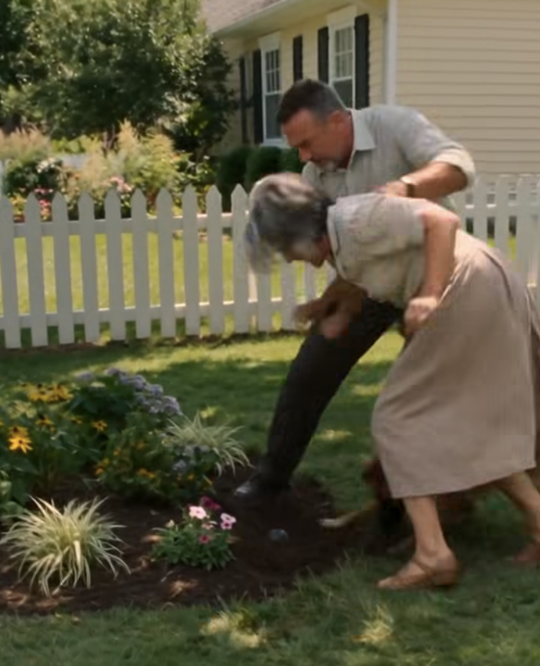
Patricia shoved me onto the lawn.
“You wanted attention?” she shouted. “Now you have it.”
My throat closed.
“Please don’t do this.”
“Then admit what you did.”
“I didn’t do anything!”
The first slap came so fast I did not see her arm move.
My head snapped sideways.
A sharp gasp came from somewhere across the street.
Patricia pointed at me. “You poisoned his appetite.”
“That doesn’t even make sense.”
Another slap.
This one split the inside of my lip against my tooth.
I tasted blood.
She grabbed my hair when I tried to turn away.
“You think because my son married you, you own this family?”
I whispered, “No.”
“You think you can replace me?”
“No.”
“You think you can take what belongs to me?”
That sentence landed differently.
It was too sharp.
Too specific.
Before I could answer, Winston exploded out of the open front door.
He ran past Patricia without looking at her.
Past me.
Straight to the flowerbed beneath the magnolia tree.
Then he began barking.
Not yapping.
Barking.
Deep, frantic, desperate sounds that seemed too large for his little body.
Patricia froze.
“Winston?”
The dog clawed at the dirt.
“Stop that,” she said.
He dug harder.
Soil flew behind him.
Neighbors stepped out onto porches now.
“Winston, come here!”
He ignored her.
The flowerbed had always bothered me.
It was the only ugly thing in Patricia’s perfect world.
A narrow strip beneath the magnolia where nothing grew right. The soil was uneven, patched with dying marigolds she claimed were “seasonal,” though she replaced the rest of the landscaping monthly.
Winston dug like his life depended on it.
Then something black appeared beneath the dirt.
A corner.
Plastic.
Mrs. Alvarez crossed the street first. “Claire, are you okay?”
I could not answer.
Patricia lunged toward Winston. “Leave it!”
But the dog had already uncovered enough.
A black waterproof pouch lay half-buried in the flowerbed.
Patricia’s face went gray.
Not pale.
Gray.
Like all the blood had drained from her and left only ash.
She whispered, “No.”
Mr. Chen stepped closer. “What is that?”
Patricia tried to grab it.
Winston snarled.
Everyone froze.
I had never heard Winston growl at Patricia before.
He planted his tiny body between her and the pouch, teeth bared, trembling with fury.
That was the moment I understood.
The dog had not refused dinner because of me.
He had refused because he smelled something.
Something buried.
Something Patricia did not want found.
My hands shook as I stepped forward.
“Claire,” Patricia said, suddenly soft. “Don’t.”
It was the first time she had said my name like a plea.
I picked up the pouch.
It was heavier than I expected.
Mud smeared my fingers.
Inside was a phone.
An old black phone sealed in plastic.
A man’s watch.
A bundle of documents.
And a small velvet box.
Patricia made a sound like she had been stabbed.
Mrs. Alvarez whispered, “Call the police.”
“No!” Patricia cried.
That one word told us everything.
Daniel arrived twelve minutes later.
By then, two patrol cars were parked by the curb, red and blue lights washing over the house like judgment.
My husband ran across the lawn still wearing his work badge, his tie loose, his face wild.
“Claire!”
He reached me and stopped dead when he saw my cheek.
His expression broke.
“Who did this?”
I looked at his mother.
So did everyone else.
Daniel turned slowly.
“Mom?”
Patricia stood near the porch with a blanket around her shoulders, performing fragility now that witnesses had appeared.
“She attacked me,” Patricia said weakly. “She became hysterical.”
Daniel looked at me again.
I had never seen him so torn.
That hurt more than the slap.
Because for sixteen months I had waited for him to see.
Not hear.
Not suspect.
See.
An officer held up the muddy pouch. “Sir, do you recognize these items?”
Daniel frowned.
Then his face changed.
He took one step closer.
“That’s my father’s watch.”
Patricia closed her eyes.
Daniel’s father, Robert Whitmore, had died three years before I met Daniel.
A heart attack, Patricia always said.
Sudden.
Tragic.
Conveniently private.
Daniel had adored him.
There was a framed photo of Robert in the study: kind eyes, silver hair, one hand resting on Daniel’s shoulder at his college graduation.
Daniel picked up the watch with trembling fingers.
“He was wearing this the week before he died,” he whispered. “Mom said it was lost at the hospital.”
The officer opened the waterproof phone.
It still powered on.
Barely.
The screen flickered.
Patricia whispered, “Daniel, please.”
He stared at her. “What did you do?”
She shook her head. “I protected you.”
The words made my skin go cold.
The police took the phone inside to charge it.
Patricia sat in the living room under the chandelier she had chosen, surrounded by the expensive furniture she had criticized me for touching.
No one spoke.
Winston sat beside my feet.
Not hers.
Daniel knelt in front of me with an ice pack.
“I’m sorry,” he whispered.
I wanted to forgive him immediately.
I wanted to fall into his arms and pretend this was the beginning of healing.
But there are wounds love does not erase in one apology.
“You didn’t believe me,” I said.
His eyes filled. “I didn’t want to believe my mother could be cruel.”
“She was cruel every day.”
“I know.”
“No, Daniel. You didn’t know. You looked away.”
He bowed his head.
For once, he did not defend her.
The phone finished charging.
One officer opened the video folder.
The first video showed Robert Whitmore.
Alive.
Sitting in the study.
His voice was weak, but clear.
“If anything happens to me, Daniel, look at the trust documents. Your mother has been moving money. Not small amounts. Millions. I confronted her tonight.”
Daniel gripped the edge of the table.
The video shook as Robert adjusted the phone.
“She thinks I’m going to cut her off. I am. But not you. Never you. And not the woman you marry someday, if she loves you honestly. I’ve changed the trust. Patricia cannot touch the house, the company shares, or the family foundation.”
Patricia sobbed once.
The officer played the next video.
This one was audio only.
Robert’s voice.
Then Patricia’s.
“You ungrateful old fool,” she snapped. “After everything I gave up for this family?”
“You stole from it,” Robert said.
“I built your image. I hosted your donors. I raised your son.”
“You raised Daniel to fear disappointing you.”
A long silence.
Then Robert said, “Tomorrow I’m giving everything to the attorneys.”
Patricia’s voice dropped.
“You won’t make it to tomorrow.”
Daniel made a broken sound.
The officer stopped the recording.
Patricia stood suddenly. “He was sick! He was confused!”
Another officer stepped in front of her. “Mrs. Whitmore, sit down.”
But Daniel was staring at the documents now.
His father’s signature.
Trust amendments.
Bank records.
A letter addressed to him.
The velvet box contained not jewelry, but a key.
A small brass key labeled: Magnolia.
Daniel looked toward the front window.
At the flowerbed.
At the tree.
His father had hidden everything beneath the magnolia.
And Winston had found it.
Not that night.
Not by accident.
Slowly, another memory surfaced.
A week earlier, Winston had refused to walk past the front window.
Three days earlier, he had barked at the flowerbed until Patricia screamed at him.
That morning, I had seen mud on his paws.
Patricia had shoved him into the laundry room and locked the door.
She knew.
Maybe not exactly what was buried.
But she knew enough to be afraid.
And when Winston refused dinner, she panicked.
She needed someone to blame.
Someone powerless.
Me.
Except I was not powerless anymore.
Patricia was arrested before midnight.
Not for Robert’s death yet.
That investigation would take time.
But for assaulting me in front of witnesses.
For obstruction.
For the stolen documents.
Daniel stood on the porch as they put her in the back of the patrol car.
She looked at him through the window.
“Daniel,” she cried. “I’m your mother.”
He swallowed hard.
Then he said, “And Claire is my wife.”
It was the first time he had chosen me out loud.
The weeks after that were not simple.
Happy endings never arrive clean.
They come limping.
They come with lawyers, therapy appointments, sleepless nights, and boxes of someone else’s belongings stacked by the door.
Patricia’s condo renovation, we discovered, had never existed. She had sold it quietly and funneled the money into an account under a cousin’s name. She had been planning to force Daniel to sign over partial ownership of the house by convincing him I was unstable, manipulative, dangerous.
The dog food incident had been part of a larger story she was building.
Poor Patricia.
Poor Winston.
Poor Daniel, trapped between a scheming wife and a helpless mother.
But Winston ruined the script.
The smallest creature in the house had been the bravest.
Robert’s buried phone led investigators to old medical records, financial transfers, and a pharmacy receipt that reopened the case around his death. Patricia had not simply stolen money.
She had likely caused the “heart attack” everyone had mourned.
Daniel did not speak for almost a day after learning that.
He sat in the study holding his father’s letter.
When he finally let me read it, I cried.
Daniel,
If you are reading this, I failed to protect you while I was alive. I hope I have protected you after. Your mother’s love has always had a price. Real love does not make you smaller. Real love gives you room to breathe.
One day, choose someone who lets you breathe.
And when you find her, defend her sooner than I defended myself.
I looked up through tears.
Daniel was crying too.
“I failed you,” he said.
I touched his hand. “You were trained not to see her.”
“That doesn’t excuse it.”
“No. But it explains where we start.”
So we started.
He asked his mother to stay away.
He changed the locks.
He began therapy.
He apologized not once, but every time another memory surfaced and I realized how alone I had been.
He learned that love was not a feeling he could claim while staying silent.
It was a choice.
A hard one.
A daily one.
As for me, I pressed charges.
Not because I hated Patricia.
Because I finally loved myself enough not to swallow violence and call it family.
The neighborhood changed too.
Mrs. Alvarez brought soup.
Mr. Chen fixed the broken porch light without asking.
People who had once watched quietly began knocking on the door, embarrassed and kind.
One afternoon, a little girl from across the street brought Winston a blue ribbon that said HERO.
He wore it for three days.
Proudly.
Six months later, the magnolia bloomed.
That shocked me most of all.
For years, Patricia had said nothing would grow there because the soil was bad.
But after the police finished digging, Daniel and I cleared the bed ourselves.
We found old plastic, broken glass, dead roots, and a rusted little lockbox Patricia must have missed.
Inside was one final letter.
Not from Robert.
From Daniel’s grandmother.
The original deed to the house had been placed in a family protection trust long before Patricia married Robert.
The house could never belong to Patricia.
It had always been meant to pass to Daniel—and someday, to the family he chose.
Daniel laughed when he read it.
A soft, disbelieving laugh.
“She spent years trying to steal something that was never available to her.”
I looked at the magnolia blossoms, pale and open against the sky.
“No,” I said. “She spent years burying the truth.”
Winston sneezed, then began digging near a fresh patch of soil.
Daniel and I both shouted, “No!”
For the first time in months, we laughed until we cried.
A year later, we renewed our vows under that same magnolia tree.
No ballroom.
No grand guest list.
Just friends, neighbors, Daniel’s father’s photo on a small table, and Winston in a ridiculous tuxedo harness.
Daniel held my hands and said, “I promise never again to confuse peace with silence. I promise to hear you the first time. I promise to stand beside you before the world forces me to.”
When it was my turn, I looked at the man who had almost lost me, the house that had nearly swallowed me, and the tree that had given everything back.
“I promise to stay,” I said, “only where love is safe.”
Daniel’s eyes filled.
Winston barked once, as if approving the contract.
Everyone laughed.
And for once, no one told him to be quiet.
That evening, after the guests left, Daniel and I sat on the porch with Winston between us.
The yard was peaceful.
The flowerbed was full of white roses, lavender, and marigolds that finally lived.
Across the street, lights glowed warmly in windows that had once hidden silent witnesses.
Daniel leaned his head against mine.
“Do you ever think about that night?” he asked.
I touched my cheek.
There was no mark anymore.
But memory has its own bruises.
“Yes,” I said. “But not only the bad part.”
He looked at me.
“I think about how truth has a smell,” I said. “How it rises through dirt. How even when someone buries it deep, something innocent can still find it.”
Winston lifted his head at the word dirt.
“No,” Daniel warned.
The dog lowered his chin again.
I smiled.
For the first time in a long time, the house felt like ours.
Not Patricia’s.
Not Robert’s shadow.
Not a battlefield.
Ours.
And in the yard where I had once been dragged, humiliated, and slapped over a dog’s untouched dinner, flowers were blooming over the place where a secret had been buried.
The same dog who refused to eat had fed us the truth.
And somehow, that truth gave us back our lives.
