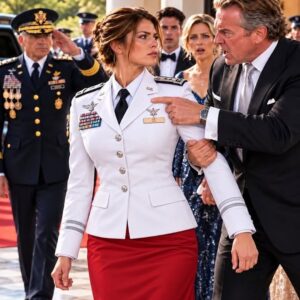
For nine years, I had believed my sister was d/e/@/d.
For almost my entire life, I had believed my biological father was d/e/@/d too.
Now both of them stood in front of me.
Alive.
And each seemed more afraid of General Samuel Wren than of anything the Army had ever trained us to face.
Daniel Harper left his cane on the concrete.
He didn’t pick it up.
He simply stood beside the helicopter, staring at Claire and me as if moving too quickly might make us disappear.
Wren broke the silence first.
“Daniel.”
My father’s eyes shifted toward him.
“Samuel.”
There was forty years of history inside that single word.
Mercer moved closer to me.
“Evelyn, stay where you are.”
I almost laughed.
Everyone had spent the last hour telling me where to stand.
Davis had ordered me onto a firing line.
Mercer had ordered me into a vehicle.
Claire had drawn me into a secret buried for decades.
Wren apparently believed my entire life had been an experiment.
I was finished standing where other people placed me.
I walked toward Daniel.
Wren said:
“Captain Harper.”
I kept walking.
He raised his voice.
“That is an order.”
I stopped.
Not because of the order.
Because of what he had called me.
Captain.
Combat Group Charlie knew me as Private Harper.
My temporary personnel file knew me as Private Harper.
Even most of the installation’s command staff knew only the cover identity.
Wren knew my real former rank.
I turned.
“How?”
He smiled faintly.
“How what?”
“How did you know?”
Mercer understood immediately.
Her expression hardened.
Wren’s smile faded.
I continued.
“My reinstated rank is compartmented.”
Claire stepped beside me.
“He knows because he never stopped watching.”
Daniel finally reached us.
Up close, the resemblance was almost unbearable.
The shape of his eyes.
The way one eyebrow lifted slightly higher when he was angry.
Even the tiny vertical line between his brows.
I had seen that face every morning of my life.
In my own mirror.
Daniel looked at me.
“Evelyn?”
I couldn’t speak.
He looked toward Claire.
She couldn’t either.
For all our training, all our discipline, all the identities we had worn, we were suddenly two daughters standing in front of the father we had never known.
Daniel opened his arms.
Claire moved first.
She collided with him so hard he nearly lost his balance.
I caught them both.
And then I was inside the embrace too.
No military training prepared you for grief reversing itself.
You learn to survive loss by building walls around empty spaces.
You tell yourself the missing person is gone.
You build routines around the absence.
Eventually the absence becomes part of the architecture of your life.
Then imagine someone tearing down the wall and telling you the empty room was never empty.
I buried my face against Daniel’s shoulder.
He was real.
Warm.
Shaking.
“I’m sorry,” he whispered.
Claire gripped his jacket.
“You were alive.”
“Yes.”
“All this time?”
“Yes.”
“Why?”
Daniel closed his eyes.
“Because I thought staying gone kept you safe.”
Claire pushed away.
“Safe?”
Her voice broke.
“They sent us into Raven Valley!”
Daniel’s face collapsed.
“I know.”
“You knew?”
“Not until afterward.”
She stared at him.
I stepped between them.
“Start at the beginning.”
Wren approached.
Daniel looked at him.
“No.”
Wren stopped.
Daniel’s voice became stronger.
“You don’t get to tell this story.”
Something in Wren’s expression changed.
Mercer motioned toward the investigator.
He quietly moved toward the hangar control room.
Wren noticed.
“General Mercer.”
She met his gaze.
“Yes?”
“Tell your investigator to stop.”
“No.”
His face hardened.
“You are interfering with a classified operation.”
Mercer looked around the hangar.
“So classify my court-martial.”
Foster almost smiled.
Wren didn’t.
Daniel looked at Claire and me.
“In 1979, I was twenty-three years old.”
He paused.
“I thought I was going to change the world.”
He had been recruited into Project Raven after demonstrating unusual spatial memory and visual processing during officer training.
The project itself had begun innocently enough.
Researchers wanted to understand why certain soldiers could process complicated environments more quickly than others.
Why some remembered terrain after seeing it once.
Why some detected movement other people missed.
Why some remained calm under extraordinary stress.
Daniel was one of the highest-scoring candidates.
Samuel Wren was another.
I looked toward the four-star general.
“You were Raven?”
Wren said nothing.
Daniel nodded.
“We were partners.”
Claire laughed bitterly.
“That explains a lot.”
Daniel continued.
“We became friends.”
His eyes remained on Wren.
“Brothers, almost.”
For several years, they trained together.
Observed together.
Deployed together.
Then Daniel discovered something troubling.
The program had begun following candidates after they left.
Not merely monitoring careers.
Influencing them.
Promotions.
Assignments.
Evaluations.
If someone performed well under pressure, Raven quietly pushed them toward increasingly demanding positions.
If someone resisted the program, their opportunities disappeared.
Human lives had become variables.
Daniel objected.
Wren did not.
“I believed in the mission,” Wren said.
Daniel looked at him.
“You believed people belonged to the mission.”
“There is a difference between idealism and national security.”
“There is also a difference between service and ownership.”
Wren’s jaw tightened.
Daniel turned back to us.
“When your mother became pregnant, I requested separation from Raven.”
My throat tightened.
“You knew about us?”
He smiled sadly.
“I heard two heartbeats during the ultrasound.”
Claire began crying again.
Daniel continued.
“I had never been more frightened or happier.”
He planned to leave.
He had already arranged civilian employment.
Then he discovered the program had opened files on the unborn twins.
On us.
Claire’s expression went cold.
“Before we were born?”
“Yes.”
I looked at Wren.
He didn’t deny it.
Daniel copied the files.
He intended to expose everything.
Three days later, a training aircraft went down during a mountain exercise.
The official report listed Daniel among the d/e/@/d.
But Daniel had not been aboard.
Someone had changed the manifest.
“Who?” I asked.
Daniel looked toward Wren.
Claire whispered:
“Of course.”
Wren shook his head.
“You don’t understand what happened.”
“Then explain,” I said.
He looked at me.
“The manifest change saved his life.”
Daniel laughed.
“That is what you have told yourself for forty-seven years.”
Wren’s face tightened.
Daniel continued.
“Samuel warned me.”
That surprised all of us.
Even Mercer.
“What?” she asked.
Daniel nodded.
“Someone inside Raven intended to silence me permanently. Samuel changed the manifest and got me out.”
I stared at Wren.
For the first time, the story no longer fit neatly into villain and victim.
Wren looked away.
Daniel continued.
“He saved me.”
Claire folded her arms.
“Then why does he terrify you?”
“Because afterward, he made a choice.”
Wren’s eyes closed.
Daniel explained.
The people behind Raven wanted proof Daniel had d/i/ed.
If he resurfaced, they would investigate everyone connected to him.
His wife.
His unborn daughters.
His brother Thomas.
So Wren created a false trail.
Daniel Harper became legally d/e/@/d.
Thomas Harper moved Daniel’s wife away.
Years later, after illness took our mother, Thomas raised us alone.
Daniel stayed hidden.
At first for months.
Then years.
Every year he intended to return.
Every year Wren told him the network still existed.
Every year Daniel believed appearing would put us in danger.
“And eventually,” Daniel said, “fear became habit.”
Claire stared at him.
“You watched us grow up?”
His eyes filled.
“From a distance.”
“How much?”
“Birthdays.”
She flinched.
“School?”
“Yes.”
“Graduation?”
“Yes.”
“My enlistment?”
His voice dropped.
“Yes.”
Claire slapped him.
The sound cracked across the hangar.
Nobody moved.
Daniel didn’t react.
A red mark appeared on his cheek.
Claire’s hand trembled.
“You watched me put on that uniform knowing exactly what it could lead to?”
“Yes.”
“You could have stopped me.”
“I tried.”
“How?”
“Thomas.”
Claire stared.
The memory hit both of us.
The night our adoptive father begged us not to enlist.
He had never explained.
He only said:
Some institutions remember families longer than families remember institutions.
At eighteen, I thought he was being dramatic.
Now I understood.
Claire’s tears returned.
“Why didn’t he tell us?”
Daniel whispered:
“Because he promised me.”
I looked toward Wren.
“And you?”
His face had changed.
He no longer looked powerful.
Only tired.
“I watched too.”
Claire laughed.
“Wonderful. We had two invisible fathers.”
Wren absorbed the insult.
Then he looked at Daniel.
“You know why I couldn’t let you return.”
“No.”
“I know why you convinced yourself.”
Daniel pointed toward us.
“But look at them, Samuel.”
His voice broke.
“They entered anyway.”
Wren looked at Claire and me.
Daniel continued.
“All our hiding accomplished was making sure they entered without knowing the truth.”
That sentence seemed to strike Wren harder than anything else.
He turned away.
For several seconds, nobody spoke.
Then Mercer asked:
“What happened in Raven Valley?”
Daniel looked at Claire.
“That is her story.”
My sister leaned against the table.
Nine years of exhaustion seemed to settle onto her shoulders.
“We were sent to recover an archive.”
I remembered.
The official objective had been communications equipment.
A remote facility in a disputed region.
Raven Team entered before dawn.
Seven operators.
No insignia.
No official presence.
The archive contained decades of personnel manipulation records.
Not only Raven.
A hidden network of officers had learned to use administrative systems as tools.
A bad evaluation could remove an honest commander.
A promotion could elevate someone cooperative.
Complaints could disappear.
Whistleblowers could be reassigned.
Nothing dramatic enough to look like conspiracy.
That was the brilliance of it.
No secret army.
No grand headquarters.
Just hundreds of small decisions.
Career pressure.
Favor trading.
Silence.
Colonel Davis was not part of Raven.
He was something more ordinary.
A bully protected by a culture that disliked embarrassment more than misconduct.
But the same administrative weaknesses that protected Davis had once protected Raven.
That was why my investigation mattered.
Claire continued.
“We found the archive.”
Then everything went wrong.
Someone transmitted our position.
An @tt/@ck followed.
Communications failed.
Extraction was cancelled.
Raven Team scattered.
Three escaped.
Four were listed as d/e/@/d.
Claire survived.
“How?” Foster asked.
Claire looked toward Daniel.
“Someone found me.”
My father nodded.
“I did.”
I stared at him.
“You were there?”
“Not initially.”
Daniel had been monitoring old Raven communication channels for decades.
The moment our mission used an obsolete emergency frequency, he knew.
He traveled across two countries and entered the region under a humanitarian identity.
It took him eleven days to find Claire.
She was injured.
Dehydrated.
Barely conscious.
But alive.
I stared at both of them.
“You had her.”
Daniel nodded.
“For nine years?”
“No.”
Claire answered.
“He had me for six weeks.”
“Then where were you?”
Her expression changed.
“Finding the rest.”
“The rest of what?”
“The archive.”
She had recovered only fragments from Raven Valley.
Names.
Transactions.
Personnel records.
Enough to know the network still existed.
Not enough to prove its modern structure.
So Claire disappeared.
She built false identities.
Followed financial trails.
Watched promotions.
Collected archived communications.
For years, she reconstructed the system.
“Why didn’t you contact me?”
“Because your name appeared in the archive.”
My stomach dropped.
“As what?”
“Potential leverage.”
I stared.
Claire’s voice softened.
“They knew we were twins.”
Of course they did.
If Claire resurfaced, they could reach her through me.
So she stayed d/e/@/d.
I stayed ignorant.
And ignorance protected me.
At least that was what she believed.
I looked at Wren.
“Did you know she survived?”
His silence answered.
Claire laughed bitterly.
“There it is.”
Wren looked at me.
“I learned two years afterward.”
“And you didn’t tell me?”
“I couldn’t.”
“You could.”
“It would have endangered—”
“Stop saying that.”
My voice echoed through the hangar.
Everyone went silent.
“Every lie in this story was supposedly meant to protect someone.”
I pointed toward Daniel.
“He stayed d/e/@/d to protect us.”
Toward Claire.
“She stayed d/e/@/d to protect me.”
Then toward Wren.
“You buried everything to protect everyone.”
I shook my head.
“Do you know what all that protection actually did?”
Nobody answered.
“It stole our lives.”
Daniel lowered his head.
Claire wiped her eyes.
Even Wren looked shaken.
I continued.
“I buried a sister who was alive.”
My voice cracked.
“I grew up without my father.”
I looked at Daniel.
“You watched your daughters from parking lots and photographs.”
Then Claire.
“You spent nine years alone.”
Then Wren.
“And you became so obsessed with controlling outcomes that you forgot people are not outcomes.”
Wren stared at me.
The four stars on his uniform suddenly looked very small.
Foster quietly said:
“She’s right.”
Wren looked at her.
Foster straightened.
“Sergeant Diane Foster.”
“I know who you are.”
“Apparently everyone does today.”
Despite everything, Claire laughed.
It was the first genuine laugh I had heard from her.
Foster continued.
“Sir, whatever Raven started as, whatever it became, this cannot remain buried.”
Wren looked toward Mercer.
She nodded.
“It won’t.”
Wren sighed.
“You think releasing those records fixes anything?”
“No,” Mercer said.
“But hiding them guarantees nothing gets fixed.”
The investigator returned from the control room.
“General Mercer.”
He handed her a tablet.
She read it.
Then looked at Claire.
“Your drive is authentic.”
Claire nodded.
“Most of it.”
Mercer frowned.
“Most?”
“I kept one file separate.”
Wren immediately looked at her.
“What file?”
Claire smiled.
“The one you’re actually afraid of.”
The hangar went still.
Wren’s face drained.
Daniel stared at Claire.
“What did you find?”
She reached into her pocket.
This time she removed an old memory card.
Tiny.
Almost laughably ordinary.
She held it between two fingers.
“The original Raven authorization ledger.”
Wren stepped forward.
Mercer blocked him.
Claire continued.
“Names of every person who approved the continuation program after Daniel disappeared.”
I looked at Wren.
“Your name?”
“Yes.”
He answered before Claire could.
Everyone stared.
Wren closed his eyes.
“My name is first.”
Daniel’s expression hardened.
Claire looked surprised.
“You admit it?”
“Yes.”
“Why?”
Wren walked toward an empty chair and sat.
For the first time, the famous General Samuel Wren looked his age.
Seventy-two.
Maybe older.
He rubbed both hands across his face.
“Because Daniel was gone.”
Daniel stared.
Wren continued.
“The program was collapsing. There were people inside it who wanted far worse than personnel influence. I believed if I took control, I could limit the damage.”
Daniel shook his head.
“You became part of it.”
“Yes.”
The answer stunned us.
No excuse.
No denial.
Just yes.
Wren looked at Claire.
“I signed the continuation.”
He looked at me.
“I approved observation of both of you.”
Then Daniel.
“And every year I told myself I was keeping your daughters safe.”
His voice trembled.
“But Evelyn is right.”
He swallowed.
“I was protecting the machine because I was afraid of what would happen if I stopped controlling it.”
Nobody spoke.
Wren removed the four-star cap from beneath his arm.
He placed it on the table.
“General Mercer.”
She stared at him.
“I am surrendering my command authority pending investigation.”
The investigator blinked.
“Sir?”
Wren looked toward him.
“You heard me.”
Mercer approached slowly.
“You understand what you are saying?”
“Yes.”
“You may face criminal investigation.”
The word came out as cr/i/minal.
Wren nodded.
“Yes.”
“You may lose everything.”
He looked at Daniel.
“No.”
His voice softened.
“I lost everything important decades ago.”
Daniel looked away.
The investigator accepted Wren’s identification.
There were no handcuffs.
No dramatic @r/rest.
No shouting.
Just an old soldier removing four stars from his shoulders one at a time.
He placed them on the table.
The tiny metallic clicks seemed louder than rifle fire.
One.
Two.
Three.
Four.
Then he looked at Claire.
“Release it.”
She stared.
“All of it?”
“All of it.”
Mercer interrupted.
“Not publicly.”
Claire’s eyes narrowed.
Mercer continued.
“Not because I want it buried.”
She pointed toward the drive.
“There are names of innocent personnel, classified operations, families, medical information. Dumping everything would h/@/rm people who had nothing to do with this.”
Claire considered that.
Mercer said:
“Give it to independent investigators, congressional oversight and the Inspector General simultaneously.”
Wren nodded.
“Multiple copies.”
The investigator added:
“External chain of custody.”
Claire looked at me.
“What do you think?”
For nine years she had made decisions alone.
Now she was asking me.
I smiled.
“We stop hiding.”
She nodded.
“Okay.”
The transfer began.
And just like that, Project Raven ended.
Not with an explosion.
Not with a secret firefight.
Not with a heroic last stand.
It ended with copies.
Receipts.
Signatures.
Backups.
Ordinary evidence placed into enough honest hands that no single dishonest hand could erase it again.
But one mystery remained.
I looked at Claire.
“The five shots.”
She smiled.
“What about them?”
“You saw them.”
“Of course.”
“From where?”
She pointed toward the ridge.
“There’s an old observation post.”
Foster laughed.
“I knew someone was watching.”
Claire shrugged.
“You were pretty good.”
“Pretty good?”
“You recognized Evie’s pattern.”
Foster folded her arms.
“Apparently I recognized your pattern.”
Claire grinned.
“That too.”
I looked between them.
“Wait.”
Something clicked.
“The Fort Bragg evaluation.”
Claire nodded.
“That was me.”
Foster stared.
“You impersonated your sister?”
Claire looked at me.
“Only a little.”
“A little?”
“You have a very convenient face.”
Despite myself, I laughed.
It felt strange.
Wonderful.
Almost painful.
“You used my name?”
“Technically.”
“Claire.”
“Fine. Yes.”
“Why?”
Her smile disappeared.
“I needed access to an evaluator.”
Foster frowned.
“Me?”
“Yes.”
“Why?”
Claire looked toward Mercer.
“Because Diane Foster’s father worked on the original Raven project.”
Foster went completely still.
“What?”
Mercer stared.
Claire nodded.
“Master Sergeant Robert Foster.”
Foster looked as though the floor had vanished.
“My father was logistics.”
“Exactly.”
Claire pulled another file onto the screen.
A photograph appeared.
A much younger Robert Foster stood beside Daniel Harper and Samuel Wren.
Foster whispered:
“No.”
Daniel stepped closer.
“Robert?”
He smiled sadly.
“He kept us alive.”
Foster looked at him.
“You knew my father?”
“He was one of my closest friends.”
Tears filled her eyes.
“He never talked about any of this.”
“He couldn’t.”
Claire touched Foster’s shoulder.
“I found his name while reconstructing the archive.”
Foster stared at her.
“That’s why you attended my range evaluation.”
“Yes.”
“You were testing me?”
“No.”
Claire smiled.
“I was trying to decide whether I could trust you.”
“And?”
“You noticed the offset pattern.”
Foster laughed through her tears.
“So I passed?”
“You yelled at me for violating range procedure.”
“That sounds like me.”
“It does.”
We laughed.
Even Mercer.
For a moment, the hangar no longer felt like a classified facility.
It felt like a room full of people discovering that their lives had been connected long before they knew one another.
Then Foster looked at me.
“So what happens to Colonel Davis?”
Mercer’s expression changed.
“His case proceeds independently.”
Claire raised an eyebrow.
“Meaning?”
“Meaning this does not become an excuse for him.”
I appreciated that.
Davis was not responsible for Raven.
Raven was not responsible for Davis.
People often wanted one giant villain because giant villains made morality easy.
Reality was messier.
Davis had humiliated soldiers because he could.
Others had looked away because confronting him was inconvenient.
That required accountability of its own.
The investigation eventually found seventeen substantiated complaints.
Retaliation.
Improper punishment.
Suppression of reports.
No dramatic cr/i/me.
No secret conspiracy.
Just repeated misuse of authority.
Davis was removed from command.
Several careers he had damaged were formally reviewed.
Specialist Morton received medical reassessment.
Sergeant Vale’s promotion recommendation was restored.
Corporal Jennings’s complaint was reopened under independent supervision.
And Combat Group Charlie learned something no firing exercise could teach.
Silence can protect the wrong person.
Three months later, I returned to Wyoming.
Not as Private Harper.
Not as Captain Harper.
Just Evelyn.
For the first time since I was eighteen, I was a civilian.
Claire drove.
Badly.
“You’re drifting.”
“I’m not drifting.”
“You’re halfway over the line.”
“That’s tactical positioning.”
“That’s terrible driving.”
Daniel laughed from the back seat.
Claire looked into the mirror.
“You don’t get a vote. You abandoned us for forty-seven years.”
Daniel winced.
“Fair.”
She smiled.
That was how healing began in our family.
Not with perfect forgiveness.
With terrible jokes.
With awkward breakfasts.
With arguments about who remembered childhood correctly.
With Daniel learning that Claire hated onions.
With him discovering I drank coffee black.
With us discovering he snored.
Loudly.
The first week we stayed together, Claire nearly threw a pillow through his bedroom door.
The second week, she bought him nasal strips.
The third week, Daniel framed the empty package.
He labeled it:
FIRST GIFT FROM MY DAUGHTER.
Claire cried for an hour.
Then threatened to destroy it.
She didn’t.
We visited Thomas Harper together.
The man we had called Dad our entire lives was seventy-six now.
He still lived in Montana.
Same house.
Same porch.
Same stubborn refusal to replace the mailbox Claire dented with a bicycle when she was eleven.
When Daniel stepped from the car, Thomas was sitting on the porch.
He stood slowly.
Neither brother spoke.
Forty-seven years separated them.
Then Thomas walked down the steps.
Daniel met him halfway.
They embraced.
No words.
None were needed.
I realized then that our happy ending wasn’t the return of one father.
It was discovering we had two.
Thomas had never been fake.
He had changed diapers.
Packed lunches.
Attended school plays.
Taught us to drive.
Waited awake when we missed curfew.
He had been our father in every way that mattered.
Daniel was not replacing him.
He was joining the family he had lost.
That evening, five of us sat around Thomas’s old kitchen table.
Thomas looked at Daniel.
“You still hate carrots?”
Daniel stared.
“You remember that?”
“You hid them under mashed potatoes for nineteen years.”
Claire looked at me.
“We’re genetically doomed.”
I laughed so hard coffee came out my nose.
For the first time in years, I felt something unfamiliar.
Peace.
But the story of the five shots still wasn’t finished.
Six months after the Wyoming range incident, I received an envelope.
No return address.
Inside was a photograph.
Combat Group Charlie stood on the same firing range.
Sergeant Foster was in front.
Behind her, the old fifty-yard target had been replaced.
A new steel plate stood eighty yards away.
Five small circles were painted at its center.
On the back of the photograph, Foster had written:
Nobody laughs before the fifth round anymore.
I smiled.
Then another piece of paper slipped from the envelope.
Official letterhead.
Department of the Army.
I almost threw it away.
Claire grabbed it.
“What is it?”
“Probably paperwork.”
“You spent half your life as a clerk. Respect paperwork.”
“I was pretending to be a clerk.”
“You were excellent at it.”
“Give me that.”
She opened the letter.
Her eyes widened.
“What?”
She looked at me.
“You’ve been invited to Fort Liberty.”
“No.”
“You don’t even know why.”
“I’m retired.”
“You’re thirty-eight.”
“Emotionally, I’m ninety.”
She kept reading.
Then stopped.
“Evie.”
Something in her voice changed.
“What?”
“They’re creating a new training program.”
I groaned.
“No.”
“It’s not Raven.”
That got my attention.
“What is it?”
She handed me the letter.
The program was called the Harper-Foster Initiative.
I stared at the name.
“What?”
Claire read over my shoulder.
Its purpose was simple.
Train junior leaders to recognize hidden competence, prevent humiliation-based leadership, protect reporting systems and evaluate soldiers based on performance rather than assumptions.
I laughed.
“They named it after us?”
“Apparently.”
“Which Harper?”
Claire looked offended.
“Obviously me.”
“You weren’t even assigned there.”
“I inspired everything.”
“You were hiding on a mountain.”
“Strategically observing.”
I kept reading.
The final paragraph named the proposed instructors.
Sergeant Major Diane Foster.
Captain Evelyn Harper, retired.
Civilian consultant Claire Harper.
I stared at my sister.
“You did this.”
“No.”
“Claire.”
“I may have answered an email.”
“You volunteered me?”
“I described you as enthusiastic.”
“I hate you.”
“No, you don’t.”
Unfortunately, she was right.
Three weeks later, we returned to the range.
Foster stood beside the firing line.
She had been promoted.
Sergeant Major Foster looked extremely pleased with herself.
“You came.”
“I was kidnapped.”
Claire waved.
“Hello.”
Foster laughed.
Twenty young soldiers waited behind her.
No one knew our story.
That was intentional.
I wore jeans and an old jacket.
Claire wore nearly the same thing.
Foster looked between us.
“This is going to be confusing.”
“That’s the idea,” Claire said.
The first lesson had nothing to do with shooting.
We gave every soldier a personnel summary.
Rank.
Job.
Education.
Physical scores.
Qualification history.
Then we asked them to predict who would perform best in several exercises.
They made assumptions.
Everyone does.
The quiet soldier must lack confidence.
The supply specialist must lack tactical experience.
The older reservist must be slower.
The smallest woman must be physically weakest.
Then we tested those assumptions.
Most were wrong.
Afterward, I stood before the class.
“The danger isn’t making an assumption.”
They listened.
“The danger is becoming emotionally attached to it.”
I thought of Davis.
“He needed me to fail because my failure confirmed his view of the world.”
I looked toward the eighty-yard target.
“When reality contradicted him, he became angry.”
One lieutenant raised his hand.
“So what should he have done?”
“Been curious.”
The lieutenant frowned.
“That simple?”
“Yes.”
I smiled.
“Curiosity is one of the cheapest forms of leadership.”
Foster leaned against the bench.
“And one of the rarest.”
At lunch, a young private approached me.
She worked in communications.
Quiet.
Nervous.
“Ma’am?”
“I’m not a ma’am anymore.”
She smiled awkwardly.
“Ms. Harper?”
“That works.”
She hesitated.
“Is the story true?”
“What story?”
“The five rounds.”
Behind her, Claire suddenly became very interested.
I knew immediately she had been telling stories.
I glared at her.
She whistled innocently.
The private continued.
“People say Colonel Davis gave you five rounds because everyone wanted to laugh.”
“Something like that.”
“And you hit a target he couldn’t see?”
“Not exactly.”
She looked disappointed.
I pointed toward the steel plate.
“The target was visible.”
“Then why didn’t anyone know?”
“Because everyone was looking at the wrong thing.”
She considered that.
Then smiled.
“I like that.”
“So do I.”
She started walking away.
I called after her.
“Private.”
She turned.
“Never let someone else’s opinion become your measurement of yourself.”
Her expression changed.
I recognized that look.
Someone had been making her feel small.
She nodded.
“Yes, Ms. Harper.”
Years later, she would become a battalion commander.
She sent me a letter after taking command.
Only one sentence:
I stayed because you told me not to measure myself with someone else’s ruler.
I still keep that letter.
But there was one more surprise waiting.
The biggest one.
It happened a year after Claire returned.
Daniel invited us to Montana.
No explanation.
Just:
Saturday.
No uniforms.
Bring Thomas.
Claire immediately suspected something.
“He’s getting married.”
“To whom?”
“I don’t know.”
“He barely leaves the house.”
“Internet.”
“You think our seventy-something father secretly found a girlfriend online?”
“People do.”
“You watch too many movies.”
“You write too many reports.”
When we arrived, cars filled the field beside Thomas’s property.
Dozens.
Maybe a hundred.
I stared at Claire.
“What did you do?”
“Nothing.”
“Liar.”
“For once, nothing.”
Daniel waited beside the barn.
He wore a dark jacket.
Thomas stood beside him.
So did Foster.
Mercer was there too.
Even Samuel Wren.
That surprised me most.
After surrendering his authority, Wren cooperated fully with the investigation.
He retired before disciplinary proceedings concluded.
Some decisions were condemned.
Others were understood in context.
The review found no evidence that he had ordered physical h/@/rm against Daniel or our family.
But he had participated in unlawful administrative surveillance and concealed records that should have been disclosed.
His legacy became complicated.
Which was probably fair.
Human beings are complicated.
Wren spent the next year helping investigators dismantle what remained of the old network.
He never asked for forgiveness.
That made forgiving him easier.
Claire leaned toward me.
“Why is he here?”
“I don’t know.”
Daniel stepped forward.
“Girls.”
Claire groaned.
“We’re almost forty.”
“You’ll be girls when you’re eighty.”
Thomas nodded.
“He’s right.”
“Traitor.”
Daniel laughed.
Then the barn doors opened.
Inside were photographs.
Hundreds.
Our childhood.
Our mother.
Thomas.
Daniel.
Raven Team.
Foster’s father.
People we had never met.
People who had helped quietly.
People who had carried pieces of the truth for decades.
At the center was an empty display case.
I frowned.
“What’s that for?”
Daniel handed me something.
A brass casing.
One of my five rounds.
“The range recovered them.”
I stared.
“You kept this?”
“Foster did.”
She shrugged.
“I’m sentimental.”
Claire laughed.
“You yelled at me for keeping a target once.”
“That was evidence.”
Daniel pointed toward the display case.
“Put it inside.”
“Why?”
He smiled.
“Because everyone keeps calling them the five shots that exposed Raven.”
He shook his head.
“They weren’t.”
“What were they?”
“The five shots that brought my daughters home.”
My throat tightened.
Claire looked away quickly.
I placed the casing inside.
Daniel closed the glass.
Then he revealed the plaque.
THE HARPER FAMILY ARCHIVE
TRUTH DOES NOT NEED TO BE LOUD.
IT ONLY NEEDS SOMEONE WILLING TO AIM AT IT.
Claire burst into tears.
“That is unbelievably cheesy.”
Daniel looked offended.
“I spent three weeks writing that.”
“I can tell.”
She hugged him anyway.
People began applauding.
I looked around.
Foster.
Mercer.
Thomas.
Daniel.
Claire.
Even Wren standing quietly near the back.
Then I noticed someone else.
A man near the barn door.
Older.
Civilian clothes.
Familiar posture.
My mind searched.
Then I recognized him.
Colonel Davis.
Former Colonel Davis.
My body stiffened.
Claire saw him too.
“What is he doing here?”
Foster’s expression darkened.
“I didn’t invite him.”
Davis noticed us looking.
He approached slowly.
He seemed different.
Smaller somehow.
Not physically.
The certainty was gone.
He stopped several feet away.
“Harper.”
I said nothing.
He corrected himself.
“Evelyn.”
Claire folded her arms.
“You have approximately ten seconds before I become unfriendly.”
Davis almost smiled.
“I deserve that.”
He looked at me.
“I came to apologize.”
Nobody spoke.
He continued.
“Not because of what you turned out to be.”
That mattered.
“If you had really been an inexperienced private who missed five shots, what I did would still have been wrong.”
Foster’s expression softened slightly.
Davis looked toward the floor.
“I thought humiliation built toughness.”
He swallowed.
“It mostly built silence.”
I remembered the range.
The laughter.
The soldiers too afraid to challenge him.
“What changed?”
“Losing command.”
He gave a humorless smile.
“And therapy.”
Claire blinked.
“I wasn’t expecting that.”
“Neither was I.”
He looked at me again.
“I spent thirty years believing leaders should never appear uncertain.”
“What do you believe now?”
“That certainty without curiosity is arrogance wearing a uniform.”
I smiled slightly.
“You stole that from my class.”
“I watched the recording.”
“Then you owe me tuition.”
He laughed.
A real laugh.
Then his expression became serious.
“I hurt people.”
The word was lightly softened in his voice, but the weight remained.
“I can’t undo that.”
“No.”
“I know.”
He nodded.
“I’m trying to make restitution where I can.”
I looked at him for a long time.
Forgiveness is strange.
People sometimes imagine it as a door.
Someone apologizes.
You open it.
Everything is restored.
It isn’t.
Sometimes forgiveness is simply deciding you no longer need to carry someone else’s failure everywhere you go.
I extended my hand.
Davis stared at it.
Then shook it.
“I forgive you.”
His eyes filled.
“But that doesn’t erase what happened.”
“I understand.”
“And the people you hurt decide for themselves.”
“I understand that too.”
Claire leaned toward him.
“And if you ever call my sister a POG again, I will make your retirement extremely inconvenient.”
Davis stared.
Then laughed.
“So you’re the terrifying one.”
“Obviously.”
I rolled my eyes.
Later that evening, the crowd gathered outside.
Wyoming-style wind swept across the Montana field.
Daniel had arranged five small lights along the fence.
One for each member of Raven Team whose story had remained hidden.
Not memorials to d/e/@/th.
Markers of truth.
Some had survived.
Some had not.
But all would be remembered accurately now.
Foster stood beside me.
“Do you miss the Army?”
“Sometimes.”
“The work?”
“Sometimes.”
“The uniform?”
“Laundry was easier.”
She laughed.
Claire joined us.
Daniel and Thomas were arguing over a grill.
Wren sat alone beneath a tree.
Mercer was telling a group of young officers a story that involved far too much gesturing.
It felt ordinary.
That was the miracle.
After decades of classified files, false identities, hidden assignments and people watching one another from shadows, happiness turned out to be painfully ordinary.
Dinner.
Family.
Arguments.
Bad jokes.
Someone burning hamburgers.
Claire stealing my chair.
Daniel calling us girls.
Thomas complaining about the weather.
Nobody disappearing.
Nobody hiding.
Nobody pretending to be d/e/@/d.
Just life.
I had spent years believing extraordinary service required extraordinary sacrifice.
Sometimes it does.
But I had learned something better.
Service is supposed to protect life.
Not replace it.
Two years after the firing-range incident, the Harper-Foster Initiative expanded to twelve installations.
Then twenty.
We refused to let them turn it into another secret program.
Every curriculum was transparent.
Every complaint channel had external review.
Every participant could challenge an evaluator without retaliation.
Claire insisted on one rule:
No hidden psychological experiments.
Foster added another:
No humiliating trainees for entertainment.
I added the simplest:
Never confuse rank with truth.
On the anniversary of the five shots, we returned to Wyoming.
The original members of Combat Group Charlie gathered around the range.
Specialist Morton was now Sergeant Morton.
Vale had made First Sergeant.
Jennings had transferred into investigative work.
The young soldier who had first admitted laughing approached me.
“Ms. Harper.”
“Still here?”
“Unfortunately.”
He smiled.
Then held out five rounds.
The same number Davis had given me.
“Tradition.”
I looked toward Foster.
She shrugged.
“Not my idea.”
Claire shouted from behind us:
“Do it!”
I shook my head.
“I’m surrounded by children.”
Foster handed me the rifle.
“You know you want to.”
The old fifty-yard paper target had been restored.
Behind it stood the eighty-yard steel plate.
I loaded the first round.
Combat Group Charlie became quiet.
But this silence was different.
No mockery.
No expectation.
Only attention.
I settled behind the rifle.
Wind crossed from west to east.
Familiar.
Cold.
Wyoming.
For a moment, I was back on that first day.
Private Harper.
Supply clerk.
Coffee runner.
The woman everyone had already decided would fail.
I remembered Davis laughing.
I remembered Foster walking past the paper.
I remembered the five holes in concrete.
I remembered the helicopter.
Claire.
Daniel.
Everything those five tiny pieces of brass had opened.
Foster stood behind me.
“Ready?”
I smiled.
“Stay on the line.”
Someone laughed.
Not cruelly.
Warmly.
I added:
“Don’t laugh yet.”
Claire shouted:
“She always says that!”
I breathed in.
Then out.
Crack.
The first round struck steel.
Center.
Crack.
Second.
Almost touching.
Crack.
Third.
Crack.
Fourth.
I paused before the fifth.
Then lowered the rifle.
Everyone waited.
Foster frowned.
“You have one left.”
“I know.”
“Aren’t you going to shoot it?”
“No.”
Claire walked closer.
“Why?”
I removed the final round.
Held it between my fingers.
Then handed it to Daniel.
He stared.
“For me?”
“For the archive.”
He smiled.
“Why keep one unfired?”
I looked toward the range.
“Because not every round needs to leave the rifle to prove you know how to use it.”
Foster smiled.
The lesson had come full circle.
The first time I stood there, everyone measured me by whether I could shoot.
Now I understood that restraint mattered more.
Daniel closed his hand around the round.
“I’ll put it beside the first casing.”
“Good.”
Claire nudged me.
“So technically you only hit four.”
I stared at her.
“Do not start.”
“I’m just saying, statistically—”
I chased her across the range.
She screamed with laughter.
Daniel shouted after us.
“Girls!”
“We’re almost forty!” Claire yelled.
Foster was laughing so hard she had to sit down.
Soldiers who once laughed at me were laughing again.
But this time I laughed with them.
That was the difference.
That was everything.
At sunset, Claire and I climbed the ridge behind the range.
The observation post where she had watched my five shots still stood there.
Barely.
Weather had eaten through the wood.
We sat together overlooking the installation.
For a while neither of us spoke.
Then Claire said:
“I almost came down that day.”
“When?”
“After the second shot.”
“Why?”
“You looked lonely.”
I smiled.
“I was fine.”
“You always say that.”
“So do you.”
She nodded.
Below us, soldiers packed equipment.
Daniel waited beside the car.
Foster was still arguing with someone about range procedures.
Normal life.
Claire leaned her head against my shoulder.
“I’m sorry.”
“For what?”
“Nine years.”
I looked toward the mountains.
“You were trying to protect me.”
“That doesn’t make it right.”
“No.”
She waited.
I took her hand.
“But you came back.”
Her fingers tightened around mine.
“So did Dad.”
“Eventually.”
“He is unbelievably slow.”
“Genetic.”
She laughed.
The sun slipped lower.
Wyoming turned gold.
Claire whispered:
“What do you think would have happened if Davis never put you on the range?”
I had wondered that too.
Maybe Claire would have found another way.
Maybe Wren would have continued manipulating events.
Maybe Daniel would have remained hidden another year.
Maybe the truth would have surfaced slowly.
Or maybe none of it would have happened.
History often turns on enormous events.
But personal history can turn on something tiny.
Five cartridges.
A cruel joke.
A paper target.
One person noticing that everyone else was looking in the wrong place.
I smiled.
“I think eventually we would have found each other.”
“You believe that?”
“Yes.”
“Why?”
I looked at my twin.
“Because apparently Harpers are terrible at staying buried.”
She laughed.
Below us, Daniel honked the horn.
Claire shouted:
“We’re coming!”
He honked again.
She stood.
“Old people are impatient.”
“You realize he can hear you.”
“Good.”
We started down the ridge.
Halfway, Claire stopped.
“Evie?”
“Yeah?”
“When you fired those five rounds…”
She hesitated.
“Did you know I was watching?”
I looked back toward the old observation post.
Then at her.
“No.”
Her expression softened.
“But I hoped someone was.”
That answer seemed enough.
We continued walking.
At the bottom of the hill, Daniel waited beside the car.
Thomas had called three times because dinner was getting cold.
Foster wanted us back next month.
Mercer had mailed another training proposal.
Life was noisy.
Complicated.
Ordinary.
Perfect.
Before getting into the car, I looked once more toward the firing line.
Years earlier, Colonel Davis had handed Private Harper five rounds because he wanted five chances to laugh at her.
He thought the exercise would remind everyone where people like her belonged.
Behind desks.
Out of the way.
Invisible.
Instead, those five rounds exposed a failed command.
They uncovered a hidden program.
They brought a supposedly d/e/@/d sister out of the mountains.
They returned a father who had been missing for nearly half a century.
They changed how young leaders were trained.
And eventually they taught me the lesson I had spent my entire career avoiding.
I did not need a hidden file to prove who I was.
I did not need a rank.
I did not need a rifle.
I did not need anyone’s permission.
The real victory had never been the five impacts on the wall.
It was everything that happened after the laughter stopped.
Claire opened the passenger door.
“You driving?”
“Absolutely.”
She threw me the keys.
“Thank God.”
Daniel climbed into the back.
“Can we please avoid another argument about tactical positioning?”
Claire pointed at me.
“She started it.”
“I did not.”
“You criticized my driving.”
“You crossed the center line.”
“There was no traffic.”
“That’s not how roads work.”
Daniel groaned.
“I waited forty-seven years for this?”
Claire and I answered together.
“Yes.”
He smiled.
And as we drove away from the Wyoming range, the mountains disappeared slowly behind us.
No helicopters followed.
No secret teams waited beyond the ridge.
No hidden orders arrived over encrypted radios.
For once, there was nowhere we needed to disappear.
There was only a road home.
And all of us were finally on it together.
THE END