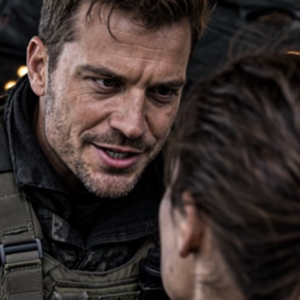
General Harlan Thorne did not look at Private First Class Miller when he spoke.
“Captain Vance,” he said, voice low and unsteady, “may I?”
Elena stood as if the air itself had become heavy. Her hands had curled at her sides, knuckles white. The jagged scar on her face seemed sharper under the mess hall lights.
For a man called the Iron Wolf, Thorne’s hesitation was more shocking than his kneeling.
Elena swallowed. Her damaged throat made the sound rough.
“You don’t need permission to look at it, General.”
“I’m not asking about the scar.”
Something moved across her face then—pain, disbelief, and the beginning of anger.
Thorne lowered his hand.
“I’m asking permission to say the name of the person who put you in that building.”
The mess hall fell even quieter.
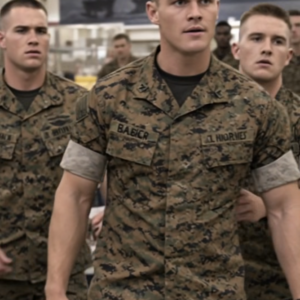
Miller stared at Elena. The joke was gone from his face. He had expected a confrontation. He had expected maybe a reprimand. He had not expected a four-star general to look at the woman he had mocked as though he owed her his life.
Elena’s eyes held Thorne’s for a long time.
“Say it,” she finally said.
“Colonel Raymond Hale.”
Thorne rose slowly. “Three months ago, Captain Vance entered the Al-Sharif refinery in northern Syria as part of a joint extraction. Colonel Hale had transmitted the building schematics. He had also sold the route, the entry point, and the names of the team to a hostile network.”
The murmur that traveled through the room was quickly swallowed.
“The refinery was rigged,” Thorne continued. “Captain Vance found a group of captured civilians and an intelligence officer inside. She had one chance to escape before the explosives ignited.”
His voice broke on the next sentence.
“She stayed.”
Elena stared at a rice grain stuck to the floor near her boot.
“The explosion collapsed the south wing,” Thorne said. “Captain Vance dragged four people through burning crude oil and toxic smoke. The fifth was Lieutenant Colonel Maya Thorne.”
No one moved.
General Thorne’s daughter.
The Iron Wolf’s expression did not harden as he said it. It shattered.
“My daughter was under the rubble with a broken pelvis and a failing airway. Captain Vance went back for her after she had already been ordered out. She used her own respirator seal to keep Maya breathing. She remained inside until every civilian who could walk was through the breach.”
His eyes returned to Elena’s scar.
“This is what the refinery took from her.”
Elena’s voice was hoarse. “The refinery took less than it wanted.”
Thorne bowed his head.
“It took everything from me,” he said. “And she gave it back.”
At the edge of the room, one of the older gunnery sergeants wiped his eyes with the back of his hand.
Miller’s face had gone colorless. He looked at the scar he had called monstrous, and for the first time saw not damage but a map of fire, smoke, and someone else’s survival.
“General,” he whispered, “I didn’t know.”
Thorne turned.
The general did not need to shout. The quiet in his voice made Miller flinch harder than a scream would have.
“That is not a defense, Marine.”
Miller’s eyes lowered.
“You did not know her name. You did not know her rank. You did not know what she had done. But you knew she was human.”
The words struck every person in the hall, not just Miller.
Elena bent to pick up her tray. Thorne reached for it instinctively.
“No,” she said softly. “I’ve got it.”
She lifted the tray herself, threw away the ruined food, and walked past Miller without another word.
That silence would follow him longer than any formal punishment.
Within an hour, the story had spread across Nellis Air Force Base in fragments: a woman with no name tape, a four-star general on one knee, a scar from a secret war, a Marine who had mocked the wrong person.
Most of it was wrong.
Elena hated that. She had spent years living in rooms where truth had to be divided into pieces small enough to carry. She did not want to become another story people used to entertain themselves.
She sat alone in an unused briefing room after the mess hall cleared, black coffee cooling untouched beside her. The room had no windows. She preferred that. Windows made her remember flames reflected in refinery glass.
When the door opened, she did not look up.
“If this is another debrief,” she said, “I already gave one.”
“It’s not.”
General Thorne entered without an escort. He wore no cap. His hair was nearly all gray, his shoulders broader than the doorway but bowed by something age had not caused.
He stopped a few feet away.
“I should have found you sooner,” he said.
Elena’s fingers tightened around the coffee cup. “I told the recovery team not to tell you I was alive.”
“Why?”
She laughed once, without humor. “Because I knew what you would do.”
“I would have brought every aircraft in the region.”
“Exactly. And Colonel Hale was still inside the command structure. If he thought I was alive, he would have run. We needed him to believe the fire had finished his work.”
Thorne’s jaw moved. “You let the world think you were dead.”
“For eleven weeks.”
“While you recovered alone.”
“Not alone.” Elena looked at him finally. “Maya was there.”
For the first time since he entered, Thorne’s control slipped.
“She told me you sang to her,” he said.
Elena’s expression softened despite herself. “She kept asking if we were going to die. I didn’t know what else to do.”
“She said you sang an old country song terribly.”
“I warned her.”
The smallest smile passed between them, fragile but real.
Then Thorne placed a sealed folder on the table.
“Hale has been arrested,” he said. “The evidence you recovered from the refinery was enough.”
Elena did not reach for the folder.
“Good.”
“There’s more.”
She looked up.
“Your mission report will be declassified in part. Not the details that could endanger people. But enough to clear your name and the names of the team members who were listed as missing. Maya insisted.”
Elena stared at him.
“I don’t need a ceremony,” she said.
“This isn’t about a ceremony.” Thorne’s voice grew firm. “It is about refusing to let a traitor decide who gets remembered.”
The sentence entered the quiet room and stayed there.
Elena thought of Staff Sergeant Omar Reyes, who had held the south corridor while she carried civilians out. Of Navy Lieutenant Jae Park, who had put out fire with his own body when her sleeve caught. Of the locals whose names could never be written on a medal citation.
“There were people braver than me,” she said.
“Then we will honor them too.”
Private First Class Miller spent the next day in a disciplinary office wishing someone would simply yell at him.
Yelling would have been easier than the paperwork, the silence from his squad, and the image of General Thorne kneeling before Captain Elena Vance.
His platoon commander, Lieutenant Vega, sat across from him with an open report.
“You understand the charges?”
“Yes, sir.”
“Harassment. Conduct prejudicial to good order. Disrespect toward a joint-service officer.”
“Yes, sir.”
Vega studied him. “What made you think that was acceptable?”
Miller wanted to say he was tired. He wanted to say everybody had been laughing. He wanted to say he had never met anyone like Captain Vance.
But General Thorne’s words kept returning: You knew she was human.
“I wanted the other guys to think I was funny,” he said.
Vega waited.
“And strong.”
“Did you feel strong?”
Miller looked down at his hands. “No, sir.”
He was reduced in rank and assigned to weeks of corrective duty, mandatory counseling, and an ethics mentorship program. Some Marines whispered he should have been discharged. Others said he was lucky. Miller did not argue with either group.
That afternoon, while cleaning chairs in the same mess hall, he found a small crescent of blackened plastic caught beneath a table. It looked like nothing. A piece of a melted tray, probably.
But he remembered the way Elena had bent calmly to pick up her own ruined lunch, even after a general had offered to do it for her.
He put the piece in the trash and kept working.
Two days later, a security alarm sounded in the Joint Training Center shortly after midnight.
Elena was in the temporary quarters assigned to her, awake despite the sedatives the base physician had given her. Sleep had become a country she could visit only briefly. The sound of the alarm pulled her from a half-dream of orange fire and collapsing steel.
Her secure phone rang immediately.
General Thorne’s voice came through. “We have a breach in the operations archive.”
Elena was already pulling on boots. “Hale?”
“He is in federal custody. This is someone else.”
The archive contained the forensic data extracted from the refinery—names, payments, encrypted contact chains. Hale had been one node in a network, not its whole body.
“Where?”
“Sublevel two.”
“I’m on my way.”
“Captain, security teams are responding.”
“And they don’t know the refinery data like I do.”
Thorne did not argue. “Be careful.”
The hallways were empty and bright as Elena ran toward the archive level. A faint chemical smell reached her before she reached the stairwell.
Smoke.
Her body stopped before her mind did.
For one terrible second, she was back in Syria: alarms screaming beneath the refinery roar, heat tightening around her lungs, Maya Thorne coughing beneath broken concrete.
Elena pressed one hand to the wall, forcing air into herself.
Not then. Now.
She descended.
On sublevel two, smoke curled from beneath the archive door. The access panel had been forced. A security guard lay unconscious beside the wall, breathing but injured.
Elena checked him quickly—pulse present, blood from a scalp wound, no obvious fracture. She dragged him behind a concrete support and pressed the emergency medical button on the wall.
Footsteps sounded inside.
“You know I can hear you,” Elena called.
A voice answered from the smoke. “Captain Vance. You survive everything except the things you should.”
Elena recognized it from intercepted refinery recordings. Faisal Rami, Hale’s logistics broker.
He emerged at the doorway wearing a stolen security uniform and a respirator. A small detonator rested in one hand.
Behind him, orange light flickered from a portable incendiary device wired to the archive server stack.
“The records go,” Rami said, “or the building does.”
Elena’s throat constricted at the smell of burning insulation.
“You don’t have enough explosive to bring down the building,” she said.
“No. But enough to burn what matters.”
He smiled behind the respirator. “You understand fire.”
Elena did. That was the problem.
“What do you want?”
“Your drive. The one you carried out of Al-Sharif.”
She had kept a final encrypted copy in a sealed evidence pouch, hidden inside the medical archive under a false index. She had never told anyone except Thorne and Maya.
“It doesn’t exist,” she said.
Rami lifted the detonator slightly.
From behind Elena, a mop bucket squeaked.
She turned sharply.
Private Miller stood at the far end of the corridor, frozen in his overnight corrective-duty uniform. He had been assigned to clean the lower-level offices. His eyes widened at the smoke and the device.
Rami saw him too.
“Another hero,” he said.
Miller started to step forward.
Elena put out one hand without looking at him.
“Stay back.”
Her voice was calm. It was the same voice she had used in the mess hall when she warned him he was changing his life.
This time, he listened.
“Captain,” he whispered, “there’s a fire suppression valve behind you. If I can get to it—”
Rami’s attention shifted toward him.
Elena saw the movement. She saw the line of his shoulders, the detonator, the open archive door, the injured guard, and the fear in Miller’s face.
Distance. Angles. Exits. Possible threats. Hard surfaces.
It was the calculation she had made in the mess hall.
This time, there was no tray between her and danger.
“Do it,” she said.
Miller ran.
Rami raised the detonator. Elena closed the distance just as he pressed the switch.
The blast was smaller than the refinery explosion, but close enough to throw them both against the wall. Heat tore across Elena’s cheek. The old scar flared with pain. The archive lights shattered.
Then the suppression system burst open, flooding the room with white chemical foam.
Miller had reached the valve.
Rami staggered through the haze toward the stairwell. Elena seized the back of his vest and drove him to the floor. He fought hard, but panic made people clumsy. She trapped his wrist, stripped the detonator away, and held him until security stormed the corridor.
When it was over, Elena sat against the wall, coughing beneath a blanket from the emergency team.
Miller stood several feet away, face soot-streaked, hands shaking.
“You okay?” he asked.
She looked at him, remembering another young person in another fire asking the same question.
“I am,” she said. “Because you listened.”
He blinked hard.
“I was scared.”
“Courage isn’t the part where you aren’t scared.” Elena accepted a cup of water from the medic. “It’s the part where you choose what you do with it.”
The ceremony took place six weeks later on a clear Nevada morning.
The official account of Al-Sharif was still incomplete. Some names remained sealed. Some missions could never be publicly named. But enough was released to tell the essential truth: Captain Elena Vance and her team had saved eleven people from a planned massacre, exposed a betrayal inside their own command chain, and prevented a terrorist network from destroying the evidence.
General Thorne stood at the podium, but he did not tell the story alone.
He read the names of every team member.
He read the names of the civilians saved.
Then he asked Elena to step forward.
She wore her dress uniform for the first time since the refinery. The scar remained visible. No makeup hid it. No one would have dared suggest it should.
Thorne pinned a medal beneath her collar with hands that trembled only slightly.
“Captain Vance,” he said, loud enough for the whole formation to hear, “you taught my daughter that survival is not a debt. It is a chance to keep serving others.”
Elena’s eyes shone, but she did not cry.
At the far end of the formation stood Lance Corporal Tyler Miller—his original rank restored only in part after months of work, his posture less swaggering now and more deliberate. He watched the medal catch the sunlight and remembered the words he had once thrown at her.
After the ceremony, he approached cautiously.
“Captain Vance.”
Elena turned.
“I wanted to say congratulations.”
“Thank you, Miller.”
He nodded toward her scar, then stopped himself. “I used to think scars were something to stare at.”
Elena waited.
“Now I think they’re something you earn the right to ask about.”
She considered him, then gave the smallest smile.
“That is a much better way to think.”
Across the parade ground, General Thorne watched them. The Iron Wolf did not smile often, but he did then.
Elena lifted her face toward the open desert sky. The sun warmed the scar that had once felt like a sentence.
It was no longer proof of what the fire had taken.
It was proof that the fire had failed.