The rifle bucked once against Sarah’s shoulder.
For an instant, the storm swallowed everything—the shot, the breath in my chest, even Cooper’s terrified bark. Then a dark shape rolled from the ridge above the outpost and vanished into the white.
“Sniper down,” Sarah said.
Her voice was the same soft voice that had asked Corporal Henson if his stitches pinched. It had no triumph in it. No anger. Just a fact.
I stared at her through the snow, unable to make my mind join the two images: Sarah kneeling with blood on her hands over Jackson’s shoulder, and Sarah behind an M24, her cheek pressed to the stock with the stillness of stone.
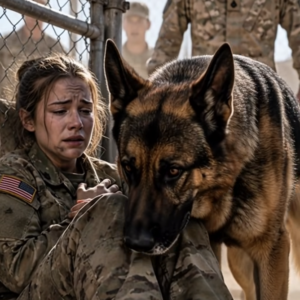
Cooper limped into her side. Sarah hooked one arm around the dog’s neck without taking her eye from the ridge.
“There’s another team moving left,” she said. “Three, maybe four. They’re using the generator shed for cover.”
“How can you tell?” I shouted.
“Because that’s where I’d put them.”
Then she slid the bolt, found another target, and fired again.
The muzzle flash briefly illuminated her face. It was not empty, as I had first thought. It was grief held so tightly it had become discipline.
The attack had begun forty minutes earlier, but time had broken into sharp, bright fragments: the blast at the gate; Sergeant Velez screaming for ammunition; a man in white camouflage falling against the floodlights; Jackson spinning into the snow after the sniper’s first shot.
The remote outpost had been built to train Marines and Navy specialists together around a prototype battlefield network buried beneath the mountain. Officially, it was a weather-resilient communications project. Unofficially, almost no one outside the bunker knew what it could do. We had been told the exercise would test our response to extreme conditions.
No one had expected real attackers.
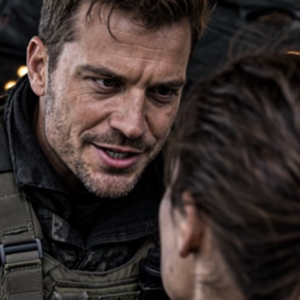
“Miller!” Sergeant Velez yelled from behind the concrete vehicle barrier. “What are you looking at?”
I snapped back. “The left team. Shift fire to the generator shed!”
Our squad opened up. The attackers answered with suppressed bursts that sounded obscene in the snow—small mechanical coughs followed by the impact of rounds chewing concrete. Sarah had bought us seconds. In combat, seconds were never small things.
She kept firing with controlled patience, moving only enough to protect Jackson and Cooper. The sniper rifle seemed too large for her narrow frame, but it belonged in her hands more naturally than it had ever belonged in Jackson’s.
“Sarah,” I called, crawling toward her. “We need to get Jackson inside.”
“His shoulder is through-and-through. No arterial damage. He can move if you support the right side.”
“And you?”
“I’m staying until that ridge is clear.”
“That isn’t your job.”
She looked at me. Snow clung to her eyelashes.
“It was,” she said, “for a very long time.”
Before I could ask what she meant, the ground beneath us trembled. A third explosion erupted near the maintenance bay. Lights blinked out across the compound, leaving only emergency lamps and the blue, merciless glare of the storm.
From the radio, Lieutenant Colonel Royce’s voice cracked through static. “Bunker access compromised. Repeat, access compromised. All personnel fall back to interior positions.”
Sarah’s expression changed.
Not fear. Recognition.
“They don’t want the weapons,” she said.
“What?”
“The attack is too loud. Too scattered. They want us looking at the bunker.”
“Then what do they want?”
She listened, head tilted toward the wind.
“The satellite relay.”
The relay stood on a separate ridge south of camp, a narrow steel tower that sent encrypted traffic through the storm. We had assumed the blizzard had knocked it out. Sarah had been the first person I knew of to doubt that.
“The communications link died before the gate blew,” she said. “Someone cut it on purpose. They need whatever is stored on the relay’s backup drive.”
“Why would mercenaries hit a relay in a blizzard?”
“Because they don’t need to escape with a weapon system. They only need to copy a list.”
Her words chilled me more deeply than the wind. A list of what? Targets? Researchers? Classified operational sites?
“You know them,” I said.
The next round from the ridge struck the snow inches from Cooper’s paw. The dog yelped and pressed against Sarah.
“I knew someone who trained them,” she said.
Then her radio crackled—not on our frequency, but on a channel I had never heard before. A man spoke calmly through the interference.
“Mara. We know you are there.”
Sarah went perfectly still.
“You were always difficult to bury,” the voice continued. “Bring the dog to the tower. You have ten minutes.”
The transmission ended.
I looked at Sarah. “Mara?”
She let out one unsteady breath. “My name is Sarah Collins. But before that, in places where names were liabilities, I was Mara Voss.”
Cooper pressed his nose into her wet glove. The dog’s torn ear trembled.
“They know Cooper?” I asked.
“They know everything they can use.”
She handed me the M24. “Get Jackson inside. Tell Velez the bunker attack is a diversion. The tower is the objective.”
“You’re not going alone.”
“I have to.”
“No.” I caught her arm before she could rise. “You don’t get to save us all while we stand here wondering who you used to be.”
For the first time since the shooting began, her control fractured. Her eyes filled with something raw and exhausted.
“You have no idea what happens if he gets that drive.”
“Then tell me while we stop him.”
We made it inside the medical tent between bursts of fire. Velez and Henson dragged Jackson to a cot while Sarah clamped the wound again, her hands returning to their gentler work with impossible steadiness. Cooper limped after us and settled against Jackson’s boots.
The tent smelled of antiseptic, damp wool, and blood.
“The man on the radio is Anton Kade,” Sarah said at last. “He runs a private group called Northstar. They sell security, training, recoveries—whatever name lets governments pretend they didn’t hire them.”
“And you worked for him?” Velez asked.
Sarah’s silence was answer enough.
“Eight years ago, I was Navy,” she said. “Not a nurse. Naval Intelligence, attached to a small reconnaissance program. We identified Northstar’s supply routes in the Balkans. Kade offered to trade information for extraction. He lied.”
Her fingers tightened around a roll of gauze.
“My team walked into an ambush. Six people died. I was the only one who got out.”
No one spoke.
“I shot my way out,” Sarah said, eyes lowered. “I spent three days in a drainage tunnel, waiting for a rescue that did not come. When I finally reached friendly forces, I was told the operation never existed. No reports. No graves with the right names. I was discharged under a sealed medical designation. I chose nursing because I could not keep being the last person people saw.”
Jackson, pale against the cot, looked at her. “And Cooper?”
Sarah stroked the dog’s neck. “Kade used dogs for tracking. Cooper was a puppy in one of their camps. They beat him for being afraid of gunfire. When I escaped, he followed me.”
The dog lifted his head at the sound of her voice. For years, we had thought Sarah rescued Cooper because she was compassionate. We had never understood that he had rescued her too.
“Why is he here?” I asked.
“Because Kade believes the relay drive contains a file called Atlas. It names every covert asset who helped expose his network, including the officers who buried my team’s operation. He wants it to erase witnesses and blackmail the rest.”
Velez’s radio crackled. “Enemy pressure at the bunker is easing,” he said. “They’re moving south.”
Sarah stood.
“He’s going to the tower.”
“Then we go,” I said.
“No,” said a new voice.
Lieutenant Colonel Royce stood in the tent entrance, snow coating his shoulders. He had listened to enough to know the shape of the truth.
“Your mission is to defend this outpost,” he told us. “I’ll send a response team.”
Sarah’s face hardened. “With respect, sir, a response team will arrive at the obvious path and get shot from the tree line. Kade expects that.”
Royce’s jaw flexed.
“I know his methods,” Sarah continued. “I can get to the tower before he does.”
“You are not an operator.”
“I am not asking to be one.” She looked at Cooper. “I’m asking to keep one man from destroying the lives of everyone who ever trusted him.”
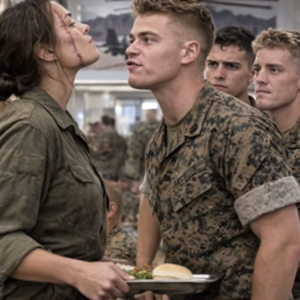
Royce studied her. Then he looked at us—seven Marines who had watched a nurse put down a sniper in a blizzard and who had been changed by the sight.
“Miller,” he said. “You take two. No heroics. Secure the relay, extract Collins, and hold until air support can see through this weather.”
“Aye, sir.”
Sarah checked the M24, then handed it back to Jackson.
“You’ll need this more than I will,” he said.
“Your shoulder—”
“Is still attached.” He gave a tired smile. “And you taught me the difference between hurt and helpless.”
Sarah looked as though she might argue. Instead she took the rifle.
The path to the relay tower was less than a mile. In good weather it took twenty minutes. In the blizzard, it became another world.
Velez, Henson, Sarah, Cooper, and I moved through waist-deep snow beneath black pines bent by wind. The storm erased our tracks behind us almost immediately. The only light came from dim chemical markers tied to trees before the weather closed in.
Sarah led without hesitation.
“How do you know this trail?” I asked.
“I walked it this afternoon.”
“For exercise?”
“For sight lines.”
I glanced at her. “You thought something was coming?”
“I saw the satellite relay’s maintenance log. Someone accessed it with an obsolete Navy encryption key. The same one used by the unit that betrayed my team.”
“And you didn’t tell anyone?”
Her mouth tightened. “I spent eight years being told I imagined the danger. I needed proof.”
That was the moment I understood her softness had never been weakness. It was vigilance without spectacle. She checked everyone’s water, remembered who favored which knee, sat beside a frightened dog in the cold—because she had learned what happened when people’s pain became inconvenient.
Cooper stopped abruptly and growled.
Sarah raised a fist. We froze.
Ahead, through the snow, a faint green beam moved across the trees.
“Night vision,” Velez mouthed.
Sarah gestured left, then pointed to a dip between two boulders. We crawled. A suppressed shot thudded into a tree trunk where Henson’s head had been.
“Two shooters,” I whispered.
Sarah was already pulling the M24 from her shoulder. “One at eleven o’clock, one behind the dead cedar.”
“You can see that?”
“No. I can hear them adjusting their footing.”
She waited until the wind surged, then fired. The first green beam fell. Velez and Henson returned fire toward the cedar. Cooper trembled against Sarah’s hip but did not run.
She leaned down and whispered into his ear. “Stay with me, brave boy.”
The words were barely audible, yet Cooper steadied.
We reached the tower just before 2:00 a.m. It rose above us, cables humming in the gale. The relay station at its base was locked, dark, and surrounded by fresh footprints.
Sarah touched the snow beside the door.
“Kade is already inside.”
“We breach?” Velez asked.
“No.” She pointed toward the roofline. “He’ll have a dead-man trigger. He likes rooms with one way in and a story he controls.”
“You know him very well.”
“I survived him very closely.”
From inside, Kade’s voice came through the storm.
“Mara. I knew you would choose the dog.”
Sarah’s face drained of color.
Cooper barked once, sharp and terrified.
“Come in alone,” Kade called. “Or I shoot the relay and your precious list dies with it.”
“If he shoots the relay, he loses the drive,” I said.
“He has copied part of it already.” Sarah’s eyes searched the tower. “He only needs time.”
She stood before we could stop her.
“Sarah—”
“If he sees any of you, he’ll trigger the charges.”
“What charges?”
“The kind he used to put on doors.”
Cooper pushed past my knee and followed her to the entrance. Sarah crouched, held his face between her hands, and pressed her forehead to his.
“You stay,” she whispered.
The dog gave a small, broken whine.
“You already saved me once.”
Then she opened the door and walked into the dark.
We heard nothing for thirty seconds.
Then Kade said, “You look smaller without the uniform.”
Sarah answered, “You look older without an army behind you.”
Through a cracked window, I saw the room in flashes of lightning: Kade holding a pistol in one hand and a small remote in the other; Sarah standing ten feet away; a rugged black drive connected to the relay console.
“Your team died because they believed in rules,” he said. “You survived because you finally stopped believing.”
“No,” Sarah said. “I survived because I remembered who I was supposed to be.”
Kade laughed. “A nurse?”
“A person who refuses to leave the wounded behind.”
He lifted the remote. “And that is why you will lose.”
Cooper broke.
With a roar I had never heard from him, the limping dog crashed through the partly open door. Kade turned instinctively. The remote slipped from his hand.
Sarah moved.
She crossed the room in two strides, knocked the pistol aside, and drove Kade against the console. He was larger, stronger, trained for violence. But she was faster than memory. They hit the floor hard. The remote skidded toward the door.
I lunged inside, but the floor panel beside me flashed red.
“Don’t!” Sarah shouted.
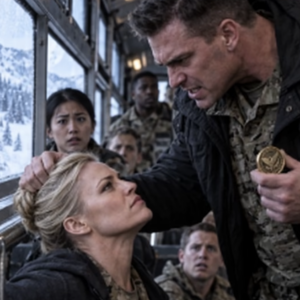
Kade’s hand closed around her throat. “You always needed saving,” he snarled.
Sarah looked at Cooper.
The dog seized Kade’s sleeve and pulled with every ounce of his battered body. Kade cursed, turning just enough. Sarah drove her elbow into his ribs, twisted free, and pinned his wrist against the floor.
For a moment, neither moved.
Then Sarah said, very quietly, “No. I needed someone to remind me I was worth saving.”
The remote lay two feet beyond her reach.
Kade smiled through blood. “Too far.”
Cooper limped past them, grabbed the remote gently in his teeth, and brought it to Sarah’s hand.
The tower erupted with a different sound: not an explosion, but the unmistakable approach of helicopters. The storm had begun to thin. In the distance, searchlights cut through the snowfall.
Kade looked toward the ceiling, and all the certainty left his face.
“You planned this,” he said.
Sarah’s breath shook. “No. I hoped.”
Velez secured Kade. Henson disconnected the drive and found the copied data transfer still incomplete. But the greatest surprise was waiting inside the relay’s encrypted archives.
Atlas was not only a list of Northstar’s targets.
It contained Kade’s original payment records—the names of the officials who had sent Sarah’s reconnaissance team into the ambush, then erased the operation to protect their careers.
One of those names belonged to Lieutenant Colonel Royce.
When the helicopter lights washed over the tower, Royce arrived with the recovery team. He saw the screen, saw his name, and seemed to become an old man in a single breath.
“Sarah,” he said.
She did not lift her rifle. She did not shout.
“You told us extraction was delayed,” she said. “You told us help was coming.”
Royce looked at the snow-covered ground. “I was ordered to abort. I signed the report. I let them call you dead because I was afraid.”
The mountain wind passed through the open doorway.
Sarah’s eyes filled, but her voice did not break. “Then you can tell the truth now.”
And he did.
In spring, when the snow had melted from the pines and the outpost looked less like a fortress than a scar in a beautiful place, the Navy publicly cleared the records of Sarah’s lost team. Their families learned at last that their sons and daughters had not been abandoned by history; they had been betrayed by people, and people had finally been held accountable.
Sarah was offered a return to intelligence. She declined.
She remained a nurse.
Not because she had forgotten how to fight, but because she had decided fighting was not the only proof that she was brave.
Jackson recovered fully and put a framed photo of Cooper in the marksman’s shelter, beneath the words: BRAVEST ONE IN THE SQUAD. Velez pretended to object, then brought Cooper a steak on every anniversary of the attack.
As for me, I stopped saying Sarah was attached to our squad.
She was part of it.
One warm evening, I found her outside the medical tent, sitting in the grass while Cooper—his limp still visible but lighter now—chased a tennis ball across the field. Sarah watched him with a quiet smile.
“You know,” I said, “we all thought we were protecting you.”
She looked at Cooper, then at the mountains beyond the base.
“You did,” she said. “Just not in the way you thought.”
Cooper returned, dropped the ball at her feet, and waited.
Sarah threw it.
This time, when it sailed across the open field, no one flinched at the sound.