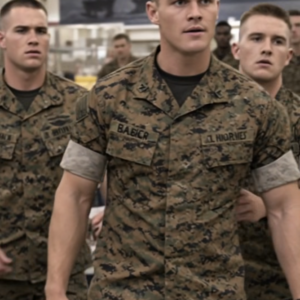
The first sound Sarah Collins heard after Captain Derek Stone tipped the water over her uniform was not the splash.
It was a spoon falling from someone’s hand three tables away.
The small metallic clatter seemed to strike every wall of Fort Ridgeline’s cafeteria. Coffee hissed behind the counter. A radio murmured static near the kitchen door. Then even those sounds felt embarrassed to continue.
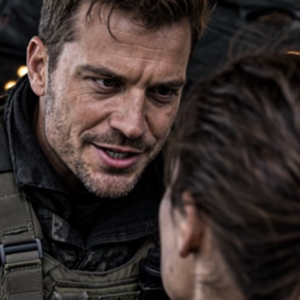
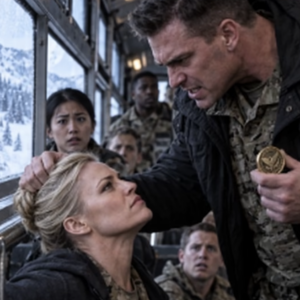
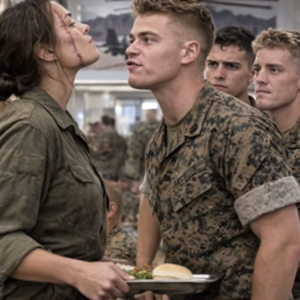
Cold water soaked the front of Sarah’s pale blue duty shirt. It slipped beneath her collar and darkened the fabric at her waist. Her eggs sat ruined beneath glittering drops. Across from her, Derek Stone stood very straight, as if he had just conducted an inspection rather than humiliated a stranger at breakfast.
“Do you understand now?” he asked.
Sarah dabbed her sleeve with a napkin. “I understand that you made a choice.”
The lieutenant behind him laughed again, but the sound came out thinner this time.
Derek’s jaw shifted. “You were told to move.”
“No,” Sarah said. “I was ordered to perform obedience for an audience.”
She rose at last. She was not tall, but the room seemed to change around her. There was no rank on her collar, only a visitor badge clipped above her heart. Her dark hair was pinned back simply, and a narrow silver ring caught the fluorescent light when she gathered her wet napkin.
“You’re finished here,” Derek said.
“I haven’t eaten.”
“You’re finished.”
Sarah regarded him for a quiet, measuring second. “Captain Stone, I hope whatever you believe this table represents was worth the way you behaved.”
Then she lifted her tray and walked away.
Derek watched her leave through the cafeteria doors with a hard satisfaction he could not explain. The two junior officers followed him to the reserved command table—empty, exactly as it had been all morning—and First Lieutenant Mason Rourke sat down opposite him with a grin.
“She had nerve,” Rourke said.
“Visitors get lost,” Derek replied.
“You think she’ll complain?”
Derek cut into his breakfast. “To whom?”
That was the answer he would remember later, long after every other detail had blurred.
To whom?
Sarah did not go to the visitors’ office. She went to the old chapel behind headquarters, where the stained-glass windows threw blue and red fragments across the wooden pews. It was empty except for Sergeant Major Luis Ortega, who stood near the front with both hands wrapped around a paper cup.
He looked at her damp uniform, then at the untouched tray she carried.
“He did that?”
Sarah put the tray on a side table. “He believes he did.”
Ortega’s face tightened. He had served at Ridgeline for twenty-six years and had the weary eyes of a man who could recognize trouble before it spoke. “Give me five minutes.”
“No.”
“Ma’am—”
“Luis.” Her tone softened. “Not today. I came to listen before I decided what needed fixing.”
“That is not a problem to listen to. That is a captain who just assaulted a civilian adviser in front of half the post.”
Sarah looked down at the water beading along her cuff. “You heard him call me a visitor?”
“Everyone heard him.”
“Then everyone heard what he thinks this place is.”
She had arrived at Fort Ridgeline at dawn in an unmarked sedan, carrying one small overnight bag and a folder no one had been meant to see. Officially, she was Sarah Collins, a civilian organizational consultant assigned to evaluate readiness after the death of General Arthur Vance, the fort’s former commander. Unofficially, the secretary of defense had asked her to determine whether Ridgeline was becoming the kind of post that polished reports could hide and soldiers could not survive.
Her authority was deliberately quiet. Her name would mean nothing to anyone who had not done their homework.
That had been the point.
“The briefing begins at ten,” Ortega said. “Stone will be there.”
“Good.”
“You aren’t going to identify yourself?”
Sarah’s eyes lifted to the altar, where an old brass plaque bore the names of soldiers who had not come home from deployments. “Not yet.”
Because a title made people careful. A title made them rehearsed. But a wet shirt, an empty chair, and a stranger who was easy to dismiss could tell the truth faster than a hundred interviews.
Captain Derek Stone was late to the briefing because Colonel Amelia Graves stopped him in the corridor.
“You look pleased with yourself,” she said.
“I’m not.”
“Then that’s your natural face, which is unfortunate.”
Derek almost smiled. Colonel Graves had arrived only three weeks earlier to take command after General Vance’s sudden death, and she had not yet learned that bluntness only made him more certain of himself.
“A visitor ignored a reasonable instruction,” he said. “I handled it.”
“Did you pour water on her?”
The question stopped him.
“Who told you that?”
“Every person in the building who is suddenly pretending not to look at me.” Graves’ voice was low. “Did you?”
“She was being deliberately provocative.”
“That was not my question.”
His silence answered it.
Graves shut her eyes briefly. “You will write an incident report.”
“Colonel, with respect, this was a minor discipline issue.”
“You do not discipline civilians. You especially do not humiliate them for sitting at a table that has no reservation sign.”
The old irritation rose in him. “It is understood that command officers use that table.”
“Understood by whom?”
He looked past her shoulder. Through the glass wall at the end of the hall, he could see the parade ground shining beneath a washed-out sky. “By people who belong here.”
Colonel Graves stared at him so steadily that he wished he could take the words back.
“Captain,” she said, “you should be very careful with that sentence.”
At ten sharp, Derek entered the command conference room. The long polished table was surrounded by section chiefs, operations staff, and the base’s senior enlisted leadership. At the far end sat a woman in a fresh, dry navy blazer.
Sarah Collins.
Her visitor badge was gone.
In its place, a small black folder rested beside her hand.
Colonel Graves remained standing. “Captain Stone, take a seat.”
He did, slowly.
“Ms. Collins is conducting the leadership climate review ordered by the Department of Defense.” Graves continued. “You will provide her complete access and complete candor.”
The room had become so still Derek could hear the air system running overhead.
Rourke stared at his notebook. Lieutenant Aaron Bell, the other officer from breakfast, had gone visibly pale.
Sarah opened the folder. “Before we begin, I’d like to state something plainly. This review is not about a single embarrassing moment. It is about patterns: whether people here feel heard, whether mistakes are safe to report, and whether authority is being used to protect the mission or protect egos.”
Her gaze rested on Derek only briefly. It made him feel more exposed than if she had shouted.
“Captain Stone,” she said, “would you like to begin by describing the cafeteria incident?”
He could have apologized. The thought arrived clearly, almost gently.
Instead he heard Rourke breathe, saw the eyes around the table, and felt the old familiar fear underneath his pride: the fear that one admission would loosen everything people believed about him.
“The visitor was disruptive,” he said. “I responded poorly to provocation.”
Sarah nodded and wrote something down.
“What did she do that was disruptive?”
“She refused a direct instruction.”
“From an officer who had no authority to give it.”
“She did not know that.”
“Did you?”
The question landed softly. It was impossible to fight without looking foolish.
“I believed the table was reserved.”
“Was it?”
“No sign was posted.”
“So no.”
His throat tightened.
Sarah closed the folder. “Thank you, Captain. We’ll continue later.”
By noon, the story had crossed the fort faster than a fire alarm. Some soldiers said Sarah Collins was a congressional investigator. Others said she had been a general once and had come undercover to test the command. Rourke claimed she was nobody important and that Stone would be fine.
But a strange unease settled over Derek. He had built his career on control: immaculate reports, punctual formations, subordinates who never caught him unprepared. At thirty-seven, he was on track for major, perhaps faster if Graves approved his recommendation. He had learned early, under a father who had called tenderness weakness, that respect was just fear wearing a cleaner uniform.
His father had died before Derek’s first deployment, still disappointed his son had joined the Army instead of the family business. Derek had promised himself that no room would ever dismiss him again.
Now Sarah Collins had done nothing but ask questions, and he felt fourteen years old.
He found her outside the maintenance hangar speaking with Specialist Nia Brooks, a young mechanic whose hands were black with grease. Sarah listened while Brooks described a repeated fault in the fuel-line inventory system. Derek knew the issue; it had been flagged twice in the previous month. Rourke’s logistics section had assured him it was a software delay.
“The replacement valves are missing from the database,” Brooks said. “We have been cannibalizing parts from grounded vehicles. I filed it through channels.”
“And what happened?” Sarah asked.
Brooks hesitated as Derek approached.
“Nothing, ma’am.”
Sarah did not look at him. “Specialist, no one here will retaliate against you for answering a question.”
Brooks swallowed. “My platoon sergeant told me to stop making the unit look bad. Lieutenant Rourke said the report would be handled.”
“Was it?”
“No, ma’am.”
Derek stepped forward. “Those reports come through multiple levels. There are procedures.”
Sarah turned toward him. “Yes. Procedures are what people call systems when they want the system to sound innocent.”
For the first time, anger flashed through him without calculation. “You arrived this morning. You do not know this fort.”
“No,” she agreed. “But I know the look of someone who has spent weeks deciding whether the truth is worth the cost.”
Brooks’s chin shook. Derek saw it then—not defiance, not melodrama, but exhaustion. The kind his soldiers had carried during deployment, when equipment failed and leaders pretended it did not.
Sarah thanked Brooks and walked away. Derek followed her across the concrete apron, past a helicopter with its engine panels open like wounded wings.
“You wanted to make an example of me,” he said.
Sarah stopped. “You made yourself an example.”
“You could have told me who you were.”
“Would that have made you kinder?”
He had no answer.
“Captain,” she said, quieter now, “I have watched people become cruel because they think rank makes them important. But rank only magnifies what is already there. It does not create character.”
She left him standing beside the aircraft.
That evening, a storm rolled down from the mountains. Rain battered the roofs and turned the roads black. In the operations center, alarms began to chirp just after 8:00 p.m.
One of Ridgeline’s night-convoy trucks had lost steering on the eastern training road. It had skidded through a barrier and stopped half over a ravine. Two soldiers were trapped inside. The fuel system was leaking.
Derek was duty operations officer. Protocol required him to dispatch the recovery team, secure the road, and notify the colonel. His phone rang before he could issue the final order.
It was Rourke.
“Captain,” the lieutenant said, voice ragged, “the truck’s unit number is 7-19.”
Derek knew it immediately. It was one of the vehicles Brooks had warned about.
“Those valves,” Rourke whispered. “I pushed the request aside. The readiness report—if it went up, it would have affected the inspection. I thought they were only grounding issues.”
Derek stared through the rain-streaked window. Two soldiers were hanging above darkness because a problem had been made inconvenient.
“Where are you?”
“At the motor pool.”
“Stay there. Pull every maintenance record. Do not alter a word.”
“Sir, if Graves finds out—”
“She will.”
The admission felt like stepping off a ledge. Then something inside him became unexpectedly still.
“And so will Collins.”
He called Colonel Graves. He gave the full report, including his own failure to pursue the earlier maintenance flags. There was a silence on the line long enough for him to hear the rain.
“Get them home,” Graves said. “Then we talk.”
Sarah arrived at the operations center ten minutes later, wearing a raincoat over civilian clothes. Derek did not ask who had called her. She looked at the map, the flashing location beacon, and the emergency crews assembling.
“The recovery crane cannot reach that shoulder in this weather,” an engineer said.
“Air evacuation?” Sarah asked.
“Wind is too high.”
The driver’s voice crackled over the radio. “The ground is moving. We’re slipping.”
Derek saw Sergeant First Class Malik Evans standing at the door in rescue gear. Evans had served under him overseas. He had a daughter who had just learned to ride a bicycle.
“I’ll go down,” Evans said.
“No,” Derek answered.
Evans blinked. “Sir?”
“You need someone who knows the road, and I signed off on the convoy route.”
“Captain, that is not—”
“It is my responsibility.”
Sarah’s eyes met his. She did not praise him. She only said, “Bring them back.”
At the ravine, the storm roared like machinery. Derek clipped into the rescue line beside Evans. Mud swallowed their boots. Below them, the truck leaned at an impossible angle, its headlights shining into a void.
“Captain,” the trapped passenger shouted through the shattered window, “we can’t get the door open!”
Derek slid down first. His shoulder slammed against metal. The smell of fuel cut through the rain. Inside, Private Cole Ramirez was bleeding from the forehead; Specialist Hannah Lee clutched the dashboard, eyes huge with terror.
“You’re getting out,” Derek said.
“The truck is moving,” Lee whispered.
“Then we move faster.”
He worked the jammed door while Evans secured the rear axle. The truck groaned. Mud cascaded around them. For one terrible second, Derek thought of the cafeteria, of Sarah standing wet and silent as he tried to force her to prove she was smaller than him.
He had mistaken fear for order. He had mistaken silence for obedience.
“Ramirez first!” he shouted.
They hauled the private out. The truck shifted again, dropping several inches. Lee screamed. Derek reached through the window, locked his hand around hers, and did not let go until Evans pulled them both against the slope.
The truck crashed into the ravine moments later, swallowing its headlights in black water.
At dawn, Fort Ridgeline gathered in the same cafeteria where Sarah’s breakfast had been ruined.
No one had ordered the meeting. Soldiers came because the near disaster had made everyone too awake to sleep. Colonel Graves stood beside Sarah Collins. Rourke waited nearby with a signed statement in his hand. His face was gray, but he had not run.
Derek entered with his left arm in a sling and dried mud still at the edge of his boots. The room parted quietly.
He walked to Sarah’s table.
It was the same gray table. The same empty chairs. Someone had placed a fresh cup of coffee there.
“Captain Stone,” Graves said, “you have something to say.”
Derek looked at the faces around him: Brooks with grease still beneath her nails, Evans exhausted and upright, Ramirez bandaged, Lee holding a paper cup with both hands. He saw Rourke, afraid at last of the right thing.
Then he looked at Sarah.
“Yesterday,” he said, “I used my rank to humiliate someone because I believed I was entitled to obedience. I punished a person for not shrinking when I wanted her to. I am sorry, Ms. Collins.”
His voice caught once, and he let it.
“I am sorry to every soldier who learned that reporting a problem could make their career harder. That changes today. Lieutenant Rourke and I have submitted full statements. The maintenance records will be reviewed independently. I will accept whatever action follows.”
No one applauded. He had not earned applause.
Sarah nodded. “An apology does not undo harm.”
“I know.”
“But it can be the first truthful thing after a long time.”
Colonel Graves stepped forward with an envelope. “Captain Stone, pending investigation, you are relieved of operations command.”
He took it. “Yes, Colonel.”
“You will remain at the fort.”
He expected humiliation to burn. Instead, strangely, he felt relief.
Sarah picked up the coffee and offered it to him. “Sit.”
He stared at the chair.
“Ma’am?”
“It isn’t reserved,” she said.
A few people laughed—not cruelly, but with the fragile surprise of tension breaking. Derek sat.
Then Sarah opened a second folder, one no one else had seen.
“There is one more reason I came to Fort Ridgeline,” she said.
Her voice made the room quiet again.
“General Arthur Vance did not die only as this post’s former commander. He was my father.”
Even Graves looked startled.
Sarah’s gaze went to the brass memorial plaque visible through the cafeteria windows, across the courtyard in the chapel.
“Before he died, he left me a letter. He wrote that he feared Ridgeline was becoming a place where people protected appearances instead of people. He asked me not to preserve his legacy if it was no longer worthy of it. He asked me to tell the truth.”
She slid a document across the table toward Graves.
“The secretary has approved the formation of a new command accountability unit. Its first director will be based here. It will report outside this chain of command, and it will include enlisted representatives with direct authority to elevate safety concerns.”
Brooks stared. “Here?”
“Here,” Sarah said. “And Specialist Brooks, if you are willing, I would like you to serve on its first field council.”
Brooks covered her mouth.
Sarah turned to Derek. “Captain Stone, the investigation may end your command career. It may not. That decision is not mine alone. But I read your rescue report. You did not hide from responsibility when hiding would have been easier.”
She paused.
“My father believed a leader could be rebuilt only after he stopped defending the person he had pretended to be.”
Derek looked at the cup in his hand. “I don’t know how to become that person.”
“Good,” Sarah said. “That means you can learn.”
Months later, the memorial outside the chapel bore three new names beneath General Vance’s: not of the dead, but of the living council that had helped change Fort Ridgeline. Nia Brooks became its first enlisted safety representative. Lieutenant Rourke accepted a demotion and stayed to rebuild the maintenance program he had neglected. Derek remained under review, then returned—not to command a company, but to teach new officers the difference between authority and control.
On his first day in that role, he entered the cafeteria and found Sarah Collins eating scrambled eggs at the same gray table.
Every chair around her was empty.
He set down his tray, waited for her to look up, and asked, “May I sit here?”
Sarah smiled.
“Only if you know where you belong.”
Derek looked around the room: soldiers, officers, civilians, all sharing the same morning, the same tables, the same right to be treated as human.
Then he pulled out the chair.
“Right here,” he said.