She slammed the door in my face so hard the wreath jumped against the wood.
For a few seconds, I just stood there on the porch with my suitcase in one hand and my purse sliding off my shoulder, too exhausted to react. Twelve hours of travel had left my legs stiff, my throat dry, and my patience worn down to a thread. All I had wanted was a shower, clean pajamas, and maybe ten quiet minutes in the bedroom I had painted with my own hands.
Instead, I was staring at my own front door.
Locked out.
“You’re not stepping into this house again!” my mother-in-law shouted from the other side.
Her voice carried through the door, sharp and triumphant, the way it always sounded when she thought she had finally won.
Across the street, Mrs. Alvarez’s curtains shifted. Next door, someone’s porch light clicked on. In our neighborhood, drama traveled faster than rainwater downhill.
I inhaled slowly.
“Diane,” I said, keeping my voice level, “open the door.”
“No.”
“My things are inside.”
“You should’ve thought about that before disrespecting me.”
I looked down at my suitcase. The handle was still warm from my grip. A luggage tag from Denver dangled from it, bent from the airport carousel. I had flown there to help my younger sister after surgery, leaving my husband, Mark, with one simple request: keep peace until I got back.
Apparently, peace had packed a bag and left before I did.
I knocked once, calmly.
Behind the door, I heard Diane muttering.
“Diane,” I said, “I live here.”
She laughed. Actually laughed.
“You lived here. Past tense.”
My heart started pounding, but my face stayed still. That was something I had learned from years of dealing with her. Never let Diane see the bruise while she was still holding the stone.
I pulled my phone from my coat pocket and opened the folder I had saved under the boring name “Utilities.” Inside were scans of the mortgage agreement, the property transfer, the insurance documents, the tax records.
Every single one had my name on it.
Not Mark’s.
Mine.
Diane did not know that.
Because when we bought the house two years earlier, Mark had begged me to keep it quiet.
“Just for now,” he had said, sitting across from me at the kitchen table of our old apartment, both hands wrapped around his coffee mug. “Mom gets weird about things like this.”
“Things like what? Me buying a house?”
“Our family home was sold when Dad died. She’s sensitive about property.”
“Mark, this isn’t her property.”
“I know. I know that. But if she thinks I moved into a house my wife owns, she’ll make it into something humiliating.”
“And if she thinks you own it?”
He had looked away.
“It’ll avoid conflict.”
That phrase should have warned me.
Avoid conflict.
What he meant was: absorb it quietly so I don’t have to.
Back then, I loved him enough to mistake his discomfort for kindness. I thought I was protecting him. I thought marriage meant choosing peace over pride.
But standing on the porch while his mother locked me out of the house I paid for, I finally understood something.
Peace built on a lie eventually becomes a prison.
I called Mark.
It rang six times, then went to voicemail.
I called again.
Voicemail.
A third time.
Nothing.
I stared at his name on the screen until it blurred.
Inside, Diane shouted, “You can call him all night. He knows what you did.”
My stomach tightened.
“What I did?”
“You turned him against his own mother.”
I almost laughed. Mark had never once been turned fully toward me, let alone against her.
I knocked again, louder this time.
“If you don’t open this door, I’m calling the police.”
She laughed again, but this time there was a brittle edge to it.
“Call whoever you want. This is my son’s house.”
That was the moment I stopped asking.
I set my suitcase upright, reached into the side pocket of my purse, and pulled out my keys.
Slowly.
Deliberately.
I let them jingle just loud enough.
The sound was small, but the silence that followed was enormous.
I imagined Diane on the other side of the door, hand still on the deadbolt, her smug expression twitching.
Then I slid the master key into the lock.
The deadbolt turned smoothly.
The door opened.
Diane was standing right there, frozen, her hand still gripping the lock.
She wore my slippers.
That was the first thing I noticed.
Not the shock on her face. Not the way her lipstick had bled slightly at the corners. Not the fact that she had clearly been waiting with her ear near the door.
My slippers.
Soft gray ones with a tear near the left toe.
A ridiculous detail to fixate on, but somehow it made the whole thing worse. She had not just locked me out. She had made herself comfortable while doing it.
Her eyes dropped to the key.
Then lifted to my face.
“What is that?” she whispered.
I stepped inside like I had never left.
“This house?” I said quietly. “It’s under my name.”
The color drained from her face.
From the hallway came the sound of movement.
Mark appeared near the stairs.
He looked like a man who had heard thunder and realized too late it was the roof collapsing.
“Julia,” he said.
I turned to him.
He was home.
He had been home the entire time.
My phone was still in my hand, his missed calls unanswered on the screen between us like evidence.
“You heard me knocking,” I said.
His mouth opened.
No words came out.
Diane started shaking, pointing at me like I was the intruder.
“You’re lying,” she said, though her voice was breaking. “You manipulative little—”
“Careful,” I said.
She stopped.
I walked past her into the living room.
The house looked different. Not messy, exactly. Invaded.
Diane’s floral overnight bag sat open on the sofa. Her coat hung over the chair where my grandmother’s quilt usually rested. On the coffee table was a mug with lipstick on the rim and a plate of crumbs. The television remote lay beside a stack of papers.
My papers.
A folder.
The folder.
My pulse slowed.
There are moments when panic burns away and leaves only clarity. This was one of them.
I crossed the room and picked up the folder from the table.
Diane made a small sound.
Mark stepped forward.
“Julia, wait.”
I looked at him.
“Why?”
He swallowed.
“Let’s talk privately.”
“Oh, now?”
His eyes flicked toward the window, where silhouettes hovered behind curtains across the street.
“Please.”
I opened the folder.
Inside were copies of the ownership documents, just as I had left them. But there were other papers too. Papers I had not placed there.
A printed real estate valuation.
A draft listing agreement.
And a document titled Spousal Authorization for Sale.
My name was typed on the signature line.
My signature was already there.
Except I had never signed it.
For a moment, the room tilted.
Then my gaze moved to Mark.
He looked away.
Diane whispered, “You weren’t supposed to see that.”
The sentence landed harder than an admission.
I lifted the page.
“What is this?”
Mark rubbed both hands over his face.
“It’s not what it looks like.”
I almost smiled.
People only said that when it was exactly what it looked like.
“It looks like someone forged my signature to sell my house.”
Diane recovered first. She always did when cruelty had somewhere to stand.
“You abandoned your husband for weeks.”
“I was helping my sister recover from surgery.”
“You left him alone.”
“He is thirty-four years old, Diane. Not a houseplant.”
Her mouth twisted.
“This house should be Mark’s. A man needs dignity.”
I looked at Mark.
“Is that what this is? Dignity?”
He flinched.
“I was going to tell you.”
“When? After the sale?”
“It was just a draft.”
“With my forged signature.”
“It wasn’t submitted.”
“That makes it practice, not innocence.”
Diane stepped between us.
“You don’t understand what you’ve done to him. Everyone knows he lives in a house his wife bought. Do you know how that feels for a son raised properly?”
I stared at her.
And suddenly I was not angry.
I was done.
“Get out.”
Diane blinked.
“What?”
“Take off my slippers, pack your bag, and get out of my house.”
Mark’s head snapped up.
“Julia.”
I turned on him.
“You too.”
His face crumpled in disbelief.
“This is my home.”
“No,” I said. “It’s where you live because I trusted you.”
Diane laughed weakly.
“She can’t throw you out. You’re married.”
“I can ask him to leave tonight. And tomorrow morning, my lawyer can explain the rest.”
At the word lawyer, Mark went pale.
There it was.
Not guilt.
Fear.
I had spent years looking for remorse in people who only feared consequences.
Diane lifted her chin.
“We’ll see what the police say.”
“Wonderful.”
I dialed.
She stared at me as if the phone might turn into a snake.
“You wouldn’t.”
“I warned you once.”
The police arrived fourteen minutes later.
By then, Diane had taken off my slippers but refused to leave the foyer. Mark sat on the bottom stair with his head in his hands. I stood beside the coffee table with the folder clutched against my chest.
Two officers came in, calm but alert. I showed them my identification, the property documents, the forged sale authorization, and the unanswered calls.
Diane tried to interrupt.
“This is a family disagreement.”
The older officer looked at her.
“Ma’am, locking a lawful owner out of their home is not a disagreement.”
“She’s poisoning my son.”
“That’s not relevant.”
“She’s unstable.”
I laughed once.
The officer glanced at me.
“Sorry,” I said. “Long flight.”
When he asked who had signed the authorization, no one answered.
Mark looked at the floor.
Diane looked at Mark.
That was all the answer I needed.
The officers did not arrest anyone that night, but they documented everything. They told Diane to leave. She argued until one officer said, “You can leave voluntarily, or we can discuss trespassing.”
She left.
Not gracefully.
She shoved clothes into her bag while muttering about betrayal and ungrateful women. At the door, she turned to Mark.
“Are you coming?”
He looked at me.
For one fragile second, I remembered the man I had married. The one who cried during our vows. The one who held my hand in the emergency room when I had a miscarriage the year before. The one who told me I was his safest place.
But safe places do not lock doors from the inside.
“Julia,” he said softly.
I wanted him to say he was sorry.
I wanted him to say he had been scared, foolish, weak, anything human enough to touch.
Instead, he said, “Can we not make this bigger than it is?”
Something closed inside me.
“It’s already bigger than us.”
He left with his mother.
The house became quiet.
For the first time since I had opened the door, I let myself shake.
I sank onto the sofa, still wearing my coat, and stared at the folder on my lap.
My house.
My signature.
My marriage.
All of it suddenly felt like a room I had walked into after a burglary, familiar furniture overturned, drawers emptied, the air still carrying the shape of people who had no right to be there.
At midnight, Mrs. Alvarez knocked.
I opened the door expecting questions.
She held a casserole.
“I saw enough to know not to ask,” she said.
I burst into tears.
She stepped inside and hugged me with one arm, holding the casserole away with the other.
The next morning, I called a lawyer.
Her name was Priya Shah, and she had the kind of voice that made panic sit down and take notes.
“Do not speak to your husband alone,” she said after reviewing the documents. “Do not let anyone back into the house without written advice. Change the locks. Preserve every message. Photograph the folder exactly as found.”
“Can he force a sale?”
“Based on what you’ve sent me, no. The house is separate property in your name only, purchased with inherited funds before it was converted into marital use. He may attempt claims depending on jurisdiction and contributions, but forging your signature puts him in a very bad position.”
I closed my eyes.
“Is it definitely forgery?”
“You tell me. Did you sign it?”
“No.”
“Then yes.”
By noon, a locksmith had changed every exterior lock.
By three, Mark had called twenty-seven times.
I did not answer.
His messages began with confusion.
Then apology.
Then blame.
Mom panicked.
I didn’t mean for it to go that far.
You know how she gets.
You’re destroying us over paperwork.
That last one made me stare at the screen for a long time.
Paperwork.
A forged signature is not paperwork. A locked door is not a misunderstanding. Silence while someone humiliates your wife on her own porch is not being caught in the middle.
It is choosing a side and hoping she is too tired to notice.
Two days later, Priya called.
“There’s something else,” she said.
My stomach tightened.
“What?”
“The draft listing agreement is tied to an email chain. The agent forwarded what they had after I contacted them. Your husband did not initiate the sale.”
I sat up.
“Then who did?”
“His mother.”
I was not surprised.
Then Priya continued.
“But the proceeds were not going to your husband.”
That surprised me.
“What do you mean?”
“There’s a proposed wire instruction attached. Funds were to be transferred to a company called Haverly Care Holdings.”
I had never heard the name.
Priya paused.
“Julia, do you know whether Diane has debts?”
I almost said no.
Then I thought of her designer handbags, her sudden move into our guest room “for a few days,” the way Mark had seemed tense whenever mail arrived for her, the whispered calls he ended when I entered the kitchen.
“I don’t know,” I said.
“We’ll find out.”
We found out more than I wanted.
Haverly Care Holdings was connected to an assisted-living investment scheme Diane had poured money into after Mark’s father died. It promised guaranteed returns and priority housing for seniors. Instead, it collapsed. Diane had borrowed against everything. Sold jewelry. Drained accounts. And when she ran out of assets, she turned to the only valuable thing close enough to reach.
My house.
Mark had known.
Not all of it, he insisted later. Not the forged signature at first. Not the final wire details.
But he had known she was desperate.
He had known she wanted to sell.
He had known she had contacted an agent.
And he had told himself that if he could convince me after the fact, if the offer was good enough, if the pressure was high enough, I would eventually agree.
That was the most painful part.
Not that he betrayed me with malice.
That would have been cleaner.
He betrayed me with cowardice and called it hope.
A week after the lockout, he asked to meet at Priya’s office.
He looked thinner when he walked in. Unshaven. Hollow-eyed. Without Diane beside him, he seemed younger and smaller, like a boy wearing a husband’s body.
“I’m sorry,” he said before sitting.
Priya remained in the room.
Good.
I needed a witness for the version of me that still wanted to soften.
Mark placed both hands on the table.
“I should have opened the door.”
“Yes.”
“I should have answered your calls.”
“Yes.”
“I should have told Mom no.”
“Yes.”
His eyes filled.
“I was afraid she’d have nowhere to go.”
“So you gave her my home?”
He winced.
“I didn’t think of it that way.”
“That’s the problem, Mark. You didn’t think of me at all.”
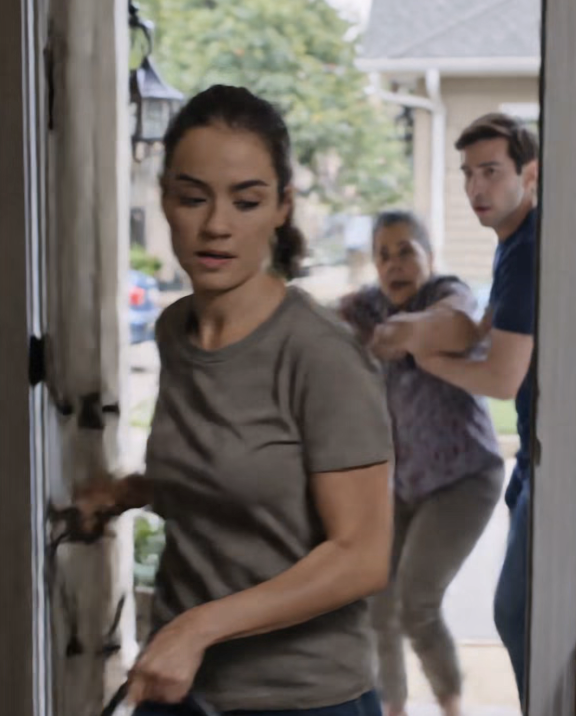
He nodded, crying silently.
“I know.”
For a second, old love moved inside me like a ghost.
I did not invite it to stay.
“Did you sign my name?”
He covered his face.
“No. But I knew she had paperwork. I knew she was trying to push it through. I told myself it wouldn’t matter unless you agreed.”
“Did you know she locked me out?”
He was quiet too long.
I looked away.
“That’s answer enough.”
“She said you needed to learn—”
He stopped.
I laughed softly.
“What? My place?”
His silence was unbearable.
Priya leaned forward.
“Mr. Collins, my client is willing to discuss a separation agreement. Given the documented attempted fraud and unlawful exclusion from the property, I suggest you listen carefully.”
The word separation hit him like a slap.
“Julia,” he whispered.
I looked at him, and I finally said the thing I had been too afraid to say for years.
“I cannot stay married to a man who thinks loving his mother means sacrificing his wife.”
His face broke.
But he did not argue.
That was the first decent thing he had done in a long time.
Diane did argue.
She sent emails in all caps. She left voicemails accusing me of theft, cruelty, elder abuse, and “feminist property hoarding,” which would have been funny if it had not been so sad. She posted vague messages online about daughters-in-law destroying families.
Then the investigation into the forged document became real.
Suddenly, Diane wanted to talk.
Not through lawyers.
Not with police present.
“Woman to woman,” she wrote.
I almost ignored it.
But a line in her message stopped me.
There are things Mark doesn’t know about his father’s death.
We met in Priya’s conference room.
Diane arrived without makeup, wearing a beige cardigan that made her look older than I had ever seen her. She sat across from me, hands clasped around a tissue.
“I did terrible things,” she said.
I waited.
“My husband, Robert, left debts. More than Mark knew. More than anyone knew. When he died, I thought insurance would cover it. It didn’t.”
“That doesn’t explain forging my name.”
“No.” Her eyes lowered. “It explains the panic. Not the sin.”
The word surprised me.
Diane had always called her behavior necessary, misunderstood, justified.
Never sin.
“I was angry when Mark married you,” she said. “Not because of you. Because you were proof he could survive without me. Then you bought the house, and he looked so proud of you. I told myself he was being diminished. But really, I was.”
I did not comfort her.
She did not deserve that from me.
“I pressured him,” she said. “I told him a son takes care of his mother. I told him if he loved me, he would fix what his father left behind. When he resisted, I said things I can’t take back.”
“What things?”
Her voice thinned.
“I told him his father died ashamed of him.”
My stomach turned.
“Was that true?”
“No.”
She began to cry.
“Robert adored him. He was proud Mark married a strong woman. He left a letter for him. I never gave it to him.”
I stared at her.
“Why?”
“Because in the letter, Robert told him not to spend his life rescuing me.”
The room went very still.
Diane reached into her purse and pulled out an envelope, worn soft at the edges.
“Please give it to him,” she said.
“You should.”
“He won’t see me.”
“That’s a consequence.”
She nodded, tears slipping down her cheeks.
“I know.”
I took the letter.
Not for her.
For Mark.
That night, I sat alone at my kitchen table with the envelope beside me.
The house was quiet, but not empty in the way it had been after the lockout. It felt like it was waiting to see what kind of life I would build inside it now.
I called Mark.
He answered on the first ring.
“Julia?”
“Your mother gave me something.”
He came over the next day with Priya’s approval and Mrs. Alvarez sitting shamelessly on her porch across the street as unofficial security.
I handed him the letter in the living room.
He recognized his father’s handwriting immediately.
His knees seemed to weaken, and he sat down before opening it.
My son,
If you are reading this, I am gone, and your mother is probably angrier at the world than she knows how to admit. Love her if you can, help her when it is right, but do not let her fear become your duty.
Build your own home.
Choose the person who gives you peace, not the person who demands proof.
And when the day comes that you must decide between being a good son and a good man, choose the harder goodness.
Mark cried for a long time.
I sat across from him, not beside him.
That mattered.
“I failed him,” he said.
“You failed yourself first.”
He nodded.
“I know.”
Months passed.
The legal separation moved forward. Diane accepted a plea agreement involving restitution, probation, and mandatory counseling. Mark cooperated fully. He moved into a small apartment across town and started therapy. He sent one message every Friday, not begging, not pressuring, just updating me on practical things and ending with: I hope you are safe and well.
For a long time, I did not reply.
Then one Friday, I wrote back:
I am.
It was not forgiveness.
It was truth.
Spring came slowly. I planted lavender along the walkway. Painted the front door deep green. Turned the guest room Diane had occupied into an office with bright curtains and a desk facing the window.
One afternoon, I found my gray slippers in the back of the closet.
The left toe was still torn.
I threw them away.
A year after the lockout, I hosted dinner for my sister, Mrs. Alvarez, Priya, and a few friends who had become family in the wreckage. We ate pasta under string lights in the backyard and laughed so loudly the neighbors probably peeked through their curtains again.
This time, I did not mind.
Near the end of the night, my phone buzzed.
A message from Mark.
I heard Mom apologized to you through her lawyer. I know it doesn’t fix anything. I also know I don’t deserve anything from you. But I wanted you to know I signed the final papers today. No contest. No claims on the house. It was always yours. I’m sorry I forgot that meant you were too.
I read it twice.
Then I looked at my home.
Not because of the deed. Not because of the locks.
Because every room now held evidence that I had chosen myself and survived the choice.
I typed back:
Thank you for signing. I hope you keep becoming someone your father would recognize.
His reply came a minute later.
Me too.
The divorce was finalized in June.
On the courthouse steps, Mark asked if he could say one last thing.
Priya stood a few feet away, pretending not to listen.
“I loved you,” he said.
“I know.”
“I just didn’t know how to love you louder than I feared her.”
That sentence hurt because it was finally honest.
“I hope you learn,” I said.
He nodded.
Then he walked away.
The happy ending did not arrive like a movie scene.
No dramatic kiss in the rain. No sudden inheritance. No apology that magically repaired the broken beams of a marriage.
It arrived quietly.
In the first night I slept without checking the locks twice.
In the morning I drank coffee on the porch while Mrs. Alvarez waved from across the street.
In the sound of my sister laughing in the kitchen during a weekend visit.
In the day I opened the door to a contractor and said, “I’m thinking of adding built-in shelves,” without wondering who would criticize the cost.
In the moment I realized the house no longer felt like something I had to defend.
It felt like something that defended me.
A year and a half after Diane locked me out, I received a small package with no return address.
Inside was a key.
Not one of mine.
Attached to it was a note in Mark’s handwriting.
This was the spare Mom kept. I found it in her storage unit. I should have taken it from her years ago.
I closed my hand around the key.
For a moment, I remembered standing on the porch after twelve hours of travel, suitcase in hand, humiliated under the neighborhood’s watchful windows.
Then I walked to the garage, took out a hammer, and smashed that key until it bent beyond use.
Afterward, I placed it in a small glass jar on my office shelf.
Not as a wound.
As a trophy.
Sometimes people think a locked door is the end of a story.
They are wrong.
Sometimes it is the first honest sentence.
And mine said this:
I was never the intruder.
I was the owner.
Of the house.
Of the truth.
Of the life waiting on the other side.