By the time my mother-in-law threw my unborn daughter’s clothes onto the nursery floor, I already knew she loved control more than she loved peace.
What I did not know was that she had spent thirty-two years controlling a lie.
The nursery was the softest room in our house. That was why I loved sitting there, even when my back ached and my ankles looked like they belonged to someone who had never met gravity before. Afternoon light spilled through the white curtains and turned everything gold: the pale rose walls, the little oak crib, the shelves lined with books my husband had read aloud to my stomach because he claimed our baby “preferred plot structure.”
I was eight months pregnant, sitting cross-legged on the carpet with a laundry basket beside me, folding clothes so small they looked impossible.
A yellow onesie with ducks.
A pair of socks no bigger than my thumbs.
A pink hospital outfit my mother had cried over when she bought it.
My daughter kicked lazily beneath my ribs, and I placed a hand on my belly.
“I know,” I whispered. “Grandma bought too much.”
From downstairs came the sharp, confident sound of my mother-in-law’s heels.
Evelyn March never entered a home quietly. She arrived like a verdict.
My husband, Adam, had inherited her green eyes and dark hair, but none of her coldness. He was gentle in ways that still surprised me after five years together. He apologized to furniture when he bumped into it. He cried during old dog commercials. He once drove forty minutes back to a bakery because they had given him the wrong cake and he “didn’t want the lemon one to feel rejected.”
Evelyn, on the other hand, could make a compliment feel like a warning.
She appeared in the nursery doorway wearing a navy dress, pearl earrings, and the faint smile she reserved for moments when she had already decided the outcome of a conversation.
In her hand was a small velvet box.
“Lena,” she said.
That was my name, though from her mouth it always sounded like a problem she was trying to solve.
“Hi, Evelyn.”
Her eyes swept over the floor.
“You shouldn’t sit like that. It’s undignified.”
“I’m folding baby clothes, not receiving ambassadors.”
Her smile did not move. “Where is Adam?”
“Garage. Trying to assemble the stroller.”
“Trying?”
“It has more parts than our car.”
Evelyn stepped inside and looked around the nursery. Her gaze paused on the wooden letters resting on the dresser, still unpainted.
M-A-R-A.
Mara.
The name Adam and I had chosen in bed one rainy morning, months before we knew we were having a girl. It was short, warm, strong. It sounded like someone who would climb trees and ask difficult questions. It sounded like ours.
Evelyn’s lips tightened.
“I see you’re still entertaining that name.”
I folded a tiny hat slowly.
“We’re not entertaining it. We chose it.”
She opened the velvet box.
Inside lay a silver baby bracelet, delicate and old-fashioned, the kind of thing people placed in keepsake drawers and never let a child actually wear.
The name engraved across the front was not Mara.
It was Celeste.
Evelyn held it toward me as if presenting a crown.
“This is what the baby will be called.”
Not suggested.
Not requested.
Declared.
I looked from the bracelet to her face.
“That’s beautiful,” I said carefully, “but Adam and I already chose her name.”
Evelyn’s smile flattened into something thinner.
“Celeste March is not a suggestion. It is tradition.”
“It’s not our tradition.”
“It is Adam’s.”
“Adam chose Mara with me.”
“He chose poorly under emotional influence.”
I blinked. “You mean marriage?”
“I mean you.”
The baby gave one hard kick, as if offended on my behalf.
I set the hat down.
“Evelyn, I’m tired. I don’t want to argue.”
“Then don’t.”
“I’m not naming my daughter Celeste just because you bought jewelry.”
Her face changed so quickly I felt the air shift.
She looked at the little pink hospital outfit in my hands, the one my mother had chosen, and her voice dropped.
“You don’t get to erase our bloodline.”
For one foolish second, I almost laughed.
Bloodline. As if we lived in a castle. As if my daughter were being born into a throne room instead of a suburban hospital with vending machines that stole quarters.
But Evelyn was not laughing.
She stepped closer.
“This family has carried that name through generations,” she said. “You don’t come in from nowhere and cut the cord.”
“From nowhere?” My throat tightened. “I’m your son’s wife.”
“You are the woman carrying the March heir.”
The words landed cold.
I had spent years trying not to hate her. For Adam’s sake. For the fragile hope that once the baby came, Evelyn might soften. But in that moment, sitting on the carpet surrounded by tiny clothes, I understood that she did not see me as family.
She saw me as a container.
I stood slowly, one hand pressed to my lower back.
“You need to leave.”
Her eyes flashed.
“Excuse me?”
“Leave the nursery.”
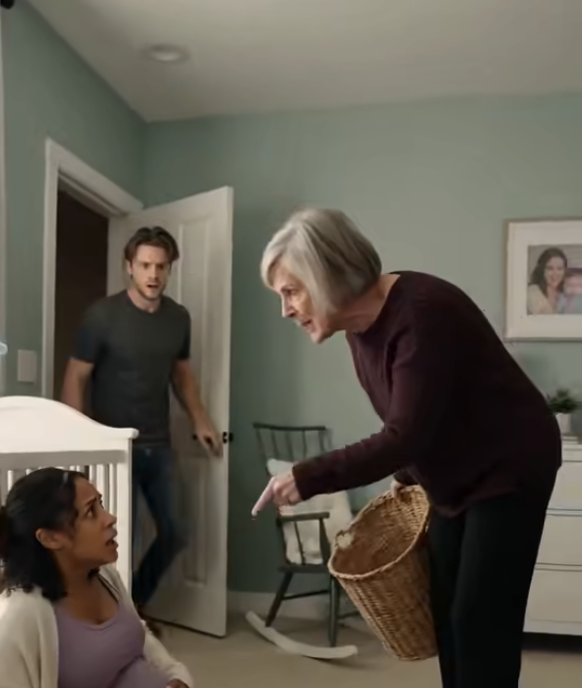
Instead, she reached down, snatched the laundry basket beside me, and flipped it upside down.
Everything spilled.
Tiny socks scattered across the rug. Blankets unfolded in soft heaps. Little hats rolled beneath the crib. The pink hospital outfit slipped from my lap and landed near her shoes.
For a moment I could not speak.
Then anger rushed through me so fast I shook.
“Stop! Those are for the baby!”
Evelyn stepped forward and placed one heel on the corner of a cream blanket embroidered with small stars.
“Then give the baby the right name.”
Something inside me cracked.
Not loudly. Not dramatically.
It cracked the way ice cracks beneath your foot, warning you that one more step will drop you into dark water.
I started crying before I meant to.
Not soft tears. Ugly, breathless ones. The kind that made me furious because they gave Evelyn the satisfaction of seeing me break.
“Get out,” I said. “Get out of my house.”
From downstairs came a clatter.
Then Adam’s voice.
“Lena?”
His footsteps pounded up the stairs.
He appeared in the doorway holding a screwdriver, his hair messy, his face open with alarm.
Then he saw the floor.
The baby clothes everywhere.
Me crying.
His mother standing over a blanket with the bracelet clenched in her hand.
The softness vanished from his face.
“Mom,” he said quietly. “What did you do?”
Evelyn lifted her chin.
“What needed to be done.”
Adam crossed the room, helped me sit in the rocking chair, then bent to pick up the pink outfit. He held it carefully, brushing dust from the sleeve.
That tenderness undid me more than the mess.
He turned to his mother.
“You dumped our daughter’s clothes on the floor?”
“She is not being named Mara.”
“That is not your decision.”
“It is when you are too weak to protect what belongs to you.”
Adam’s jaw tightened.
“What are you talking about?”
Evelyn opened her hand. The silver bracelet gleamed against her palm.
Adam stared at it.
Something flickered across his face. Recognition, maybe, or unease.
“Why does that name matter so much?” he asked.
Evelyn clutched it like evidence.
“Because some names are promises.”
I wiped my face and looked at the bracelet again.
The longer I stared, the more certain I became that this was not just about a name.
“Because that’s not just a name, is it?” I said.
Evelyn’s face changed.
For the first time since I had known her, fear cracked through her polish.
Adam noticed too.
He stepped closer and gently took the bracelet from her hand.
She resisted.
“Adam.”
“Let go.”
“Please.”
The word startled all of us.
Evelyn March did not say please unless a waiter had brought the wrong wine.
Adam pried the bracelet free and turned it over.
His body went still.
“What?” I whispered.
He looked down at the back of the bracelet. His face had gone pale.
“There’s another engraving.”
“What does it say?”
He swallowed.
“A date.”
I knew before he said it.
Not how. Not why.
I just knew.
“My birth date,” Adam whispered.
Evelyn pressed both hands to her mouth.
Adam stared at the bracelet as if it had opened beneath him.
Then his voice came out small, almost childlike.
“Mom, why is my name crossed out?”
The room became silent except for the soft hum of the ceiling fan.
I rose carefully and moved beside him.
On the back of the bracelet, beneath the date, was a name scratched so fiercely it was almost unreadable.
Almost.
Adrian.
Not Adam.
Adrian March.
The name had been carved through with a sharp line.
My husband looked at his mother.
“Who is Adrian?”
Evelyn’s eyes filled with something worse than sorrow.
Guilt.
“Adam,” she said. “You have to understand—”
“No.” His voice hardened. “I have spent my entire life understanding things for you. Understanding why Dad left. Understanding why we never visited relatives. Understanding why you burned every family photo before I was five because you said they carried bad memories.”
He held up the bracelet.
“I want the truth.”
Evelyn looked at me, then my belly, then the scattered clothes at her feet.
And for one terrible second, I thought she might lie again.
Instead, she sank onto the edge of the crib as if her bones had turned to sand.
“Adrian was your name,” she said.
Adam did not move.
“What?”
“When you were born, your father named you Adrian.”
“My father?”
“Yes.”
“You told me he left before I was born.”
Evelyn shut her eyes.
“I know.”
The baby kicked once, hard.
I placed both hands over my stomach.
Adam’s face was unreadable.
“Keep going.”
Evelyn twisted her pearl ring.
“Your father’s name was Gabriel March. He came from an old family. Wealth, expectations, rules. The Marches named their first daughters Celeste and their first sons Adrian. Always. It was tradition going back generations.”
She gave a bitter little laugh.
“I used to think tradition meant belonging.”
Adam said nothing.
“When I married Gabriel, I thought I was entering a family. But I was entering a system. Every meal, every holiday, every word was controlled by his mother, Celeste.”
The name seemed to darken the room.
“She was cruel,” Evelyn continued. “Not loud. Not obvious. She smiled while she cut people apart. She believed children belonged to the March family before they belonged to their parents. When I became pregnant, she brought me that bracelet and said the baby would be named according to blood.”
I stared at the bracelet.
“You hated it,” I said.
Evelyn looked at me.
“I feared it.”
Adam’s voice was tight. “So why are you doing the same thing to us?”
The question struck her like a slap.
Her mouth opened, but no answer came.
Then she looked toward the window, where the late sun threw bars of light across the floor.
“Because I thought if your daughter carried the name willingly, it would mean I had survived it. That I had turned it into something beautiful.”
“No,” Adam said. “You tried to turn us into proof.”
Evelyn flinched.
I wanted to be angry with her. I was angry with her. But something about the way she sat there, suddenly small among the baby clothes she had thrown, made the room feel less simple.
“What happened to Gabriel?” I asked.
Evelyn’s hands froze.
Adam turned to me, then back to her.
“Yes,” he said. “What happened to my father?”
She shook her head.
“He died.”
“You said he left.”
“He did both.”
“That’s not an answer.”
Evelyn looked at him then, and the fear returned.
“Because he came back.”
The words sent a chill through me.
“When?” Adam asked.
“When you were three months old.”
Evelyn’s voice lowered.
“I had left him. I took you and came here, to this house. My sister helped me disappear. Gabriel found us. He said I had stolen a March child. He had papers. Lawyers. Money. He told me his mother would raise you properly and I would be allowed to visit if I behaved.”
Adam’s knuckles whitened around the bracelet.
“What did you do?”
“I ran again. New city. New records. I changed your name from Adrian to Adam. My sister knew someone who helped with paperwork. It was wrong, but I thought it was the only way to keep you.”
My pulse thudded.
“So Adam isn’t legally—”
“It is now,” Evelyn said quickly. “Everything was corrected later. Legally, you are Adam. But at first…”
She covered her face.
“At first, I was a terrified woman with a baby and no money and a family powerful enough to take him.”
Adam stepped back.
His eyes were bright.
“My whole life,” he said. “My whole life you told me he abandoned me.”
“He would have taken you.”
“You don’t know that.”
“I do.”
“No, you know what you feared.”
Evelyn stood.
“I know what he wrote.”
She left the room before either of us could stop her.
Adam looked at me, stunned.
Then we heard her moving in the hallway closet. Boxes scraped. A lid fell. She returned holding a yellowed envelope.
She handed it to Adam.
He opened it with shaking hands.
Inside was a letter written in elegant black ink.
My dearest Evelyn,
You have confused motherhood with ownership. The child is March by blood and will be restored to his rightful place. You may return with him and be forgiven, or you may be removed from his life entirely.
There will be no Adam.
There is only Adrian.
Adam read the letter twice.
Then he sat on the floor among our daughter’s clothes.
For a while, nobody spoke.
Evelyn stood there with tears slipping silently down her face. I had never seen her cry. I had imagined it would satisfy me.
It did not.
It made me tired.
Adam looked at the bracelet in his hand.
“So you saved me from them,” he said.
Evelyn nodded.
“Then became them.”
The words were soft, but they shattered her.
She covered her mouth and wept.
Not elegantly. Not carefully.
Like someone who had finally reached the end of a hallway she had been walking for decades and found a mirror waiting.
“I’m sorry,” she said. “I am so sorry.”
Adam did not comfort her.
Neither did I.
Some apologies need to sit in the room alone before anyone decides what they are worth.
That night, after Evelyn left, Adam and I sat in the nursery together and refolded every piece of clothing.
He washed the blanket she had stepped on twice.
I did not tell him that was excessive.
I understood.
He placed the silver bracelet on the dresser, far from the wooden letters spelling Mara.
“Do you want to know more?” I asked.
He sat beside me heavily.
“I don’t know.”
“That’s allowed.”
“I thought my father was a coward who left.”
“Maybe he was worse.”
“Maybe Mom made him worse in my head because it was easier than telling me she was scared.”
I leaned into him.
“Both can be true.”
He rested a hand on my belly.
Our daughter shifted beneath his palm.
“Mara,” he whispered, as if anchoring himself.
Two days later, the first letter arrived.
It was addressed to Adrian March.
No return address.
Adam stared at it on the kitchen table for almost an hour before opening it.
Inside was a single sheet of paper.
Congratulations on the daughter.
The family name continues.
My mouth went dry.
Adam called Evelyn immediately.
She arrived in twenty minutes, pale and breathless.
When she saw the letter, she gripped the back of a chair.
“No,” she whispered.
“You said Gabriel died,” Adam said.
“He did.”
“Then who sent this?”
Evelyn shook her head.
“I don’t know.”
But I could see she had an idea.
The next week became a slow unraveling.
More letters came. No threats, exactly. Just statements.
A child needs roots.
Celeste is waiting.
Blood remembers.
Adam contacted a lawyer. The lawyer recommended documenting everything and installing cameras. Evelyn stayed away unless invited, but she called every night to ask if we were safe.
On the fourth night, she told us the part she had not been brave enough to say.
Gabriel had died in a car accident when Adam was six months old.
His mother, Celeste March, had not.
“She would be in her eighties now,” Evelyn said over speakerphone. “But if she knows about the baby…”
“How would she?” Adam asked.
Silence.
“Mom?”
Evelyn exhaled shakily.
“Because I wrote to her.”
I closed my eyes.
Adam’s voice went dangerously calm.
“You what?”
“Years ago. When your father died. I sent one letter. I told her you were safe and that she would never find you. I didn’t give an address.”
“But she did find us.”
“I don’t know how.”
I did.
The bracelet.
I took it from the dresser and looked at the old clasp. There, almost invisible beneath the curve of silver, was a tiny maker’s mark and a number.
Not jewelry.
A code.
Adam searched online. The number belonged to a private registry for antique family pieces. The bracelet had been appraised six months earlier.
Six months.
Around the same time Evelyn had taken it from a bank box to have it polished for “her granddaughter.”
Celeste had not found us through fate.
Evelyn had opened the door.
At first, Adam was furious. Then frightened. Then something quieter and harder.
“No more running,” he said.
He called the lawyer again.
He requested every record connected to Gabriel March, Celeste March, and the estate Evelyn had fled.
The truth arrived in a stack of documents thick enough to make our dining table groan.
And there, buried under legal filings and old trust agreements, was the secret Celeste had been protecting.
The March bloodline did not matter because of pride.
It mattered because of money.
A trust created generations earlier controlled land, investments, and voting shares in a company still worth millions. The first child of each direct March line could claim a share only after producing a living daughter named Celeste or a living son named Adrian.
It was absurd.
It was archaic.
It was exactly the kind of rule rich, controlling people wrote when they confused inheritance with immortality.
Adam stared at the papers.
“So if our daughter is named Celeste…”
“She unlocks your claim,” the lawyer said.
“And if she isn’t?”
“The claim becomes contestable. Possibly void, depending on how aggressively the remaining family trustees pursue it.”
I laughed then.
I could not help it.
All this terror, all this pressure, all this talk of bloodline, and underneath it was not destiny.
It was greed with calligraphy.
Adam reached for my hand.
“She’s still Mara,” he said.
I cried for the second time that week. This time not from fear.
From relief.
But the final letter came the day before my scheduled induction.
It was hand-delivered in a cream envelope.
Inside was a photograph.
A woman sat in a wheelchair beneath a crystal chandelier, ancient and severe, her white hair pinned perfectly. Across her lap lay a blue baby blanket.
On the back, someone had written:
Bring Adrian’s daughter home, or I will take back everything Evelyn stole.
Evelyn read it and went utterly still.
Then she did something I never expected.
She took the silver bracelet, walked to the garage, placed it on the concrete floor, and smashed it with a hammer.
Once.
Twice.
Again and again until the name Celeste bent, cracked, and disappeared.
Adam and I stood watching.
When she finished, Evelyn was shaking.
“She doesn’t get another child,” she said. “Not yours. Not mine. Not ever.”
The next morning, Mara Rose March was born with a furious cry and one tiny fist raised beside her face.
Adam cut the cord with tears dripping off his chin.
I held her against my chest, stunned by the weight of her, the warmth of her, the impossible fact that someone so small could make every old fear in the room seem suddenly breakable.
Evelyn came in an hour later.
She stood at the doorway, uncertain for the first time in her life.
“May I?” she asked.
Adam looked at me.
I nodded.
Evelyn washed her hands twice before holding Mara. The moment the baby settled into her arms, her face changed. Not into the hard mask of tradition. Not into the sharp pride of possession.
Into grief.
“I’m sorry,” she whispered to Mara. “I almost gave you a chain and called it a gift.”
Mara yawned.
Evelyn laughed through her tears.
Three months later, Celeste March’s lawyers requested a meeting.
Adam agreed on one condition: it would happen in our lawyer’s office, with all communication recorded.
Celeste appeared on a video screen, thin and regal, with eyes like polished stones.
“My great-granddaughter should know who she is,” she said.
Adam held Mara in his arms.
“She will.”
“Then you will give her the family name.”
“No.”
“You would deny her inheritance?”
“I would deny you ownership.”
Celeste’s gaze moved to me.
“You have no idea what you are costing your child.”
I smiled.
That surprised her.
“Actually,” I said, “we do.”
Our lawyer slid papers across the table.
For weeks, he had been digging through the trust’s original language. One clause, ignored by everyone because no one thought it mattered, stated that the name requirement applied only if the child was born to a legally recognized March father using his registered birth name.
Adam had not been Adrian for thirty-two years.
The trust could not claim Mara.
Celeste could not use her.
Better yet, because Gabriel’s line had been interfered with, coerced, and threatened, Adam had grounds to challenge the trustees for misconduct. The fortune Celeste had tried to use as bait became evidence against her.
Her face on the screen went slack.
For once, the woman who had named generations had no words.
Adam leaned toward the camera.
“My daughter’s name is Mara,” he said. “It means bitter in some stories. It means strength in ours. She will grow up knowing exactly who she is, and none of it will belong to you.”
He ended the call.
A year later, we used the settlement from the March trust to start a foundation for mothers escaping controlling families with children in their arms and no safe place to go.
Evelyn suggested the idea.
She did not ask for her name on it.
She asked if she could volunteer.
On Mara’s first birthday, our house filled with people and noise. My mother brought too many balloons. Adam baked a lopsided cake. Evelyn arrived with a small box wrapped in yellow paper.
My body tensed before I could stop it.
She noticed.
“I promise,” she said softly, “no bracelets.”
Inside was a wooden music box.
On the lid, carefully carved, was one word.
Mara.
I looked at Evelyn.
Her eyes shone.
“I thought,” she said, “a name chosen with love deserved something made with love.”
Adam put an arm around me.
Mara sat on the carpet, clapping at nothing, delighted with the world.
For a moment, I saw the nursery as it had been that day: clothes scattered, blanket under Evelyn’s heel, the silver bracelet shining like a curse.
Then I saw it as it was now.
Sunlight on the floor.
Our daughter laughing.
A grandmother learning to kneel without demanding worship.
A father who had lost a name and found himself.
And me, holding the proof that bloodlines are not erased by love.
They are redeemed by it.
That night, after everyone left, Adam stood in the nursery doorway while I rocked Mara to sleep.
“Do you think she’ll hate us one day for turning down all that money?” he asked quietly.
I looked down at our daughter, her lashes dark against her cheeks, one hand curled around my finger.
“No,” I said. “I think she’ll know we chose her over it.”
Adam smiled.
From the shelf, the music box played a soft, imperfect tune.
Mara stirred but did not wake.
Outside, the house settled around us, no longer a hiding place, no longer a battlefield, but a home.
And in that home, our daughter’s name belonged to no dead woman, no trust, no bloodline, no fear.
It belonged to her.
Exactly as it should.