The night my husband put divorce papers on the dining table, I was seven months pregnant and still wearing the slippers my mother had knitted for me after my ankles began to swell.
They were pale blue, soft at the heels, stitched unevenly because my mother’s hands had started to ache in the cold. She had apologized for the flaws when she gave them to me.
“Your father was the careful one,” she said, smiling sadly. “I only know how to love things together.”
I thought of those words as I stared at the papers.
Petition for Dissolution of Marriage.
My husband, Daniel, had placed them in front of me like a threat dressed in legal language. His mother, Helen, sat beside him with her chin lifted, her silver bracelet flashing under the chandelier. She looked pleased. Not sad. Not conflicted. Pleased.
“You don’t have to sign tonight,” Daniel said.
His voice was low, tired, almost gentle. That made it worse.
I looked at the man I had married three years earlier, the man who had once stood in my mother’s backyard under strings of lanterns and promised my father he would protect me. My father had been thin by then, his illness already stealing color from his face, but he had gripped Daniel’s hand and said, “She does not need protecting. She needs standing beside.”
Daniel had laughed then.
He was not laughing now.
“You’re threatening to divorce me because I won’t convince my widowed mother to sell her home,” I said.
Daniel flinched, but Helen leaned forward.
“Don’t twist this, Linh. That house is sitting there while this family burns.”
“That house is where my mother lives.”
“It is too large for one woman.”
“It is hers.”
Helen’s mouth tightened. “A good wife understands sacrifice.”
I placed one hand over my belly. The baby shifted faintly beneath my palm, a small reminder that another person was already listening to the world we were building around him.
“A good husband doesn’t ask his pregnant wife to strip her mother of shelter because his business failed,” I said.
Daniel’s eyes sharpened. “You think I wanted this?”
“I think you are blaming me for a debt I didn’t create.”
His face turned red. “You have no idea what I’m carrying.”
“No,” I said softly. “But I know what you’re trying to make me carry.”
For weeks, the house had become a courtroom with no judge. Creditors called before breakfast. Lawyers sent emails with urgent subject lines. Daniel’s construction supply company, Hartwell Materials, was collapsing under loans, unpaid invoices, lawsuits, and missing funds no one seemed able to explain.
At first, I had held Daniel while he shook in the dark.
Then his fear changed shape.
It became anger.
Then entitlement.
Then Helen arrived with her solution.
My parents’ house.
The house my father, Minh Nguyen, had bought with thirty years of factory shifts, weekend repairs, and careful envelopes of cash labeled mortgage, taxes, roof, emergencies. The house where he had planted a mango tree when I was nine. The house where my mother still set a place for him at the altar every morning, lighting incense and whispering updates about the weather, the neighbors, and me.
Helen spoke of selling it as if it were an old sofa.
“You are family now,” she said. “Your mother should want to help.”
“My mother already helped,” I snapped. “She helped bury my father. She helped pay for my wedding. She helped me when I was sick during my first trimester. She does not owe your creditors her roof.”
Helen stood so quickly her chair scraped the floor.
“You selfish little girl.”
Daniel rubbed his forehead. “Mom, stop.”
But he did not tell her she was wrong.
That was how I knew I was alone.
I took the divorce papers and tore them once down the middle.
Daniel stared at me.
Then I tore them again.
The sound was small, but it felt like thunder.
Helen’s face twisted with fury. “How dare you?”
“How dare I?” I pushed back my chair and stood, my belly heavy, my breath uneven. “You both sat here and decided my mother’s grief had a price tag.”
Helen crossed the room before I could move.
The slap snapped my face sideways.
For a moment, there was no sound.
Only heat.
Then the chandelier seemed to hum. My cheek burned. My hand rose slowly to touch it, not because I did not understand what had happened, but because my body needed proof.
Daniel stood frozen.
He had not stopped her.
He had not even said my name.
The baby kicked hard.
Something inside me went still.
I looked at Helen. Her hand was trembling now, but not with regret. With outrage that I had made her reveal herself.
Then I looked at Daniel.
“Are you going to say something?”
His throat moved.
Helen pointed toward the door. “If she won’t help, she can leave.”
Daniel closed his eyes.
For one terrible second, I waited.
A word. A defense. A sign of the man who had once kissed my father’s hand at our wedding after my father gave us his blessing.
Daniel opened his eyes and pointed toward the hallway.
“If you won’t stand with me,” he said, “then go.”
The room did not explode.
It emptied.
Everything I had hoped he still was left his face, and I saw only a frightened man choosing the easiest person to punish.
I turned without crying.
My purse was by the entry table. I took it. My phone. My keys. Nothing else.
Helen gave a cold laugh behind me. “Run to your mother, then. See how long pride keeps you warm.”
I reached for the door.
Before my fingers touched the handle, someone began pounding from the other side.
Not knocking.
Pounding.
Three heavy blows that shook the frame.
Daniel froze.
Helen’s face changed so quickly I almost missed it. Rage vanished. Color drained from her cheeks. She looked not surprised, but recognized.
Like trouble had finally found the right address.
The pounding came again.
“Open up, Daniel Hartwell!”
Daniel whispered, “No.”
I stepped back.
Helen grabbed his sleeve. “Don’t answer.”
But the voice outside boomed again. “We know you’re in there. Open the door before this gets uglier.”
Daniel moved like a man walking underwater. He opened it.
Three men stood on the porch in the rain.
The one in front was tall, broad-shouldered, and completely dry beneath a black umbrella held by one of the others. He wore a dark coat and carried a thick black folder under his arm.
“Mr. Hartwell,” he said. “Mrs. Hartwell.”
His eyes passed over Daniel, over Helen, then stopped on me.
His expression shifted.
“You’re the daughter of Mr. Nguyen, aren’t you?”
The room changed.
It was subtle, like air tightening before a storm.
I gripped my purse strap. “Yes.”
The man lowered his umbrella. “Minh Nguyen?”
My heart lurched at the sound of my father’s full name in a stranger’s mouth.
“Yes,” I said. “He was my father.”
The man’s face softened with something almost like respect.
“My name is Victor Sloane. Your father once saved my brother from losing his shop. He cosigned a restructuring agreement when no bank would touch him. He was a careful man.”
My throat closed.
“He was,” I whispered.
Helen stepped forward quickly. “Mr. Sloane, please. We were going to call tomorrow. We can arrange payment.”
Victor did not look at her.
“Mrs. Helen Hartwell,” he said. “I imagine you were.”
She went rigid.
Daniel frowned. “What is this?”
Victor stepped inside without waiting for permission. The two men followed. One remained by the door; the other carried a tablet and a stack of sealed envelopes.
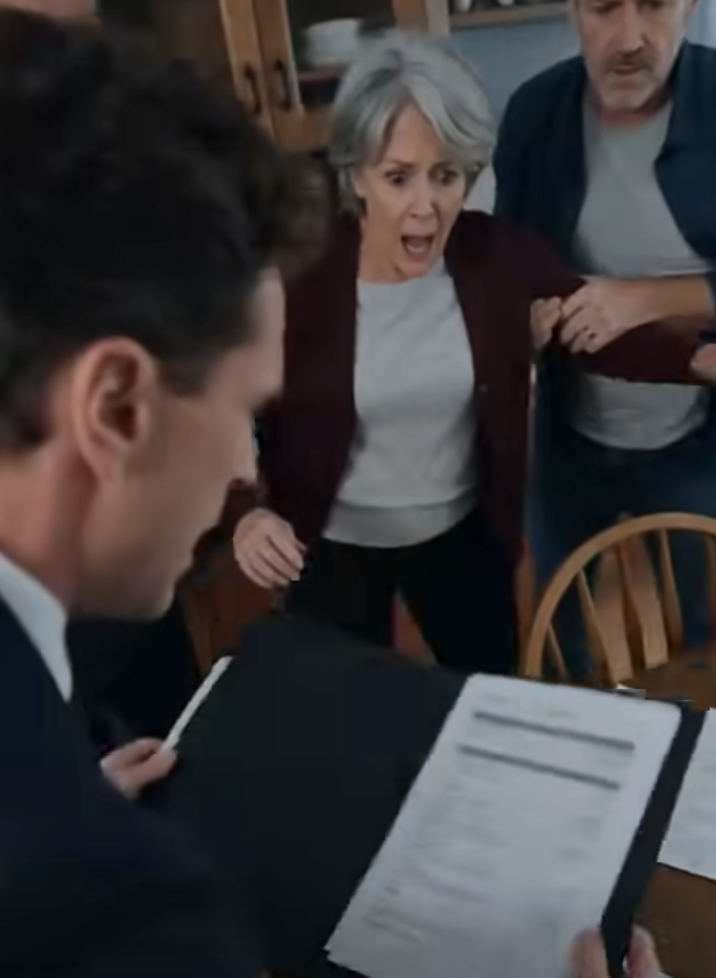
Victor placed the black folder on the dining table, on top of the shredded divorce papers.
“I came tonight because Mrs. Hartwell has been pressuring Mrs. Linh Hartwell to liquidate property connected to the Nguyen estate.”
Helen’s lips parted.
Daniel turned to me. “Did you call them?”
“No.”
Victor opened the folder.
Inside were contracts, property records, bank statements, copies of checks, wire transfer receipts, and pages marked with colored tabs.
“I advise everyone not to touch anything without permission,” Victor said.
Daniel reached anyway.
He grabbed the first page, scanned it, and went pale.
“What is this?”
“The truth,” Victor said. “Which is overdue.”
Helen made a sharp sound. “This is harassment.”
“No,” Victor replied. “Harassment is what you have been doing to your daughter-in-law.”
My hand moved again to my cheek.
Victor saw it.
His expression hardened.
“Did she hit you?”
Daniel looked away.
Helen said, “That is none of your business.”
“It became my business when you tried to drag Mr. Nguyen’s family property into a fraud investigation.”
The word fraud landed like a glass breaking.
Daniel stared at the folder. “Fraud?”
Victor nodded. “Your company’s debt is real. But it did not originate from business failure. Most of the missing money disappeared years before Hartwell Materials began struggling.”
“That’s impossible,” Daniel said.
“It is documented.”
Helen lunged toward the folder. “You have no right!”
One of the men stepped between her and the table.
Victor’s voice remained calm. “Sit down, Mrs. Hartwell.”
She did not sit.
But she stopped moving.
The front door opened again.
Arthur Hartwell, Daniel’s father, stumbled in, soaked from the rain, his glasses fogged, his face frantic.
“Helen?” he panted. “What did you do?”
Helen turned toward him. “Arthur, don’t.”
Victor looked at him. “Mr. Hartwell. Good. You should see this too.”
Arthur approached the table, already trembling.
Daniel flipped through the papers with increasing desperation.
“Fake vendor accounts,” Victor said. “Loans taken against company assets. Payments routed through shell entities. Property purchased under relatives’ names. Insurance claims manipulated. Credit extended using forged guarantees.”
Daniel shook his head. “I didn’t sign these.”
“No,” Victor said. “You didn’t.”
Arthur leaned over one document and made a sound that seemed to come from somewhere deep in his bones.
“My God.”
Daniel turned the page.
Then another.
His breathing grew uneven.
“Dad?” he whispered.
Arthur covered his mouth.
Daniel stopped on a single document near the back. His hands began to shake.
The signature at the bottom was not his.
Not Arthur’s.
It was written in elegant, slanted script.
Helen M. Hartwell.
Daniel looked up slowly.
His face was no longer angry.
It was destroyed.
“You did all of this?”
Helen’s eyes darted around the room, searching for an exit that did not exist.
“I did it for the family.”
Arthur nearly collapsed into a chair.
“No,” he whispered. “No, Helen.”
She turned on him. “Don’t you dare act innocent. You were weak. You always were. You would have let the company die years ago.”
Arthur stared at her. “So you stole from it?”
“I moved money.”
“You forged my name.”
“I protected what was ours.”
Victor slid another set of papers across the table. “You purchased two properties in Da Nang through a holding company. You transferred company funds into accounts controlled by your cousin. You used your son’s authority credentials after convincing him to give you access during his surgery recovery three years ago.”
Daniel sank into a chair.
Three years ago. I remembered that time. Daniel had broken his leg in a site accident and spent six weeks on pain medication, groggy and dependent. Helen had come every day with soup and documents.
“She said she was helping,” Daniel whispered.
Helen straightened. “I was.”
“You ruined us.”
“I kept us alive!”
“No,” Victor said. “You kept yourself hidden.”
The rain beat against the windows.
I stood very still, one hand on my belly, watching the family that had tried to sacrifice my mother’s home realize the altar had been built by one of their own.
Daniel looked at me.
The shame in his eyes was almost unbearable.
“Linh,” he said.
I did not answer.
Because something else had become clear.
If Victor had not come tonight, Daniel would have let me walk into the rain. Pregnant. Slapped. Blamed. Threatened. He would have let me choose between my marriage and my mother’s roof.
The truth had saved me from the lie.
But it could not erase what the lie revealed.
Helen grabbed the back of a chair. “Mr. Sloane, we can make an arrangement.”
Victor’s mouth tightened. “You already tried. You offered us Mrs. Nguyen’s property as collateral.”
My blood went cold.
“What?”
Daniel turned sharply. “Mom?”
Helen looked trapped now.
Victor removed another paper from the folder. “A preliminary collateral proposal listing the Nguyen residence as an anticipated asset transfer.”
I stepped toward the table.
There it was.
My mother’s address.
Written in cold black letters.
As if she were already gone.
As if my father had worked thirty years only for Helen to place his life on a balance sheet.
I picked up the paper with shaking hands. “You had no right.”
Helen’s expression hardened again. “You were going to come around.”
“No,” I said. “I wasn’t.”
“You don’t understand what families do to survive.”
“I understand perfectly,” I replied. “My father survived by working. My mother survived by grieving without becoming cruel. I am surviving by walking away from people who think love means obedience.”
Daniel stood. “Linh, please.”
I turned to him.
“Did you know about this document?”
“No,” he said quickly. “I swear.”
I believed him.
That did not save him.
“But you knew they wanted the house,” I said. “You knew I said no. You knew your mother hit me. And you told me to leave.”
His eyes filled with tears. “I was scared.”
“So was I.”
The words struck him harder than shouting would have.
Victor gathered the papers carefully. “Mrs. Hartwell, your mother’s home is protected. Your father placed safeguards on the title before his passing. No transfer can occur without your mother’s direct notarized consent and independent legal review.”
My knees weakened.
My father.
Careful, quiet, stubborn Papa.
Even gone, he had built one more wall around us.
Victor looked at me. “He also left instructions with an attorney. If anyone attempted to pressure your mother regarding the property, certain records were to be reviewed.”
I stared at him. “My father knew?”
“Not everything. But he suspected Mrs. Hartwell had unusual interest in his assets before your marriage. He asked questions others ignored.”
I remembered my father watching Helen at our engagement dinner.
Helen had praised the house too much. Asked too many questions. “Such a valuable property,” she had said. “Linh will inherit one day, yes?”
My father had smiled politely.
That night, as he locked the gate, he told me, “A person who counts your roof before they love your heart is not family yet.”
I had thought he was being overprotective.
Now tears blurred my eyes.
Arthur stood slowly. “Helen, tell me the truth. Is there anything else?”
She laughed bitterly. “The truth? You want truth now? Fine. I did what none of you had the courage to do. I kept appearances. I kept the company looking strong. I kept banks trusting us. I kept Daniel proud.”
Daniel stared at her. “You kept me blind.”
“I kept you safe.”
“You turned me into someone who threatened his pregnant wife.”
Helen’s face faltered.
For the first time, she looked at my belly.
Not at me.
At the child.
Maybe she finally understood that the damage had moved beyond money.
Arthur removed his wedding ring and placed it on the table.
Helen gasped.
“Arthur.”
“I lost a company tonight,” he said, voice breaking. “But I think I lost my wife years ago.”
She began to cry then, but her tears came too late to soften anything.
Victor’s men collected statements. Calls were made. Legal consequences, he explained, would follow. There would be investigations, asset freezes, court orders.
I heard it all as if from another room.
My body had reached the end of what it could carry.
I turned toward the door again.
This time, no one stopped me.
Daniel followed me onto the porch.
Rain fell in silver sheets beyond the awning.
“Linh,” he said, voice cracking. “Please don’t go like this.”
I looked at him, really looked.
I saw the boyish face I had loved, the panic, the regret, the collapse of everything he believed about his mother and himself.
Part of me wanted to hold him.
Another part remembered his finger pointing to the door.
“I am going to my mother’s house,” I said. “The house you wanted sold.”
He flinched.
“I’m sorry.”
“I know.”
“Can I come tomorrow? Can we talk?”
I touched my cheek, where the heat had faded into a dull ache.
“You can talk to my lawyer.”
His tears spilled over.
“Linh, I love you.”
I placed my hand over my belly.
“Then become the kind of man who understands why love is not enough.”
My mother opened the door before I knocked.
She looked at my face, then my belly, then the bag in my hand.
Her own face changed.
Not with surprise.
With a mother’s terrible recognition.
She pulled me inside without a word.
Only after I was seated on the old green sofa did she kneel in front of me and touch my cheek with trembling fingers.
“Who did this?”
I broke then.
I cried like a child in the house where I had once been one.
My mother held me carefully, one arm around my shoulders, one hand over the baby. The house smelled of ginger tea, incense, and rain. My father’s photograph watched from the altar, his eyes steady behind the glass.
When I finally told her everything, my mother did not shout.
She rose, walked to the altar, and lit a stick of incense.
Then she said, “Your father was right.”
I wiped my face. “About what?”
She looked back at me.
“He said one day that family would ask you to prove love by betraying yourself. He told me to remind you, when that day came, that betrayal is not love.”
The baby moved.
A slow roll beneath my ribs.
My mother sat beside me and took my hand.
“You and the baby will stay here,” she said.
“I don’t want to burden you.”
She gave me a look so sharp it almost made me laugh through my tears.
“This house was built to shelter my child. Now it shelters hers.”
In the months that followed, the Hartwell name unraveled.
Helen was charged. Assets were seized. The two secret properties were traced. Arthur cooperated with investigators. Daniel resigned from what remained of the company and found work under someone else’s name, at a smaller firm where nobody called him Mr. Hartwell.
He wrote to me often.
At first, I did not read the letters.
Then one afternoon, heavily pregnant and restless, I opened one.
It did not ask me to come back.
That surprised me.
It said:
I blamed you because I was too afraid to blame myself. I let my mother’s fear become my voice. I cannot undo that night. I am learning to become someone our child will not be ashamed of. I will respect whatever you decide.
I folded the letter and placed it in a drawer.
Respect was a start.
It was not a home.
Our son was born on a bright morning after three days of rain.
I named him Minh Daniel Nguyen-Hartwell.
Daniel cried when he saw the name on the birth certificate.
“You gave him my name,” he whispered.
“I gave him both,” I said. “So he remembers where he came from. And so you remember what you must live up to.”
Daniel nodded, holding our son with reverent, terrified hands.
My mother stood nearby, smiling softly.
For the next year, Daniel showed up.
Not with grand speeches.
With diapers. Court dates. Apologies that did not demand forgiveness. Child support paid early. Therapy appointments kept. Boundaries respected. He came to my mother’s house and repaired the porch railing without stepping inside until invited. He took our son to the park and brought him back on time. He never mentioned selling anything again.
Helen wrote once from prison.
I did not open the letter.
My mother burned it in a metal bowl in the backyard.
“Some words do not deserve a door,” she said.
Two years later, Daniel and I stood beneath the mango tree my father had planted.
Our son toddled between us, chasing a yellow ball. My mother sat on the porch, knitting something uneven and blue.
Daniel looked at the house.
“I hated this place once,” he said softly. “Because I thought it was the thing standing between me and being saved.”
“And now?”
He watched our son laugh.
“Now I know it was the thing that saved you from me.”
I looked at him.
He had changed. Not perfectly. Not magically. But honestly.
The old Daniel had wanted forgiveness as relief.
This one treated it like work.
“I don’t know what we become,” I said.
He nodded. “I know.”
“But I’m not angry every time I see you anymore.”
A small, cautious smile touched his mouth. “That’s more than I deserve.”
“Yes,” I said. “It is.”
He laughed quietly, and for the first time in years, the sound did not hurt.
Months later, we did not remarry.
Not then.
Instead, we began again differently.
Slow Sunday lunches with my mother. Co-parenting that became friendship. Friendship that became trust. Trust that, slowly and carefully, became love with its eyes open.
When Daniel finally asked if he could come home, he did not bring a ring.
He brought my father’s old toolbox, which my mother had given him permission to use, and a handwritten agreement he had made with his therapist: promises, boundaries, financial transparency, and a line at the bottom that made me cry.
I will never again ask you to burn your mother’s house to keep me warm.
I said yes.
Not because I forgot.
Because he remembered.
And because remembering had changed him.
Years later, when our son asked why Grandma’s house was so important, I took him to the hallway where my father’s photograph hung.
“This house,” I told him, “is not just walls.”
Daniel stood beside me, his hand warm against my back.
“It is proof,” he added softly, “that love protects. It does not take.”
Our son nodded solemnly, though he was too young to understand.
One day, he would.
One day, we would tell him how his grandfather built a house strong enough to shield three generations. How his grandmother kept it full of light. How his father nearly lost everything because fear made him cruel. How his mother learned that walking away could be the beginning of coming home.
But not yet.
For now, he ran into the yard under the mango tree, laughing as sunlight spilled over the grass.
My mother called us in for dinner.
Daniel picked up our son and carried him toward the porch.
I paused at the gate and looked back at the house.
The windows glowed gold.
The roof was still ours.
My father’s tree was heavy with fruit.
And inside, the people I loved were waiting—not demanding sacrifice, not weighing my worth, not asking me to choose between them and myself.
Just waiting.
With food.
With warmth.
With truth.
I touched the doorframe before going in, the way my father always had.
For luck, he used to say.
But I knew better now.
It was gratitude.
Because the night they tried to take my mother’s house from me, they revealed who had truly stolen from the family.
And in losing their lie, I found my strength.
I found my way back to my mother.
I found the kind of love that could be rebuilt only because it first learned how to bow before the truth.
Most of all, I learned that a home paid for with honest years cannot be taken by dishonest hands.
Not while one daughter is still standing at the door.