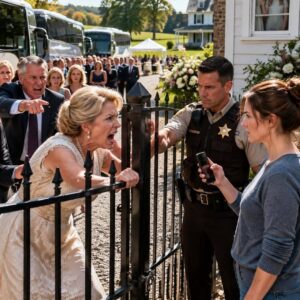
The moment Olivia Grant pushed me into the fountain, I understood that she was not trying to hurt me.
She was trying to make me drop the folder.
The shallow reflecting pool behind the Hawthorne Community Pavilion was only two feet deep, built more for photographs than swimming. White stone surrounded it in a perfect oval, and thin streams of water arched from bronze fixtures shaped like oak leaves. On ordinary weekends, children tossed pennies into it while their parents drank lemonade beneath striped awnings.
That Saturday afternoon, nearly four hundred people watched me fall into it.
My name is Bianca Rivera-Russo. I was thirty-four years old, seven months pregnant, and standing before the Brookhaven Community Development Council with enough documents to destroy the reputation of the most powerful woman in town.
The annual Brookhaven Unity Fair was supposed to celebrate neighborhood renewal. Banners hung between the trees. A local jazz trio played beside the pavilion. Volunteers in bright yellow shirts handed out food vouchers while elected officials shook hands beneath signs promising transparency, opportunity, and trust.
Behind the stage, however, three families were about to lose their homes.
And Olivia Grant expected everyone to applaud.
She stood near the microphone in a cream-colored suit, smiling as though she had personally invented civic responsibility. For twelve years, Olivia had chaired the Brookhaven Redevelopment Authority. She decided which streets received grants, which businesses qualified for permits, and which complaints disappeared into procedural darkness.
People described her as efficient.
They described hurricanes the same way.
I had spent six months investigating a redevelopment project called Riverlight Commons. Officially, it would transform abandoned warehouses near the eastern canal into affordable housing, public gardens, and small-business spaces.
Unofficially, it was pushing longtime residents out of their homes before the land became valuable.
The authority had declared several properties unsafe based on inspection reports that did not match the buildings. Compensation offers arrived days before condemnation notices. Families who questioned the process suddenly discovered unpaid fines, missing applications, or violations that had never existed.
My organization, Harbor Bridge Neighbors, had represented twelve affected households.
Then our funding disappeared.
The grant cancellation came with my name attached to it.
According to the redevelopment authority, I had falsified resident statements, mishandled public funds, and pressured elderly homeowners into resisting lawful relocation.
None of it was true.
But truth has a difficult time competing with an official letter stamped in blue ink.
By the morning of the fair, half the town believed I was a fraud.
The other half was waiting to see whether I would confess.
My husband, Daniel Russo, stood beside the fountain when Olivia stepped toward me. He was tall, quiet, and usually impossible to intimidate, but that afternoon his face had gone pale.
“Bianca,” he said softly, “we can leave.”
He rested one hand against my back and the other near my elbow, as though he could shield both me and our unborn daughter from the entire crowd.
I shook my head.
“We leave now, she wins.”
“She already knows you have something.”
“That’s why I have to speak.”
Daniel glanced toward the folder beneath my arm. It was dark blue, swollen with copied emails, altered inspection logs, financial records, and witness statements. At the center was a password-protected flash drive containing the original files.
Or what I believed were the original files.
“You said the evidence was incomplete,” he whispered.
“It’s enough to prove the reports were changed.”
“Enough to make her desperate?”
I looked across the pavilion.
Olivia was watching us.
She smiled.
That was when I knew Daniel was right.
She was desperate.
Before I could answer, Councilman Peter Vale approached the microphone.
“Ladies and gentlemen,” he announced, “we’re honored to welcome the woman whose leadership made Riverlight Commons possible.”
Applause moved through the crowd like a reluctant wave.
Olivia climbed the steps to the stage.
She spoke for ten minutes about dignity, progress, and revitalization. She praised volunteers. She thanked donors. She promised that no resident would be forgotten.
Then she looked directly at me.
“Unfortunately,” she said, “community progress sometimes attracts individuals who profit from fear.”
The crowd became very still.
Daniel muttered something under his breath.
Olivia continued.
“Recent concerns regarding Harbor Bridge Neighbors have forced us to protect vulnerable residents from misinformation and financial manipulation.”
My daughter shifted inside me.
It felt like a warning.
Olivia’s voice remained calm. That was one of her gifts. She could ruin a life without changing her expression.
“We will not permit personal ambition to obstruct lawful development.”
Several people turned toward me.
Mrs. Halloran, an eighty-one-year-old widow whose home had been declared structurally unsafe, stood near the front. Her fingers tightened around the handle of her cane.
She knew Olivia was lying.
So did the Mercer family.
So did the tenants of Canal Row.
But fear keeps people quiet long after loyalty has disappeared.
Olivia stepped away from the microphone.
I moved toward the stage.
Daniel caught my wrist.
“Bianca.”
“I have to.”
“What if she planned this?”
“She did.”
“That is not reassuring.”
I squeezed his hand.
“Stay near Mrs. Halloran.”
“Why?”
“Because if things go wrong, she knows where the backup is.”
His eyes narrowed.
“What backup?”
I kissed his cheek before he could stop me.
Then I walked through the crowd.
Each step felt heavy. Not because of the pregnancy, although my ankles were swollen and my lower back ached constantly. It was the weight of hundreds of eyes measuring whether I looked guilty.
People want innocence to appear graceful.
Real innocence is usually tired, angry, and carrying receipts.
“Councilman Vale,” I called. “I would like five minutes.”
Peter Vale froze beside the microphone.
Olivia turned.
“This is not the appropriate forum,” she said.
“You made it the forum when you accused me publicly.”
Murmurs spread through the audience.
Peter glanced between us. He was a cautious man with the survival instincts of someone who had built an entire career by never being the bravest person in the room.
“Ms. Rivera-Russo,” he said, “perhaps we can arrange a formal review.”
“I requested three reviews. All three were denied.”
“Because your allegations lacked supporting evidence,” Olivia said.
I raised the folder.
“I brought the evidence.”
That changed the crowd.
People leaned forward. Phones appeared. The jazz trio stopped playing.
For one brief second, Olivia’s smile vanished.
Then it returned.
“Bianca,” she said gently, “you have been under enormous stress.”
There it was.
Not the evidence.
My pregnancy.
“I am not confused,” I said.
“No one said you were.”
“You told Councilman Vale that my recent behavior might be affected by hormonal instability.”
Peter looked at the floor.
A few women in the crowd gasped.
Olivia’s jaw tightened.
“That was a private expression of concern.”
“You also told the funding committee that pregnancy had made me emotionally unreliable.”
“I was trying to protect you.”
“By accusing me of fraud?”
“By preventing you from damaging your organization further.”
I opened the folder.
“These are inspection reports for nineteen properties along Canal Row. The original reports show ordinary maintenance issues. The versions submitted to the council describe foundation failure, electrical hazards, and immediate risk of collapse.”
Someone shouted, “Let her speak!”
Another voice answered, “Show the reports!”
Olivia stepped down from the stage.
She came toward me slowly.
“Those documents were stolen.”
“You just said they did not exist.”
“I said your allegations were unsupported.”
“They were downloaded from the authority’s internal archive.”
“You accessed confidential government records?”
“No. They were sent to me.”
“By whom?”
I hesitated.
That was the only fact I could not reveal.
My source had contacted me through an encrypted account six weeks earlier. No name. No face. Only instructions and fragments of evidence. The final message had said:
THE BLUE FILE IS NOT COMPLETE. DO NOT TRUST THE FIRST SIGNATURE.
I had assumed it meant one of the inspection reports.
Now, with Olivia standing three feet away, I wondered whether I had misunderstood.
“By whom?” she repeated.
“I will disclose that during an independent investigation.”
Olivia moved closer.
Behind her, the fountain flashed in the sunlight.
“You have no idea what you’re holding,” she said quietly.
“Then explain it.”
“You think a few copied pages make you important?”
“No. They make the displaced residents important.”
Her eyes dropped toward my stomach.
“You should be thinking about your child.”
“I am.”
“Then stop.”
The word was almost inaudible.
I stared at her.
For the first time, I saw something beneath the anger.
Fear.
Not fear of losing her position.
Fear of the folder itself.
I lifted the first report so the nearest cameras could see it.
“This inspection was signed by Chief Engineer Marcus Bell on March fourth. The digital metadata shows that the hazard classification was changed eleven days later from a private account connected to—”
Olivia grabbed for the page.
I pulled it back.
Her hand struck my wrist.
The folder slipped slightly beneath my arm.
Daniel started toward us.
“Do not touch her!” he shouted.
Everything happened in less than two seconds.
Olivia looked at Daniel.
She looked at the phones recording us.
Then she placed both hands against my shoulders and shoved.
The stone edge hit the back of my knees.
I fell into the fountain.
Cold water swallowed the lower half of my body. My hip struck the smooth floor, and panic exploded through me before pain had time to arrive.
My hands flew to my stomach.
For one horrifying moment, the entire world became silent.
Then Daniel was in the water.
“Bianca!”
He dropped beside me, his shoes splashing as he slid one arm behind my shoulders.
“Look at me. Are you hurt?”
“I don’t know.”
“Is the baby moving?”
“I don’t know.”
The crowd erupted.
People shouted for an ambulance. Someone called the police. Mrs. Halloran screamed Olivia’s name with a fury I had never heard from her before.
But Olivia was not looking at me.
She was looking at the folder.
It had fallen open on the fountain’s edge.
Half the documents were wet. Several pages floated across the water. The flash drive had landed near one of the bronze fixtures.
Olivia lunged toward it.
That was when I understood.
She had not pushed me because I challenged her.
She had pushed me to create chaos around the evidence.
“Daniel,” I said.
He was checking my arms.
“Don’t move.”
“The drive.”
“What?”
“Get the drive!”
Olivia stepped into the fountain.
Her polished shoes disappeared beneath the water as she reached toward the bronze fixture.
Daniel saw her.
So did everyone else.
Councilman Vale grabbed Olivia’s arm.
“What are you doing?”
“That contains confidential records,” she snapped.
“You just pushed a pregnant woman!”
“She slipped.”
Four hundred people shouted at once.
Olivia tore free from Peter and reached down.
Before her fingers touched the drive, Mrs. Halloran struck her hand with the curved handle of her cane.
The flash drive skittered across the stone.
A teenage volunteer caught it.
“I’ve got it!” he yelled.
Olivia’s face changed.
All the polish disappeared.
“Give that to me.”
The boy backed away.
Daniel helped me stand. Water streamed from my dress, and my knees trembled so badly I could barely remain upright.
Then my daughter kicked.
Hard.
I pressed both hands against my stomach and began to cry.
“She moved,” I whispered.
Daniel closed his eyes.
Around us, the shouting softened.
An off-duty nurse from the crowd checked me while we waited for the ambulance. She asked questions, measured my pulse, and told me not to walk.
Olivia stood under the pavilion surrounded by security officers.
She was still insisting that I had fallen.
Then the pavilion’s sound system crackled.
A man’s voice emerged from the speakers.
“If you are hearing this, Bianca opened the blue file in public.”
The crowd went silent again.
I recognized the voice instantly.
Marcus Bell.
The chief engineer whose signature appeared on every altered report.
Marcus had disappeared three months earlier.
The authority claimed he had resigned and moved overseas.
His sister said she had not heard from him.
The recording continued.
“My name is Marcus Bell. I did not authorize the final hazard classifications for Canal Row. Olivia Grant instructed my department to alter the reports after the Riverlight acquisition agreement had already been signed.”
Olivia stopped struggling.
Her face drained of color.
The teenage volunteer held up the flash drive.
“I plugged it into the event laptop,” he explained.
A murmur swept through the crowd.
Marcus’s voice continued.
“The altered reports were used to reduce property values before transfer to a private holding company called Northstar Civic Partners.”
I knew that name. Northstar had appeared in the financial documents, but its ownership records were hidden behind several shell companies.
“Northstar is controlled through a trust,” Marcus said. “The beneficiary is not Olivia Grant.”
Olivia shut her eyes.
“The beneficiary is Councilman Peter Vale.”
Every head turned.
Peter staggered backward.
“That is a lie.”
The recording continued without mercy.
“Olivia Grant signed the transfer approvals, but Vale controlled the financing. He promised her a state appointment after the project was complete.”
Peter reached for the laptop.
Security stopped him.
“You cannot play stolen material!” he shouted. “This is manipulated!”
Marcus’s voice changed.
It became slower.
More personal.
“If Peter Vale denies this, open the encrypted ledger using the password printed on the reverse side of the missing inspection page.”
My heart sank.
The missing page.
I looked through the soaked documents.
Page fourteen was gone.
Olivia saw my expression.
For the first time since the recording began, she smiled.
“You don’t have it,” she said.
The recording ended.
The pavilion filled with confusion.
Peter began shouting about fabricated evidence and political sabotage. Olivia demanded an attorney. Police officers separated them while reporters pushed toward the fountain.
The teenage volunteer searched the folder.
“No page fourteen,” he said.
“Check the water,” Daniel ordered.
We searched everywhere.
The fountain drains.
The grass.
Beneath the stage.
Inside the soaked folder.
Nothing.
Without the password, the ledger remained encrypted.
Without the ledger, Peter Vale could claim that Marcus’s recording had been edited or coerced.
Olivia understood that.
She stood beside a police officer with her wet shoes and ruined suit, looking almost peaceful.
“One missing page,” she said to me. “That is all it takes.”
The ambulance arrived.
At the hospital, doctors monitored me for four hours. My daughter’s heartbeat remained strong. I had bruising along my hip and shoulder, but no serious injury.
Daniel never left my side.
He sat beside the bed with his hands clasped so tightly his knuckles had turned white.
“You could have lost her,” he said.
“I know.”
“You could have lost both of you.”
“I know.”
He stood and walked toward the window.
For months, he had supported my investigation, but he had never understood why I could not stop. He saw the threats, the anonymous calls, the funding loss, and the strain spreading through our marriage.
I saw Mrs. Halloran packing fifty years of her life into cardboard boxes.
“I am angry with you,” he said.
“I know.”
“And I am ashamed that I am angry.”
“You’re scared.”
“So are you.”
“Yes.”
He turned toward me.
“Then why do you keep acting like fear is something you can defeat by walking directly into it?”
“Because sometimes walking away gives it your address.”
He stared at me.
Then he sat beside the bed and rested his forehead against my hand.
“I thought she killed our daughter,” he whispered.
The anger left me.
I touched his hair.
“I’m sorry.”
“No more secrets, Bianca.”
The words struck deeper than he intended.
Because I still had one.
Mrs. Halloran knew about the backup.
I had told Daniel that before the confrontation, but I had never explained what it meant.
At nine that evening, Mrs. Halloran arrived at the hospital carrying a plastic grocery bag.
She wore the same blue cardigan from the fair. One sleeve was damp from the fountain.
“I brought you socks,” she announced.
Daniel looked inside the bag.
There were no socks.
There was a small metal cash box.
Mrs. Halloran locked the hospital room door.
“My husband installed security systems for municipal buildings,” she said. “Before he died, Marcus Bell came to our house.”
I sat upright.
“You met Marcus?”
“He was frightened. He said someone was monitoring his office and that he could not trust electronic storage.”
She placed the box on my blanket.
“He gave me this.”
Inside were three cassette tapes, an old brass key, and a sealed envelope bearing my name.
My hands shook as I opened it.
Bianca,
If you are reading this, Olivia has probably tried to destroy the blue file. She will believe the missing page contains the password. It does not.
The page is bait.
The password is the date Riverlight Commons was first proposed—not publicly, but privately.
Ask Daniel about the photograph.
I read the final line twice.
Then I looked at my husband.
Daniel had gone completely still.
“What photograph?” I asked.
He said nothing.
Mrs. Halloran stepped back.
“Daniel?”
He reached into his wallet.
Behind his driver’s license was an old photograph folded into quarters.
He opened it carefully.
The picture showed five people standing beside the eastern canal nearly twenty years earlier. One was Marcus Bell, much younger. Another was Olivia Grant.
A third was Peter Vale.
The fourth was Daniel’s father.
The fifth was my mother.
I stopped breathing.
My mother, Elena Rivera, had died when I was fourteen.
At least, that was what I had always been told.
In the photograph, she stood with one hand resting over a set of architectural plans labeled RIVERLIGHT COMMUNITY LAND TRUST.
On the back, someone had written a date.
September 18, 2007.
“Why do you have this?” I asked.
Daniel’s eyes filled with tears.
“My father gave it to me before he died.”
“You knew my mother was involved?”
“I knew she had worked on an early neighborhood project. I did not know it became Riverlight.”
“You had this the entire time?”
“I forgot about it until Marcus’s message.”
I stared at him.
“No more secrets.”
“I was afraid.”
“Of what?”
“That your mother’s name was connected to whatever they had done.”
The room felt suddenly too small.
I entered the date into the encrypted ledger.
The files opened.
Hundreds of transactions filled the screen.
Payments to shell companies.
Bribes disguised as consulting fees.
Property transfers.
Political donations.
And one trust agreement signed in 2007.
The original Riverlight project had not been a private development.
It had been a community land trust designed to protect Canal Row residents permanently. My mother and Daniel’s father had created it together, with Marcus serving as engineer.
Olivia and Peter had stolen the plan.
But that was not the greatest shock.
The trust had never been dissolved.
It had been hidden.
And according to its terms, control transferred to the founders’ surviving children if the land was threatened by private acquisition.
Daniel read the final page.
Then he looked at me.
“Bianca.”
“What?”
“You and I own the controlling trust.”
I stared at him.
“That’s impossible.”
“Our parents named us successor trustees.”
Mrs. Halloran began to cry.
The entire redevelopment deal rested on land that Peter Vale and Olivia Grant did not legally control.
They had spent years intimidating residents, altering reports, and manipulating public votes to acquire something that already belonged to a protected community trust.
By attacking me in public, Olivia had triggered the one investigation guaranteed to expose it.
But one question remained.
“Where is Marcus?” I asked.
Mrs. Halloran looked toward the locked door.
Then someone knocked.
Three slow taps.
A pause.
Two more.
Mrs. Halloran opened it.
The man standing in the hallway wore hospital scrubs and carried a janitor’s cart. His beard was gray, and a scar crossed one side of his forehead.
I recognized his voice before his face.
“Hello, Bianca,” Marcus Bell said.
Daniel stood between us.
“You’re alive.”
“For the moment.”
Marcus entered and locked the door again.
He had not moved overseas. After discovering Peter’s control of Northstar, he had tried to report the scheme to a state investigator. The investigator turned out to be one of Peter’s allies.
Two days later, Marcus’s car was forced off a rural road.
He survived, but the attack convinced him that formal channels were compromised.
“So you vanished,” I said.
“I needed them to think I was gone.”
“You used me.”
“Yes.”
The answer was so direct that it stunned me.
“You sent the files knowing Olivia would come after me.”
“I sent them because you were the only organizer she could not buy.”
“You put my child at risk.”
Marcus looked at my stomach.
“I did.”
Daniel moved toward him.
I caught Daniel’s arm.
Marcus did not defend himself.
“I will regret that for the rest of my life,” he said. “But there is something you still do not understand.”
He took the brass key from the cash box.
“This opens a records cabinet beneath the original Riverlight survey office. Inside is a signed confession from the person who ordered the entire scheme.”
“Peter Vale?”
“No.”
“Olivia?”
“No.”
Marcus looked at me.
“Your mother.”
The room went silent.
I laughed once, because the alternative was screaming.
“My mother died before this began.”
“No,” Marcus said. “Your mother disappeared because she began it.”
He explained that Elena Rivera had originally designed Riverlight as a protected community trust. But when investors offered millions for the canal district, she secretly negotiated with them.
She planned to relocate the residents, dissolve the trust, and divide the profits.
Daniel’s father discovered her betrayal.
He warned Marcus.
Olivia and Peter were junior officials then. Elena recruited them to help manipulate the first inspections.
“But the plan failed,” Marcus said. “Your mother changed her mind.”
“Why?”
“You.”
I felt my daughter move again.
Marcus’s eyes softened.
“Elena saw what the scheme was doing to families. Then she imagined someone doing the same thing to you. She tried to stop the sale and expose everyone involved.”
Peter retaliated by threatening me.
My mother staged her death to protect me and entered federal witness protection after turning over partial evidence.
The prosecution collapsed when the lead investigator was bribed.
Elena remained hidden, believing that contacting me would place me in danger.
I could barely hear Marcus’s final words.
“She is alive, Bianca.”
The door opened again.
A woman stood in the hallway.
Her hair was silver. Her shoulders were narrower than I remembered, but her eyes were exactly the same.
The same dark eyes I saw every morning in the mirror.
“Hello, mija,” she whispered.
For twenty years, I had imagined what I would say if death returned someone I loved.
In every version, I ran forward.
In reality, I could not move.
“You left me,” I said.
My mother began to cry.
“I thought it was the only way to keep you alive.”
“You let me bury you.”
“I know.”
“You let me grow up without you.”
“I know.”
“You watched?”
“From a distance. Every birthday. Your graduation. Your wedding.”
Daniel covered his mouth.
Rage and grief collided inside me until I could not separate them.
“You do not get to come back because the evidence needs a witness.”
“I did not come back for the evidence.”
“Then why?”
Her gaze dropped toward my stomach.
“Because I have already lost twenty years with my daughter. I could not lose another lifetime with my granddaughter.”

I cried then.
Not gracefully.
Not quietly.
I cried for the fourteen-year-old girl who had stood beside an empty grave. I cried for the woman who had inherited her mother’s unfinished fight without knowing it. I cried because forgiveness felt impossible, but so did turning away.
My mother did not ask me to forgive her.
She simply waited.
Eventually, I held out my hand.
She crossed the room and took it.
Three months later, Olivia Grant pleaded guilty to assault, evidence tampering, and conspiracy. Peter Vale was indicted on fraud, bribery, obstruction, and racketeering charges. Additional investigations removed two authority officials and a state investigator who had protected them.
The Riverlight redevelopment deal was canceled.
The original community land trust was restored.
No Canal Row residents lost their homes.
Daniel and I declined personal control of the property. Instead, we created an elected resident board and transferred permanent decision-making authority to the families who lived there.
Mrs. Halloran became its first chairperson.
She ruled meetings with the same cane she had used to stop Olivia from taking the flash drive.
Marcus entered protective custody and testified before a federal grand jury.
My mother did too.
Rebuilding our relationship was not simple. Happy endings rarely are.
There were days I could not look at her without remembering the funeral. There were questions she could not answer without shame. Sometimes we sat together for an hour and said almost nothing.
But she stayed.
That mattered.
On a bright morning in early autumn, I gave birth to a healthy daughter.
We named her Lucia Elena Russo.
The first time my mother held her, she whispered a promise into the baby’s dark hair.
“No secrets,” she said.
Daniel looked at me.
I looked at him.
Then we both laughed, because some promises are too important to make solemnly.
A year later, the old Hawthorne fountain was removed.
In its place, the community installed a garden surrounded by stones engraved with the names of Canal Row families. At the center stood a small bronze plaque.
It did not mention Olivia Grant.
It did not mention Peter Vale.
It did not mention me.
It read:
TRUTH DOES NOT BELONG TO THE PERSON WHO HIDES IT OR THE PERSON WHO FINDS IT. IT BELONGS TO EVERYONE WHO WAS HARMED BY ITS ABSENCE.
At the dedication ceremony, Lucia toddled between the flower beds while Daniel followed with both arms extended.
My mother stood beside me.
“Do you ever wonder what would have happened if Olivia had not pushed you?” she asked.
“All the time.”
“She thought she was destroying the evidence.”
“She almost did.”
My mother shook her head.
“No. She made everyone look at it.”
Across the garden, Mrs. Halloran raised her cane and ordered the councilman to stop standing on the new grass.
Marcus laughed.
Daniel lifted Lucia into the air.
And beneath the noise, sunlight, and ordinary happiness of people who had finally reclaimed their neighborhood, I understood the final truth.
Olivia had believed that pushing me into the water would make me appear weak, unstable, and easy to dismiss.
Instead, she had forced the entire town to watch what powerful people did when they thought no one would stop them.
She had exposed Peter.
She had restored Riverlight.
She had brought my mother home.
The shove meant to silence me became the loudest testimony of all.
And the page Olivia had tried so desperately to find had never been missing.
It had been waiting in my husband’s wallet for twenty years, folded behind a photograph of the family we had lost—and the future we were finally brave enough to rebuild.