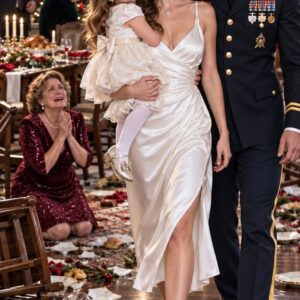
The cruelest words I ever heard were not shouted.
They were spoken gently, almost lazily, between the clink of crystal glasses and the soft scrape of forks against porcelain, as if my humiliation were nothing more than another dish being served at the table.
“No parents,” my mother-in-law said, lifting her wineglass with two perfectly manicured fingers. “No family. No background.”
A few people laughed.
Not loudly. Not bravely.
Just enough to let her know they were on her side.
I sat across from her at the long restaurant table, wearing the emerald dress my husband once said made me look like hope. It was our fifth wedding anniversary. There were relatives on both sides, neighbors from our apartment building, two of Daniel’s old colleagues, and people I barely knew but had learned to smile at because that was what good wives did.
My mother-in-law, Evelyn Whitmore, looked me up and down as if I were a stain on the linen.
“You brought nothing into this marriage, Nora,” she continued. “Honestly, an orphan like you should be grateful anyone agreed to marry you.”
The room tilted.
For one impossible second, I thought I had imagined it. Surely nobody would say something that ugly in public. Surely my husband would reach for my hand, or laugh sharply and tell his mother she had gone too far.
But Daniel did not move.
He lowered his head.
And somehow, his silence wounded me more deeply than her words.
I had spent my whole life surviving silence. The silence of a nursery where nobody came when I cried. The silence of foster homes where doors closed softly and children learned not to ask when they would be loved. The silence of birthdays no one remembered, school events no one attended, hospitals where I signed my own forms at eighteen because no emergency contact existed.
I had built myself from scraps.
Two jobs through college. Night classes. Cheap shoes with cardboard slipped inside when the soles split open. Instant noodles eaten over textbooks. Smiling through interviews with people who assumed confidence came naturally to anyone wearing a clean blouse.
I had brought myself into the marriage.
But to Evelyn Whitmore, that was nothing.
“A girl with no roots,” she said, smiling at me over the candlelight. “That’s a dangerous thing. She’ll cling to anything.”
Daniel’s cousin coughed into his napkin. Someone muttered, “Evelyn, really,” but no one meant it enough to stop her.
I looked at my husband.
“Daniel?” I whispered.
He stared at his plate.
My throat tightened until swallowing hurt.
Evelyn leaned back, satisfied. She had always known how to destroy with elegance. She never raised her voice, never dirtied her hands. She simply dropped poison into a room and watched everyone else drink it.
That night, when Daniel and I returned home, he said, “You know how my mother is.”
I stood in the hallway, still wearing my coat.
“No,” I said quietly. “I know how she is. What I don’t know is how you are.”
His face hardened with guilt, which was worse than anger because guilt meant he understood.
“She’s old-fashioned.”
“She called me a charity case in front of everyone.”
“She didn’t say—”
“She said I should be grateful someone married me.”
Daniel rubbed his forehead. “I didn’t want to make a scene.”
I laughed once, but it broke in the middle.
“A scene was already happening,” I said. “You just decided I should stand in it alone.”
He looked at me then, really looked, and for a moment I saw the man I had married: gentle, tired, afraid of confrontation but never cruel. Yet fear can become cruelty when it chooses comfort over courage.
“I’m sorry,” he whispered.
But apologies were small things. They could not rebuild trust by themselves.
After that dinner, something inside me shifted. Not dramatically. There was no slammed door, no suitcase, no stormy declaration. I simply began to notice.
I noticed how Daniel’s hand tightened around mine whenever his mother entered a room, not to protect me, but to restrain me.
I noticed how Evelyn studied me whenever I wore the necklace that held my childhood bracelet.
It was a small silver thing, too tiny for an adult wrist, so I had threaded it onto a chain years ago. The bracelet was the only object I had from the time before foster care. It had been found tucked into the blanket I was wrapped in when someone left me outside a church in northern Maine. On its surface was an engraved symbol: a crescent wrapped around a small star, with three dots beneath it like falling rain.
No one knew what it meant.
Not the social worker. Not the police. Not any foster parent who had briefly pretended to care.
To me, it meant proof.
Proof that before the system gave me a case number, I had belonged somewhere.
Evelyn hated it.
“Cheap little thing,” she once said, touching it without permission. “You should stop wearing that. It makes you look desperate.”
I stepped back. “It’s mine.”
Her eyes narrowed.
“Not everything that’s found belongs to the person holding it.”
At the time, I thought she was being cruel in her usual cryptic way. Later, I would remember that sentence and feel the floor vanish beneath me.
The worst thing she did happened three months after the anniversary dinner.
I came home early from work with a migraine and found Evelyn in our apartment.
She had a key because Daniel had given her one “for emergencies.” Apparently, emergencies included reorganizing our kitchen, judging my curtains, and throwing away the parts of my life she found unattractive.
She stood by the trash bin with an old blue photo album in her hand.
My photo album.
It was cracked along the spine, swollen from age, and mostly empty. A few pictures from foster homes. A school portrait where my bangs were uneven because I had cut them myself. A faded photo of me as a toddler, sitting on a blanket, wearing the silver bracelet.
“What are you doing?” I asked.
She startled, then recovered instantly.
“Cleaning.”
I crossed the room. “Give that to me.”
“Nora, don’t be dramatic. It’s old junk. You keep clinging to trash and then wonder why you feel like trash.”
She dropped the album into the bin.
Something wild and wounded rose in me.
I shoved past her and pulled it out, hands shaking. Coffee grounds smeared the cover. An eggshell stuck to one corner.
“You had no right,” I said.
Evelyn’s face changed. For a second, the mask slipped, and what I saw was not disgust.
It was fear.
Then it was gone.
“You’re too sentimental,” she snapped. “That’s why Daniel has to carry you.”
That night, I sat on the bathroom floor and cleaned every page with damp cotton pads. Daniel stood in the doorway, helpless and ashamed.
“She shouldn’t have done that,” he said.
“No,” I replied without looking up. “She shouldn’t have had a key.”
He took it back the next morning.
It was the first time he had chosen me over her.
But the damage had already been done.
Weeks passed. Then months.
I stopped attending Evelyn’s Sunday lunches. I stopped answering her calls. Daniel went sometimes, returning quiet and uneasy. He started therapy after I told him I did not want a husband who needed permission from his mother to love his wife.
For the first time, he tried.
And for the first time, Evelyn began losing control.
Then, on a rainy Thursday morning, the black car arrived.
I worked as a project manager at a small architectural firm downtown. My office was on the fourth floor of an old brick building that smelled like wet coats and printer ink whenever it rained.
At 10:17, my coworker Maya leaned over the cubicle wall.
“Nora,” she whispered. “There are two movie villains downstairs asking for you.”
I looked up from a budget spreadsheet. “What?”
“Black car. Expensive suits. Very serious faces. One of them has cheekbones sharp enough to cut glass.”
I almost smiled, until my phone rang.
Reception.
“Nora, there are two gentlemen here to see you. They say it’s urgent.”
“Did they give names?”
A pause.
“They said it concerns your family.”
My family.
The word struck an old bruise.
I went downstairs expecting a mistake, maybe a scam, perhaps some legal error connected to old foster records. Instead, I found two men standing in the lobby. Both wore dark suits, but only one looked comfortable in his. The older one had silver hair and steady eyes. The younger kept glancing toward the windows as if guarding against ghosts.
“Ms. Nora Whitmore?” the older man asked.
“Rowan,” I corrected automatically. “I kept my name after marriage.”
His expression flickered with something like approval.
“My apologies. Ms. Rowan. My name is Elias Voss. This is Adrian Vale. May we speak privately?”
“No,” I said.
I had learned early that private rooms were where people tried to take things from you.
Elias looked at Adrian, then back at me. “Very well. I’ll be direct. We believe you may be connected to a missing child case from twenty years ago.”
My body went cold.
Adrian’s gaze had dropped to my necklace.
His face drained of color.
“Mr. Voss,” he said, voice strained. “The bracelet.”
Elias stared.
For a moment, all sound in the lobby disappeared: the elevator bell, the rain, the receptionist typing.
“Where did you get that?” Elias asked.
“It’s mine.”
“May I see it?”
“No.”
His eyes filled—not with greed, not with calculation, but with grief so sudden it frightened me.
Adrian stepped away and made a phone call. His voice was low, urgent.
I heard only one sentence.
“We found the silver mark.”
Within an hour, the street outside my office was blocked by three black vehicles. People gathered at the windows. Maya texted me twelve question marks. My boss came downstairs, saw the convoy, and quietly went back up.
Then an elderly man stepped out of the lead car.
He was tall despite his age, dressed in a charcoal overcoat, with white hair swept back from a face the world knew from business magazines and charity galas. Even I recognized him.
Arthur Bellamy.
Billionaire founder of Bellamy Global. Hotels, shipping, medical research, private foundations. A man wealthy enough to have wings of hospitals named after him.
He walked toward me slowly, as if one wrong movement might shatter me.
When he saw the bracelet, he covered his mouth.
“My God,” he whispered. “Lilia.”
The name passed through me like a song I had forgotten I knew.
“I’m Nora,” I said, but my voice sounded far away.
Arthur’s hands trembled. “You were Lilia Bellamy. My granddaughter.”
I almost laughed. Not because it was funny, but because the mind protects itself from impossible things by making them ridiculous.
“No,” I said. “I was abandoned.”
His face crumpled.
“No, child. You were taken.”
He showed me photographs in a leather folder: a toddler with dark curls and solemn eyes; a woman holding that toddler beside a fountain; a close-up of a tiny wrist wearing my bracelet.
My bracelet.
The room blurred.
Arthur explained gently, every word careful. His daughter, Celeste Bellamy, had been traveling with her little girl when a trusted aide betrayed the family. The child vanished during a charity event in Montreal. Ransom demands came, then stopped. Evidence suggested the kidnapping ring crossed borders. For twenty years, the Bellamys searched through agencies, investigators, and governments.
They found bones that were not mine. Leads that collapsed. Scammers who memorized details from old news articles and came pretending to be the lost heiress.
“But the bracelet was never public,” Arthur said. “Neither was the symbol. My wife designed it. The crescent for Celeste, the star for you, the three dots for the three generations of Bellamy women.”
I gripped the edge of the chair.
“DNA,” I said. “I want DNA.”
Arthur nodded immediately. “Of course.”
That was the first reason I believed him.
He did not demand trust.
He offered proof.
The test came back with a probability so high the geneticist called it conclusive.
I was Lilia Nora Bellamy.
Granddaughter of Arthur Bellamy.
Daughter of Celeste Bellamy, who had died eight years earlier after a long illness, never knowing her child had survived.
I read that part alone.
Then I locked myself in a bathroom stall at the testing center and cried for a woman whose face I knew only from photographs but whose eyes looked exactly like mine.
When the news reached Daniel, he sat on our living room floor with the documents spread around him.
“Nora,” he whispered. “This is…”
“I know.”
He looked shattered, not by the money or the name, but by the enormity of what had been stolen.
“You had a family,” he said.
I nodded. “And someone took them from me.”
When Evelyn found out, she transformed overnight.
She called first.
“My darling girl,” she said warmly, as if the word darling had not curdled in her mouth for years. “I heard the most wonderful news.”
I held the phone away from my ear and stared at it.
“Who is this?”
A pause.
Then a brittle laugh. “Nora, don’t be silly. It’s Mom.”
“You are not my mother.”
Daniel, sitting beside me, closed his eyes.
Evelyn inhaled sharply. “I know I made mistakes, but family forgives.”
“You said I had no family.”
Another pause.
“That was before—”
“Before what?”
Before I mattered? Before my bloodline impressed you? Before my poverty turned into an inheritance?
She began sending gifts. Silk scarves. Flowers. Handmade pastries she claimed were my favorite, though she had never once noticed what I ate. She told neighbors she had always known I was “special.” She posted an old wedding photo online with the caption: My beautiful daughter-in-law, a blessing from the beginning.
I did not respond.
Daniel did.
He went to her house and came back pale.
“What happened?” I asked.
He stood in the kitchen for a long time before answering.
“She asked if we could convince Arthur to invest in Uncle Richard’s company.”
I laughed, softly and without joy.
“There it is.”
“I told her no.”
“And?”
He swallowed. “She said I was choosing you over my own blood.”
I looked at him carefully.
“And what did you say?”
His eyes met mine.
“I said you are my family. And if she ever insults you again, she loses me.”
Something inside my chest loosened.
Not healed. Not yet.
But loosened.
Two weeks later, Arthur invited both families to dinner at Bellamy House.
It was not a house. It was a stone estate overlooking the Hudson River, with windows tall enough to hold the sunset and a driveway lined with winter-bare trees. The place looked like it belonged to another century, another life.
My life, apparently.
I wore a simple navy dress and the silver bracelet around my neck. Daniel walked beside me, nervous but steady.
Evelyn arrived in pearls.
She kissed both my cheeks before I could step back.
“My sweet Nora,” she said loudly, ensuring everyone heard. “Or should I say Lilia? I always told Daniel there was something noble about you.”
Daniel’s jaw tightened.
Arthur watched from across the foyer, expression unreadable.
Dinner was served in a room where portraits lined the walls. Celeste’s portrait hung above the fireplace. She had my eyes. Or I had hers. I still did not know which way grief was supposed to travel.
Evelyn performed through every course.
She told Arthur how she had welcomed me “despite my difficult beginnings.” She bragged that she had encouraged my education. She described herself as a second mother.
I sat silently, fingers resting on my necklace.
Arthur let her speak.
That was the frightening part.
He simply listened.
After dessert, he stood.
The room fell quiet.
“Before we discuss the future,” Arthur said, “there is something everyone here deserves to see.”
Elias Voss placed a thick folder on the table.
Evelyn’s smile stiffened.
Arthur opened it.
“For twenty years,” he said, “my family searched for Lilia. We were told many lies. Some came from criminals. Some came from officials who had been paid. But one lie came from much closer to this table.”
Evelyn’s fork slipped from her fingers.
It struck the plate with a sharp, bright sound.
Arthur removed a photograph and laid it down.
It showed a much younger Evelyn standing outside a courthouse. Beside her was a man I did not recognize, holding a file box.
Daniel leaned forward.
“Mom?”
Evelyn’s lips parted. “I don’t know what this is.”
Arthur placed another document beside it.
“Twenty years ago, your mother worked as a records clerk for a private adoption attorney named Malcolm Price.”
Evelyn’s face lost all color.
Daniel stared at her. “You told me you worked for a dentist.”
“I did,” she snapped too quickly. “Later.”
Arthur continued. “Malcolm Price helped launder children through false abandonment records. Most were infants from desperate mothers. But one child was different. One child had been kidnapped.”
The room was silent except for my heartbeat.
Elias passed me a copy of a form.
My old name was not there. Neither was Lilia Bellamy.
But there was a description.
Female toddler. Dark hair. Silver bracelet removed before placement.
Removed.
My hand flew to my throat.
Arthur’s voice grew colder. “The bracelet should have disappeared. But someone kept it. Someone placed it back with the child before she was left at a church.”
Evelyn whispered, “No.”
Not denial.
Memory.
Daniel rose slowly. “What did you do?”
Evelyn looked at him, and for the first time since I had known her, she seemed old.
“I didn’t know at first,” she said.
Arthur said nothing.
She turned to me. “You have to understand. I was twenty-two. I needed the job. Price handled private adoptions for wealthy people. I filed papers. That was all.”
“Then why did you recognize my bracelet?” I asked.
Her eyes filled with tears. I hated that they looked real.
“Because I saw you.”
The room seemed to contract.
Evelyn pressed shaking fingers to her mouth.
“They brought you in at night. You were crying. Price told me not to ask questions. He said your mother was unstable and your family wanted the matter quiet. But you kept reaching for that bracelet after they took it off you.”
A memory flickered in my mind—not an image exactly, but a feeling.
Cold air.
A woman humming.
Metal warm against my wrist.
“I put it back in the blanket,” Evelyn whispered. “I don’t know why. Maybe because you cried for it. Maybe because I thought someone might identify you. I don’t know.”
Arthur’s eyes glistened.
Daniel’s voice cracked. “You knew?”
“Not then,” Evelyn said. “Years later, I saw a news special. The Bellamy child. The symbol. I realized.”
My stomach twisted.
“You realized I was kidnapped.”
She nodded, barely.
“And you said nothing.”
“I was scared.”
“No,” I said. “You were safe.”
She flinched.
Arthur placed the final page on the table.
A bank record.
Evelyn Whitmore had received three payments from a shell company connected to Malcolm Price. The payments began one month after the news special aired.
Daniel stepped back as if she had struck him.
“You took money?” he whispered.
Evelyn sobbed. “Price found me first. He said if I spoke, I would go to prison too. He said Daniel would grow up with a criminal mother. Your father had left. I had nothing. I thought the child was gone, lost somewhere. I didn’t know it was you until Daniel brought Nora home.”
The words entered me slowly.
Until Daniel brought Nora home.
I looked at her.
“You knew who I was before the wedding.”
Evelyn covered her face.
I remembered her staring at my necklace during our first dinner. Her hand freezing when Daniel introduced me. Her saying, “Not everything that’s found belongs to the person holding it.”
“You knew,” I repeated.
She dropped her hands. The tears were gone now, replaced by something desperate and ugly.
“Yes,” she said. “I knew. And do you know what I thought? I thought if the Bellamys found you, they would take Daniel from me. They would take the only person I had left. You already had their blood, their fortune, their tragedy. I had one son.”
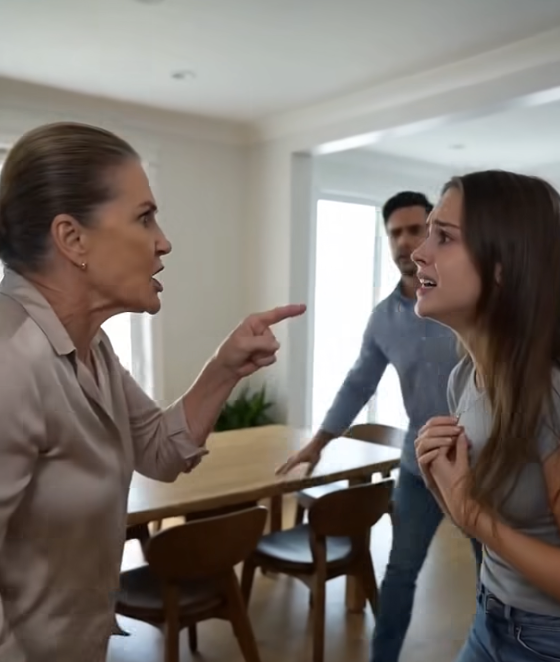
Daniel looked devastated.
“I was never yours to own,” he said.
Evelyn turned on him. “I gave up everything for you.”
“No,” he said. “You used that sentence to make me give up everything for you.”
The room held its breath.
Then Adrian, the younger man who had first seen my bracelet, stepped forward from the wall where he had been standing silently all night.
“There is more,” he said.
Arthur looked at him sharply. “Adrian.”
But Adrian’s eyes were on me.
“I’m sorry,” he said. “You deserve the whole truth.”
Elias stiffened.
Arthur closed his eyes.
And suddenly I understood that the folder had not contained the final secret.
Adrian placed a small velvet pouch on the table. From it, he removed a second silver bracelet.
Larger than mine.
The same crescent. The same star. Three dots beneath.
My breath stopped.
“This belonged to my mother,” Adrian said. “Celeste Bellamy.”
I stared at him.
Arthur’s face had gone pale with grief and something else.
Hope.
“My mother died believing she had lost her only child,” Adrian continued. “But she had another.”
The room erupted.
“What?” Daniel whispered.
Adrian looked at Arthur. “Tell her.”
Arthur gripped the back of his chair.
“Celeste was pregnant when Lilia disappeared,” he said hoarsely. “The stress nearly killed her. She gave birth months later, secretly, because the kidnappers had threatened any future children. We hid Adrian under his father’s name. For his safety, even from much of the family.”
Adrian’s voice softened.
“I am your brother.”
The word broke something open in me.
Brother.
Not inheritance. Not scandal. Not revenge.
Family.
I looked at him—the familiar eyes, the shape of his mouth, the way his hands trembled like mine when emotion outran control—and the world rearranged itself.
Then the final twist landed, quiet and devastating.
Adrian turned to Evelyn.
“You didn’t just hide Nora from the Bellamys,” he said. “You also hid her from me.”
Evelyn frowned through tears. “I didn’t know about you.”
“No,” Adrian said. “But my mother knew about you.”
Elias opened another envelope and removed a letter sealed in plastic.
Arthur looked stunned. “Where did you find that?”
“In Celeste’s private journal,” Adrian said. “She wrote it months before she died.”
He read aloud, voice breaking only once.
Celeste had suspected, years earlier, that a woman connected to Malcolm Price had seen her daughter alive. She had found Evelyn’s name. She had even gone to Evelyn’s house.
Evelyn had denied everything.
Celeste wrote that the woman’s son, a boy of about twelve, had offered her tea and asked why she was crying.
Daniel slowly sat down.
“I remember that,” he whispered. “A woman came to the house. Mom told me she was confused.”
Adrian folded the letter.
“My mother died thinking she had failed to recognize the one person who could lead her to her daughter.”
Evelyn made a sound so small it was almost not human.
But I was no longer looking at her.
I was looking at Daniel.
He was weeping silently, not for himself, but for the child I had been, the mother I had lost, the brother hidden from me, and the years his silence had helped continue.
He stood, walked to me, and stopped just short of touching me.
“I am so sorry,” he said. “For every time I made peace easier for myself by making pain harder for you.”
There was no excuse in his voice.
Only truth.
I took his hand.
Not because everything was healed.
Because healing had to begin somewhere.
Evelyn was arrested two days later after giving a full statement. Her testimony helped authorities reopen Malcolm Price’s network and identify other stolen children. She did not become heroic. She did not deserve that. But for once, she told the truth.
Months passed.
The Bellamy name changed my life, but not in the way people expected. Yes, there were lawyers, trusts, headlines, and strangers suddenly interested in my childhood. But the real miracles were quieter.
Arthur showing me Celeste’s garden.
Adrian sending me awkward good morning texts because neither of us knew how siblings were supposed to begin.
Daniel attending therapy without being asked.
Me learning that love did not have to be begged for, earned, or defended at every meal.
On my next birthday, Arthur hosted a small dinner. No reporters. No distant relatives. No neighbors waiting for gossip.
Just people who had chosen truth.
After dessert, Adrian handed me a restored version of my old blue photo album. Every page had been cleaned and repaired. He had added new photographs after the old ones: Celeste holding me as a baby, Arthur dancing with me in a sunlit room, Adrian as an infant wrapped in a blanket with the same crescent-star symbol embroidered at the corner.
At the very back was an empty page.
“For everything we still get to remember,” Adrian said.
I touched the page and smiled through tears.
Daniel squeezed my hand.
Arthur lifted his glass.
“To Lilia,” he said.
I looked around the table at the grandfather who had searched, the brother who had waited without knowing, the husband who was finally learning courage, and the empty chair where my mother should have been.
Then I touched the silver bracelet at my throat.
For most of my life, I had thought it was proof that I had once been abandoned.
I was wrong.
It was proof that someone had loved me enough to leave a trail.
And this time, when the room filled with silence, it did not hurt.
It held me.
“I’m Nora,” I said softly. “And I’m Lilia too.”
Arthur smiled.
Adrian raised his glass.
Daniel kissed my knuckles.
Outside, beyond the windows, snow began to fall over the dark river, covering the world not like an ending, but like a clean white page.
And for the first time in my life, I was not grateful that someone had agreed to love me.
I was grateful that I had finally learned I had always been worthy of it.