The first thing I remember was the heat.
Not the scream.
Not the crash of the chair.
Not even my husband shouting my name.
Just heat.
Scalding, blinding, impossible heat pouring across my chest, my arms, my neck, soaking through the pale blue blouse I had ironed so carefully that afternoon because I wanted one peaceful family dinner.
One peaceful dinner.
That was all I had wanted.
Instead, I was standing in my dining room with chicken soup dripping from my clothes while my skin burned and my mother-in-law stared at me with eyes so cold they frightened me more than the pain.
For one terrible second, nobody moved.
Steam curled between us.
The pot shook in her hands.
My husband, Ethan, shoved his chair backward so hard it slammed against the wall.
“Claire!”
He ran toward me.
His father, Robert, jumped up too, his face gray with horror.
My sister-in-law gasped.
Someone started crying.
But Margaret, my mother-in-law, only tightened her grip on the empty pot and said the sentence that made every person in that room freeze.
“She should be grateful I didn’t do what I did to the other one.”
The room died.
Even my pain seemed to pause.
Ethan stopped halfway to me.
His father went completely still.
“The other one?” Ethan whispered.
Margaret’s face changed instantly.
She had not meant to say it.
The fury drained from her expression, replaced by something much older.
Fear.
Then the front door opened.
A woman stepped into the dining room.
She was thin, elegant, and pale, with silver-streaked brown hair and a long beige coat.
She looked at Margaret.
Margaret looked at her.
The pot slipped from my mother-in-law’s hands and crashed onto the floor.
And the woman said quietly, “Hello, Margaret. I told you I would come back.”
Before that night, I believed Margaret hated me because I had married her only son.
It was almost simple that way.
Painful, yes.
Exhausting, definitely.
But understandable.
Some mothers struggled to let go.
Some mothers treated daughters-in-law like invaders.
Margaret treated me like a disease.
From the day Ethan brought me home, she inspected me like a stain on expensive fabric.
My dress was too plain.
My laugh was too loud.
My job as a nurse was “respectable, but not refined.”
My family was “sweet, but ordinary.”
She smiled when she said these things, which somehow made them cut deeper.
Ethan always defended me.
At first gently.
Then firmly.
Then angrily.
But Margaret never stopped.
She simply learned to disguise her cruelty as concern.
“I only want what’s best for my son.”
“I’m just trying to help Claire improve.”
“A wife should know her place in a family.”
That last one stayed with me.
A wife should know her place.
I spent three years trying to prove I belonged.
I hosted birthdays.
I remembered anniversaries.
I helped Robert after his knee surgery.
I visited Margaret when she had migraines, bringing groceries and medication even after she complained I bought the wrong brand of tea.
And still, when she looked at me, I saw resentment.
Not irritation.
Not jealousy.
Resentment.
As if I had taken something she could never get back.
That Saturday, I thought maybe dinner could change things.
It sounds foolish now.
But hope is stubborn.
Ethan had been working long hours at his architecture firm, and his parents had complained they barely saw him.
So I suggested inviting them over.
“Are you sure?” Ethan asked.
I knew what he meant.
I smiled anyway.
“She’s your mother.”
His eyes softened.
“You don’t have to keep giving her chances.”
“I know,” I said. “But maybe one day she’ll take one.”
That afternoon, I cooked my grandmother’s chicken soup.
It was the one recipe that always made me feel safe.
My grandmother had raised me after my mother died, and her kitchen had been the warmest place in the world.
She believed soup could heal almost anything.
Heartbreak.
Fever.
Loneliness.
Fear.
“Good food tells people they are welcome,” she used to say.
So I chopped carrots and celery.
I browned the chicken.
I crushed garlic beneath the flat of a knife.
I added thyme, bay leaves, onions, pepper, and the small spoonful of lemon zest my grandmother swore made the broth “wake up.”
By the time Ethan’s parents arrived, the whole house smelled like memory.
Robert stepped inside first and smiled.
“Something smells incredible.”
I relaxed.
Margaret entered behind him wearing pearls, a cream sweater, and the expression of a woman already disappointed.
She glanced toward the kitchen.
“Soup?”
“Yes,” I said brightly. “My grandmother’s recipe.”
“How quaint.”
Ethan’s jaw tightened.
I touched his arm under the table later, silently asking him to let it go.
For the first ten minutes, dinner seemed normal.
Robert talked about golf.
Ethan told a funny story about a client who wanted a glass staircase despite being terrified of heights.
My sister-in-law, Anna, laughed into her napkin.
Even Margaret behaved.
She tasted the soup without comment.
That alone felt like victory.
Then Ethan took another spoonful.
He closed his eyes dramatically.
“Oh my God.”
I laughed. “What?”
“This is unbelievable.”
My cheeks warmed.
“Stop.”
“No, seriously,” he said, looking around the table. “This might be the best meal I’ve had in years.”
Robert chuckled.
“It is excellent, Claire.”
I felt a small rush of happiness.
Not pride exactly.
Relief.
Then Ethan made the mistake.
He smiled at me and said, “Honestly, it’s even better than Mom’s chicken soup.”
Silence.
Immediate.
Sharp.
Margaret slowly lowered her spoon.
Robert’s smile vanished.
Anna stared at her bowl.
I felt the air leave the room.
“Ethan,” I said softly.
He realized too late.
“I didn’t mean—”
Margaret looked at him.
“Better than mine?”
“It was just a compliment,” he said.
“To her.”
“Mom.”
“No,” Margaret said, her voice trembling. “Say it again. Tell everyone your wife replaced me.”
My stomach turned.
“Nobody is replacing you,” I said quickly. “Margaret, your cooking is wonderful. Ethan was only being kind.”
Her eyes snapped to me.
“Do not speak to me like I’m stupid.”
“I wasn’t—”
“You think I don’t see what you’re doing?”
Ethan pushed his chair back slightly.
“That’s enough.”
But Margaret was rising now, anger blooming red across her face.
“You smile. You serve your little soup. You sit in my son’s house as if you built him.”
Claire, breathe, I told myself.
Just breathe.
“I’m not trying to take anything from you,” I said.
Margaret laughed once.
A horrible sound.
“You already did.”
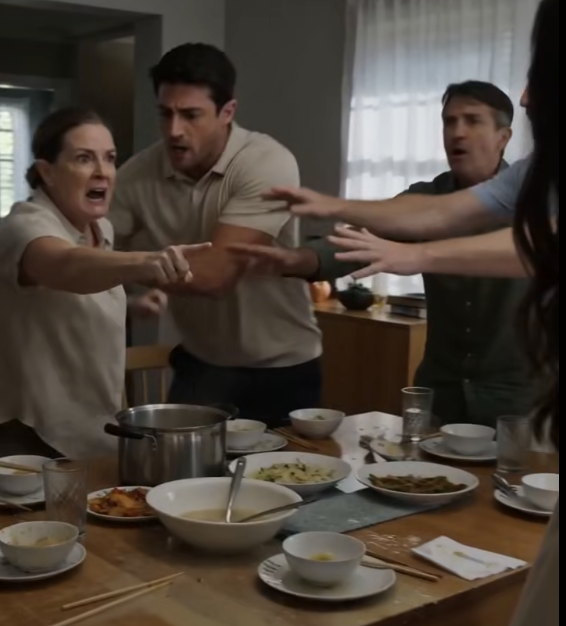
Then she grabbed the pot.
At first, I truly thought she was carrying it away.
Then she turned toward me.
Our eyes met.
In hers, I saw a decision.
Not impulse.
Decision.
“Mom, don’t!” Ethan shouted.
But it was too late.
She lifted the pot.
The soup flew.
The pain swallowed me whole.
The stranger in the beige coat stood just beyond the dining room entrance, staring at the chaos Margaret had made.
Soup on the floor.
Steam rising from the tablecloth.
Me shaking in Ethan’s arms.
Margaret white-faced beside the fallen pot.
The woman’s expression broke when she saw me.
“Oh, sweetheart,” she whispered.
Ethan was already pulling my blouse away from my skin.
“Call 911!” he shouted.
Anna grabbed her phone.
Robert stood frozen, staring not at me but at the woman by the door.
“You,” he breathed.
The woman looked at him.
“Hello, Robert.”
Margaret suddenly found her voice.
“Get out.”
The woman didn’t move.
“After what I just saw? No.”
“Get out of my son’s house!”
Ethan looked up.
Something in his face changed.
“Who is she?”
Nobody answered.
“Dad?” Ethan demanded.
Robert sank slowly into a chair.
His mouth opened twice before any sound came out.
“Her name is Lydia.”
Margaret shook her head violently.
“No.”
Robert looked twenty years older.
“Lydia Harper.”
The woman took one step closer.
“And I am Ethan’s mother.”
The room tilted.
Ethan stared at her.
“What?”
Margaret screamed.
“She’s lying!”
Lydia reached into her coat pocket and pulled out a small envelope.
“I wish I were.”
Sirens wailed faintly in the distance, growing louder.
Ethan looked between Margaret and Lydia like a man watching his entire childhood burn.
“That’s impossible.”
Lydia’s eyes filled with tears.
“No,” she said. “What was impossible was staying away from you for thirty-two years.”
At the hospital, the doctors said I was lucky.
The burns were painful but not life-threatening.
Mostly first-degree, with several patches of second-degree along my forearm and collarbone.
Ethan never left my side.
He held my hand while nurses treated the burns.
He apologized so many times I finally touched his face.
“You didn’t do this.”
His eyes were red.
“I brought her into our house.”
“You also tried to stop her.”
He looked toward the hallway.
“My whole life might be a lie.”
I had no answer for that.
Because it was.
Lydia waited outside my room with Robert.
Margaret had not come to the hospital.
The police had taken statements at the house.
For once, she had no audience to control.
When the nurse finished dressing my arm, Ethan asked Lydia to come in.
She entered carefully, as if afraid sudden movement might shatter us.
Up close, I saw details I had missed.
Her eyes were Ethan’s eyes.
Same gray-green color.
Same sadness at the corners.
Same way of looking directly at people, as if truth mattered more than comfort.
Ethan saw it too.
His voice broke.
“Tell me everything.”
So Lydia did.
Thirty-three years earlier, she and Robert had been in love.
Not casually.
Not foolishly.
Truly.
Robert had been engaged to Margaret through family pressure, but he fell in love with Lydia while working at a community legal office.
When Lydia became pregnant, Robert planned to end the engagement.
But Margaret found out first.
She came to Lydia alone.
“She told me Robert had changed his mind,” Lydia said. “She said he wanted the baby gone. She said if I loved him, I would disappear quietly.”
Robert covered his face.
“I never said that.”
“I know that now.”
Lydia swallowed.
“But I was young. Terrified. No family. No money. Then Margaret gave me documents that looked real. A signed letter from Robert. A check. A threat from his family attorney.”
Ethan’s voice was barely audible.
“What happened to the baby?”
Lydia looked at him.
“You were born three weeks early. I held you for one hour.”
Tears slipped down her face.
“Then a nurse told me you had breathing complications. She said they needed to take you to another ward.”
Her hands trembled.
“I never saw you again.”
The room went silent.
I forgot my own pain.
Robert stood abruptly.
“She told me the baby died,” he said, voice shaking. “Margaret told me Lydia left town after losing the baby. She said you didn’t want to see me.”
Lydia closed her eyes.
“She told me you abandoned us.”
Ethan looked physically sick.
“And Margaret raised me?”
Robert nodded slowly.
“We married six months later. She said she couldn’t have children. Then, suddenly, she told me a distant relative had a baby they couldn’t keep.”
His voice cracked.
“She brought you home.”
Ethan stood.
He walked to the window.
For a long time, he said nothing.
Then he whispered, “My entire life, she told me I owed her everything.”
Lydia covered her mouth.
“She stole you from me.”
The words hung there.
Terrible.
Undeniable.
A nurse entered quietly to check my vitals, then left just as quietly.
I looked at Ethan.
His hands were shaking.
But beneath the shock, I saw something else forming.
Not rage.
Recognition.
Suddenly Margaret’s cruelty made sense.
Her possessiveness.
Her obsession with being replaced.
Her panic whenever Ethan loved someone else.
She had built motherhood on a theft.
And every woman Ethan loved threatened to reveal the emptiness beneath it.
The days that followed were a storm.
Police reopened old hospital records.
A retired nurse came forward after seeing Lydia’s name in the report.
She confessed Margaret had paid a hospital administrator to falsify transfer records.
The administrator was dead now, but his files were not.
Lydia had spent decades searching.
Every few years, she found a clue, then lost the trail.
Recently, an ancestry test matched her with Anna, Ethan’s sister, who had secretly taken one for fun.
That match exposed everything.
Lydia contacted Robert first.
He didn’t believe her.
Then she sent documents.
Photographs.
Medical records.
Dates.
The truth became impossible to deny.
The night of the dinner, Robert had invited Lydia over secretly.
He planned to tell Ethan after dessert.
That was why Margaret had been tense from the moment she arrived.
She knew Robert had been asking questions.
She knew the wall was cracking.
The soup wasn’t about cooking.
It was never about cooking.
It was about fear.
Ethan’s compliment had struck the deepest wound in Margaret’s stolen life.
Better than Mom.
Those words reminded her that motherhood could not be forced.
Love could not be forged.
And truth could not be boiled away.
Margaret was arrested two days later.
Assault was only the beginning.
Kidnapping.
Fraud.
Falsified records.
Conspiracy.
The woman who had controlled every room she entered was finally escorted from her own home in handcuffs.
She looked smaller than I expected.
Not sorry.
Just exposed.
As officers guided her down the steps, she saw Ethan standing beside Lydia.
Margaret’s face twisted.
“I raised you,” she cried. “I fed you. I loved you.”
Ethan’s jaw tightened.
“You owned me,” he said. “That isn’t love.”
Margaret looked at me then.
For one second, I thought she might apologize.
Instead she whispered, “You ruined everything.”
I stepped forward carefully, my bandaged arm against my chest.
“No,” I said. “I cooked dinner.”
The police car door closed.
And Margaret was gone.
Healing did not happen quickly.
Not for my burns.
Not for Ethan.
Not for Lydia.
For weeks, our house felt like a place after a fire.
Everything looked the same, but smoke lingered in invisible corners.
Ethan grieved a childhood he had misunderstood.
Lydia grieved thirty-two birthdays, first steps, school plays, fevers, graduations, and every ordinary day stolen from her.
Robert grieved his own weakness.
He had believed lies because believing them hurt less than questioning them.
Anna struggled too.
Margaret was the only mother she had known, and now every memory felt contaminated.
I listened.
I held hands.
I changed bandages.
I cried in the shower when my skin hurt.
But slowly, life returned.
Lydia began visiting on Sundays.
The first time she entered our kitchen, she froze near the stove.
“I don’t want to intrude,” she said.
Ethan smiled sadly.
“You’re not intruding.”
She brought a small notebook.
Inside were recipes.
Her mother’s recipes.
Soups, breads, cakes, stews.
“I used to imagine cooking for you,” she told Ethan. “It was silly, maybe.”
“It wasn’t silly,” he said.
Her eyes filled with tears.
Mine did too.
One Sunday, months later, Lydia asked if I would teach her my grandmother’s chicken soup.
I hesitated.
Not because I didn’t want to.
Because that recipe now carried pain.
She noticed.
“We can make something else.”
I looked at Ethan.
He gave me a gentle nod.
“No,” I said. “My grandmother always said soup heals things.”
So we cooked.
Together.
Lydia chopped celery.
Ethan peeled carrots badly.
I laughed for the first time in weeks.
Robert washed dishes quietly, grateful to be allowed near the edges of our rebuilding.
Anna set the table.
No pearls.
No judgment.
No fear.
Just people trying.
When the soup was done, Ethan took a spoonful.
He paused dramatically.
Everyone froze.
Then he said, “I am not comparing this to anyone’s soup ever again.”
We burst out laughing.
The sound filled the kitchen.
Warm.
Messy.
Alive.
A year later, my scars had faded.
Thin pale marks remained on my arm and near my collarbone, but I no longer hid them.
They reminded me of what I survived.
They also reminded me of what was revealed.
Margaret’s trial ended with a plea agreement.
She admitted enough to spare everyone a public spectacle, though not enough to satisfy justice completely.
But justice rarely arrives whole.
Sometimes it arrives cracked.
Sometimes it arrives late.
Sometimes it arrives through a woman in a beige coat walking through a door at the exact moment a stolen life begins to collapse.
Ethan legally changed his birth certificate.
Lydia Harper became Lydia Harper Monroe, not through marriage, but through truth.
She and Ethan built something neither of them knew how to name at first.
Not instant mother and son.
Not strangers.
Something tender in between.
A bridge.
Every week, they crossed a little more of it.
One evening, Lydia came over carrying a box.
Inside was a tiny knitted blanket.
Blue and white.
“I made this before you were born,” she told Ethan. “I kept it all these years.”
He held it like it was sacred.
Then he broke down.
Lydia held him.
And I realized happy endings are not always loud.
Sometimes they are a grown man crying into the arms of the mother who never stopped searching for him.
Sometimes they are soup simmering gently on a stove.
Sometimes they are a family choosing truth, even after lies have taken almost everything.
Two years after that terrible dinner, we hosted another family meal.
This time, the table was bigger.
Lydia sat beside Ethan.
Robert sat beside Anna.
There was laughter, bread, roasted chicken, salad, and yes, soup.
My grandmother’s soup.
I carried the pot carefully to the table.
For a moment, everyone went quiet.
Not from fear.
From memory.
Ethan reached for my hand.
“Are you okay?”
I looked around.
At Lydia’s hopeful smile.
At Anna’s gentle eyes.
At Robert’s bowed head.
At the empty space where Margaret used to sit like a queen guarding a stolen throne.
Then I looked at the soup.
Golden.
Fragrant.
Warm.
“I’m okay,” I said.
And I meant it.
Ethan lifted his spoon.
He looked at me.
Then at Lydia.
Then around the table.
“This,” he said carefully, “is the best soup for this family.”
Everyone laughed.
Even I did.
Outside, rain tapped softly against the windows.
Inside, our daughter slept upstairs, born into a family finally free of secrets.
We had named her Grace.
Because that was what survived after everything else burned away.
Grace.
Lydia helped me clear the plates later.
At the sink, she touched my arm gently, near the faint scar.
“I’m so sorry,” she whispered.
I shook my head.
“You came through the door.”
Her eyes softened.
“You opened it first.”
I didn’t understand.
She smiled.
“With kindness. With patience. With soup. You gave truth somewhere to enter.”
I looked toward the dining room, where Ethan was holding Grace and making silly faces while she giggled.
For years, Margaret had believed love was something you could possess.
Control it tightly enough, lie hard enough, punish anyone who threatened it, and maybe it would stay.
But love is not a prison.
Love is a table.
A door.
A bowl set down gently before someone hungry.
And that night, the night Margaret poured boiling soup over me, she thought she was proving I didn’t belong in her family.
Instead, she revealed that the family had never truly belonged to her.
The truth walked in wearing a beige coat.
The lies fell with the pot.
And from the wreckage of one ruined dinner, we finally built the home all of us had been searching for.
